

Article
Thomas de Waal
{
  "authors": [
    "Thomas de Waal"
  ],
  "type": "commentary",
  "centerAffiliationAll": "",
  "centers": [
    "Carnegie Endowment for International Peace",
    "Carnegie Europe",
    "Carnegie Russia Eurasia Center"
  ],
  "collections": [],
  "englishNewsletterAll": "",
  "nonEnglishNewsletterAll": "",
  "primaryCenter": "Carnegie Europe",
  "programAffiliation": "",
  "programs": [],
  "projects": [],
  "regions": [
    "Caucasus",
    "Russia",
    "Georgia"
  ],
  "topics": [
    "Political Reform",
    "Foreign Policy"
  ]
}
Source: Getty
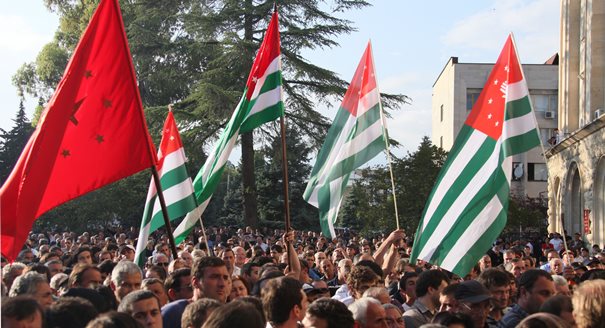
Abkhazia is in crisis, but it is not a spillover from events in Ukraine. This is overwhelmingly a local crisis. For the past 20 years Abkhazia has lived in a world of its own.
Abkhazia is in crisis. Late on May 27, the opposition took over the presidential administration building and Abkhaz President Alexander Ankvab left the city. Later the Abkhaz parliament passed a resolution of no-confidence in the prime minister and called on the president to resign.
It is tempting to see the current crisis as a spillover from events in Ukraine. That would be a mistake. This is overwhelmingly a local crisis. For the past 20 years, since it de facto broke away from Georgia, Abkhazia has lived in a world of its own.
Since he was elected in 2011, Ankvab has alienated a lot of this political class with a reputation for being aloof and indifferent to their problems.
Ankvab has had a bad six months. The Sochi Olympics, which Abkhaz hoped would bring an economic boon to the republic, were a disappointment and actually produced the opposite effect.
Russia’s annexation of Crimea also means that Moscow now controls a much more strategically valuable and reliable slice of the Black Sea coast, which lessens Abkhazia’s relative importance. Russian state money and tourism revenues which might have gone to Abkhazia are now likely to be diverted to Crimea.
The opposition is a diverse group and hard to characterize. One die-hard nationalist Russian commentator, has alleged—incredibly—that they are the instigators of a Western-backed coup.
Others see them as being backed by Moscow as a more reliable alternative than the difficult Ankvab—although the truth is probably that both the president and opposition have their patrons in Russia.
Two things can be said about the opposition with certainty. One is that most of them are disgruntled for being shut out of political office. Opposition leader Raul Khajimba is the perpetual nearly-man of Abkhaz politics having failed to win the presidency in 2004, when he was backed by Moscow, and again in 2011—when he was not. These men have also lost out by not getting access to the republic’s limited economic resources. The recent announcement of plans for oil exploration off the Abkhaz coast may have especially enraged them.
The second common denominator about the opposition is that they are generally more ethno-nationalist. They have made waves over the issue of plans for distribution of Abkhaz passports to the up to 50,000 ethnic Georgians living an uncertain existence in Gali district adjoining western Georgia. They allege that these Georgians, most of whom also have Georgian passports, could become a “fifth column.”
The immediate focus in the coming days will be on whether Ankvab and the opposition can agree on a political solution, perhaps through early elections. A longer-term concern is that Gali does not become the location of a new political—or even worse physical—battleground.

Senior Fellow, Carnegie Europe
Thomas de Waal is a senior fellow at Carnegie Europe, specializing in Eastern Europe and the Caucasus.
Recent Work
Thomas de Waal
Thomas de Waal
Carnegie India does not take institutional positions on public policy issues; the views represented herein are those of the author(s) and do not necessarily reflect the views of Carnegie, its staff, or its trustees.

After the chill in ties between 2020 and 2024 that brought India–China relations to their lowest point in several decades, the two countries have engaged each other afresh. This paper argues that there are predominantly four imperatives guiding India’s approach to China, and they exist in an order of priority.

Saheb Singh Chadha

This piece argues that India’s central challenge is not managing a single flashpoint but resolving the underlying tension between expansion and institutional coherency of the BRICS grouping.

Vrinda Sahai

A partnership between India, a country of subcontinental size, and Africa, a continent of fifty-four countries, may seem asymmetric until one notes that both are home to nearly the same number of people—1.4 billion. This essay spells out the existing challenges to the partnership, its optimal potential, and the possible pathways to realize it over the next quarter-century.

Rajiv Bhatia

The India–EU Free Trade Agreement (FTA) is shaping up to be one of the most consequential trade negotiations, both economically and strategically. But, what’s in the agreement, what’s missing, and what will determine its success in the years ahead
Vrinda Sahai, Nicolas Köhler-Suzuki
Trump 2.0 has unsettled India’s external environment—but has not overturned its foreign policy strategy, which continues to rely on diversification, hedging, and calibrated partnerships across a fractured order.



Milan Vaishnav, ed., Sameer Lalwani, Tanvi Madan, …