

Research
- +4
Milan Vaishnav, Rahul Verma, Rukmini S., …
{
  "authors": [
    "Christophe Jaffrelot"
  ],
  "type": "legacyinthemedia",
  "centerAffiliationAll": "dc",
  "centers": [
    "Carnegie Endowment for International Peace"
  ],
  "collections": [],
  "englishNewsletterAll": "ctw",
  "nonEnglishNewsletterAll": "",
  "primaryCenter": "Carnegie Endowment for International Peace",
  "programAffiliation": "SAP",
  "programs": [
    "South Asia"
  ],
  "projects": [
    "India Decides 2014"
  ],
  "regions": [
    "South Asia",
    "India"
  ],
  "topics": [
    "Political Reform"
  ]
}
Source: Getty
Political scientists argue that the electoral process inevitably modernizes religious political parties. While the “moderation thesis” may have a point, it is largely irrelevant in the case of India.
Source: Indian Express
Political scientists supporting the “moderation thesis” argue that democratic regimes which incorporate exclusivist parties (including those which claim to represent a religious group) in electoral games usually transform them into more moderate political actors. First, when an exclusivist party contests elections, it is bound to dilute its ideology to attract voters outside its core constituency. Second, an exclusivist party generally emerges from an ideological movement displaying a deep sense of doctrinal purity, but it gradually emancipates itself from this matrix. Third, in their quest for power in a democratic arena, exclusivist parties are more likely to form coalitions with parties which do not share their views.
This theory applies to the Hindutva forces up to a point. In the 1960s and ’70s, the Jana Sangh diluted its all-Hindi policy in order to attract voters beyond north India. It even accepted the redrawing of the Indian map according to the linguistic criterion, in spite of the fact that the RSS had originally wanted to abolish linguistic states because of “their dangerous potential for secession” (The Organiser, January 24, 1956).Simultaneously, the Jana Sangh developed a new interest in socio-economic issues in order to speak to “the common man” — a formula that party president Atal Bihari Vajpayee used systematically in the early 1970s.
But the Jana Sangh continued to mobilise voters by deploying Hindu symbols, as evident from the anti-cow slaughter movement of 1966-67, intended to help the party in the 1967 elections. The party joined hands with the VHP and thousands of demonstrators gathered around Parliament to persuade the MPs to pass a law prohibiting cow slaughter. As determined activists stormed Parliament, the police intervened and killed eight of them, who then became the martyrs of the cause.
The BJP repeated the same strategy during the Ayodhya agitation of the late-1980s and early-1990s, with the pre-election Ram Shila movement of 1989 and L.K. Advani’s Rath Yatra in 1990. This agitation, which had been unleashed, once again in conjunction with the VHP, resulted in an unprecedented number of communal riots across the country. It polarised Indian society along religious lines and consolidated the Hindu vote, which Balasaheb Deoras, RSS chief from 1973-94, had decided to promote in 1979, after the split in the Janata Party and the formation of the BJP. Deoras had then declared: “Hindus must now awaken themselves to such an extent that even from the elections’ point of view the politicians will have to respect the Hindu sentiments and change their policy accordingly” (Hindu Vishwa, March 7-8, 1979).
The moderating effect of the democratic game was clearly neutralised by the polarisation strategy. BJP electoral campaigns have always oscillated between the projection of more acceptable faces (including Vajpayee’s) and programmes (including development) and an exclusivist ethno-religious discourse, as well as provocations to broaden its base and to cash in on a Hindu vote. The second dimension of this Janus-like strategy worked well. The constituencies where communal riots have taken place before elections have also been, generally, those where the BJP performed best, as evident from the 2002 Gujarat elections. It is easy to see why the “moderation thesis” is wrong in the case of India: because the core constituency the BJP is aiming at is a majority.
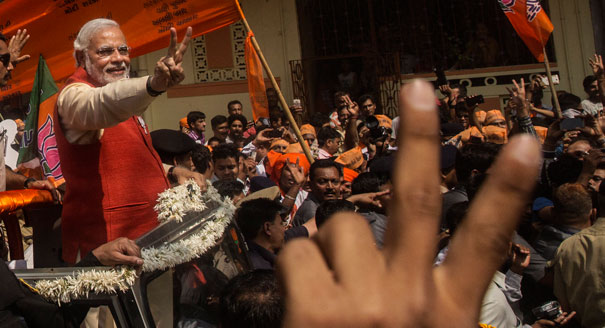
Today, the BJP is resorting to polarisation techniques again in Uttar Pradesh and Bihar to circumvent caste politics. In western UP, the party has capitalised on the Muzaffarnagar riot by nominating MLAs who had allegedly been implicated in it and Amit Shah even invited local citizens to use their vote to take “revenge”. Similarly, the description of Azamgarh as a “base” of terrorists can easily be interpreted as aimed at the Muslim community in the post-Batla House context. The Election Commission has repeatedly objected to such discourse and the use of religious symbols, which, under Section 123 (3) of the Representation of the People Act, is deemed a corrupt practice.
The electoral process does not necessarily moderate exclusivist parties in a majoritarian democracy. Neither do these parties necessarily emancipate themselves from their exclusivist matrix. The relationship between the BJP and the RSS is a case in point. The political scientists who have predicted that the BJP would eventually become a right of centre party have generally assumed that it would sever its links with the Sangh. Certainly, the party enjoyed a great deal of autonomy in the 1980s, when Vajpayee coined new slogans such as “Gandhian socialism” and “positive secularism”, which were not to the liking of the RSS. But the party’s independence has eroded since its 2004 defeat, to such an extent that then BJP president L.K. Advani was openly criticised by then RSS chief K. Sudarshan during a TV interview. At the party’s national executive meeting in September 2005, Advani responded that in the BJP “an impression has gained ground that no political or organisational decision can be taken without the consent of the RSS functionaries”. His overall plea for the recognition of the party’s autonomy was not appreciated by Sudarshan. At the end of 2005, Advani was removed from the BJP’s presidency and Rajnath Singh took over from him.
Today, the RSS is facing a dilemma. On one hand, it is reluctant to indulge in a personality cult that is contrary to the philosophy of an institution where the organisation is above the man, to such an extent that RSS chief Mohan Bhagwat has reportedly told swayamsevaks not to chant “Namo” or “Har Har Modi”. On the other hand, the RSS is canvassing in favour of Modi more openly and more actively than ever before and is effectively monitoring the party campaign at the grassroots level. The BJP may emancipate itself from the RSS in future, the way it has done in Gujarat over the last 10 years, but this has not been accomplished yet.
What about the impact of coalition politics? Vajpayee and Advani initiated a moderate phase in the BJP’s trajectory in the late 1990s, when they formed the NDA. They had learnt from their experience of 1996, when Vajpayee could not garner sufficient support to form a coalition government. Three bones of contention had to be put on the back burner: the construction of the Ram Temple in Ayodhya, the abolition of Article 370 and the uniform civil code. But coalition compulsions forced the BJP to dilute its politics only up to a point. None of the major partners of the BJP objected to the organisation of elections in Gujarat after the 2002 carnage, for instance. Whether coalition politics has a moderating impact on the BJP after the 16th general election remains to be seen, but the party’s list of candidates, which includes only a few from the minorities, reflects the resilience of some forms of exclusivism.
While the “moderation thesis” may have a point so far as the impact of coalition politics is concerned, it is largely irrelevant in the case of India. In such a context, the only balancing power can come from the custodians of the rule of law. The difficulties faced by the EC in containing hate speeches and the limitations of the judiciary, exposed by Manoj Mitta’s recent book on the post-Godhra SIT, are therefore causes for great concern.
This article was originally published by the Indian Express.

Former Nonresident Scholar, South Asia Program
Jaffrelot’s core research focuses on theories of nationalism and democracy, mobilization of the lower castes and Dalits (ex-untouchables) in India, the Hindu nationalist movement, and ethnic conflicts in Pakistan.
Recent Work

Milan Vaishnav, Rahul Verma, Rukmini S., …
Christophe Jaffrelot
Carnegie India does not take institutional positions on public policy issues; the views represented herein are those of the author(s) and do not necessarily reflect the views of Carnegie, its staff, or its trustees.

A partnership between India, a country of subcontinental size, and Africa, a continent of fifty-four countries, may seem asymmetric until one notes that both are home to nearly the same number of people—1.4 billion. This essay spells out the existing challenges to the partnership, its optimal potential, and the possible pathways to realize it over the next quarter-century.

Rajiv Bhatia

The U.S.–India semiconductor cooperation story is well-stocked with top-level strategic intent. What remains unresolved, however, are some underlying challenges that will determine whether the cooperation actually functions. Three such friction points stand out.

Shruti Mittal

The India–EU Free Trade Agreement (FTA) is shaping up to be one of the most consequential trade negotiations, both economically and strategically. But, what’s in the agreement, what’s missing, and what will determine its success in the years ahead

Vrinda Sahai, Nicolas Köhler-Suzuki

Drawing on ten public discussions from the India AI Impact Summit 2026, this article highlights key outlooks on open source in AI that are likely to shape policy and governance conversations going forward.
Shruti Mittal
This collection of essays by scholars from Carnegie India’s Technology and Society program traces the evolution of the AI summit series and examines India’s framing around the three sutras of people, planet, and progress. Scholars have catalogued and assessed the concrete deliverables that emerged and assessed what the precedent of a Global South country hosting means for the future of the multilateral conversation.


Nidhi Singh, Tejas Bharadwaj, Shruti Mittal, …