

In The Media
Lilia Shevtsova
{
  "authors": [
    "Lilia Shevtsova"
  ],
  "type": "legacyinthemedia",
  "centerAffiliationAll": "",
  "centers": [
    "Carnegie Endowment for International Peace",
    "Carnegie Russia Eurasia Center"
  ],
  "collections": [],
  "englishNewsletterAll": "",
  "nonEnglishNewsletterAll": "",
  "primaryCenter": "Carnegie Russia Eurasia Center",
  "programAffiliation": "",
  "programs": [],
  "projects": [],
  "regions": [
    "Russia",
    "Eastern Europe",
    "Ukraine"
  ],
  "topics": [
    "Political Reform",
    "Foreign Policy"
  ]
}
Source: Getty
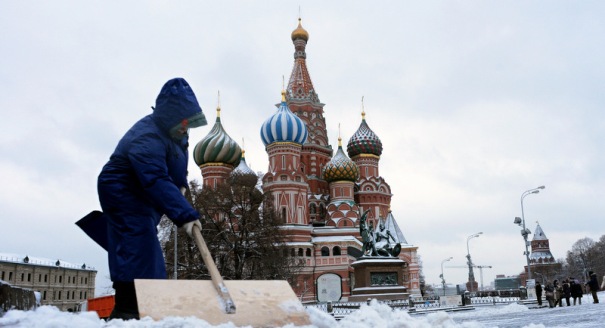
Putin looks like he will continue to ride the tide he has set into motion for the time being. But amidst his tactical successes the signs of a looming strategic defeat can be already seen.
Source: American Interest
Let’s begin with two broad brushstrokes: First, imagine, if you will, a country whose political establishment and society can’t stop talking about a neighboring country. This country obsesses over teaching its neighbor how to live and angrily punishes it for its disobedience. Moreover, this country and its media are fixated on this neighbor, even to the exclusion of domestic developments. What could we say about such a country? That it has lost its way. That it doesn’t have a feel for its own sense of identity. I’m speaking, of course, about Russia, whose television personalities, politicians, and pundits can’t stop talking about Ukraine and show not the slightest interest in anything happening in Russia itself. Everyone is looking at Ukraine, and Ukraine is the key trigger of Russian emotions, anger, frustration, and longing to demonstrate might and resolve.Second, regarding the national “round tables” in Ukraine that Kiev is trying to host under OSCE auspices in order to resolve its political crisis: Kiev is right not to want to legitimize the separatists by dealing with them. However, the Western governments have been pretty evasive on the issue of who should talk to whom. If the West supports the “federalization” concept endorsed by the separatists, then it would mean the end of Ukraine in its current geographical format.
Putin looks like he will continue to ride the tide he has set into motion for the time being. But amidst his tactical successes we can already see the signs of a looming strategic defeat: The very idea of prolonging one’s rule by attempting to hold one’s country and the world in the past, after all, is in itself a kind of defeat.
So much for the broad brushstrokes. Now let’s add a few finer brushstrokes, step back, and give our landscape a chance to come into view. ...
Read the full text of this article in the American Interest.

Former Senior Associate, Russian Domestic Politics and Political Institutions Program, Moscow Center
Shevtsova chaired the Russian Domestic Politics and Political Institutions Program at the Carnegie Moscow Center, dividing her time between Carnegie’s offices in Washington, DC, and Moscow. She had been with Carnegie since 1995.
Recent Work
Lilia Shevtsova
Lilia Shevtsova
Carnegie India does not take institutional positions on public policy issues; the views represented herein are those of the author(s) and do not necessarily reflect the views of Carnegie, its staff, or its trustees.

After the chill in ties between 2020 and 2024 that brought India–China relations to their lowest point in several decades, the two countries have engaged each other afresh. This paper argues that there are predominantly four imperatives guiding India’s approach to China, and they exist in an order of priority.

Saheb Singh Chadha

This piece argues that India’s central challenge is not managing a single flashpoint but resolving the underlying tension between expansion and institutional coherency of the BRICS grouping.

Vrinda Sahai

A partnership between India, a country of subcontinental size, and Africa, a continent of fifty-four countries, may seem asymmetric until one notes that both are home to nearly the same number of people—1.4 billion. This essay spells out the existing challenges to the partnership, its optimal potential, and the possible pathways to realize it over the next quarter-century.

Rajiv Bhatia

The India–EU Free Trade Agreement (FTA) is shaping up to be one of the most consequential trade negotiations, both economically and strategically. But, what’s in the agreement, what’s missing, and what will determine its success in the years ahead
Vrinda Sahai, Nicolas Köhler-Suzuki
Trump 2.0 has unsettled India’s external environment—but has not overturned its foreign policy strategy, which continues to rely on diversification, hedging, and calibrated partnerships across a fractured order.



Milan Vaishnav, ed., Sameer Lalwani, Tanvi Madan, …