

Commentary
Dmitri Trenin
{
  "authors": [
    "Dmitri Trenin"
  ],
  "type": "commentary",
  "centerAffiliationAll": "",
  "centers": [
    "Carnegie Endowment for International Peace",
    "Carnegie Russia Eurasia Center"
  ],
  "collections": [],
  "englishNewsletterAll": "",
  "nonEnglishNewsletterAll": "",
  "primaryCenter": "Carnegie Russia Eurasia Center",
  "programAffiliation": "",
  "programs": [],
  "projects": [],
  "regions": [
    "North America",
    "United States",
    "Russia",
    "Eastern Europe",
    "Ukraine"
  ],
  "topics": [
    "Foreign Policy"
  ]
}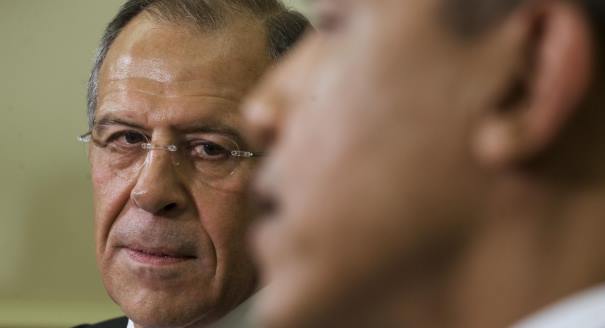
Source: Getty
The 25-year-long quest for Russia's integration with the West is off. A new normalcy is setting between Russia and the West resembles the Russo-British Great Game of the 19th century—this time between America and Russia.
In my discussions about Russia and the West in London last week, a sense of the end of an era was palpable. The 25-year-long quest for Russia's integration with the West is off, at least for the foreseeable future, everyone agreed. Russia is pivoting to itself, to its partners in Eurasia, and to Asia. Ukraine symbolizes the new period of intense rivalry between Russia and the West.
Interestingly, this conclusion is accompanied by some regret, but not too much alarm. While "Mr. Putin's motives and strategies" are often believed to be a mystery, there is no fear of an impending armed conflict involving Russia and the West. Ukraine is seen as remaining unstable for some time. Vladimir Putin has certainly won no friends in Western Europe, but a new cold war is not believed to be on the cards unless Russia goes on to destabilize the Baltics, which everyone, except the Balts themselves, thinks is a very long shot.
Appetite for Ukraine, Georgia and Moldova drawing closer to the EU is very light. The disappointment which followed the 2004 Orange revolution has made people more cautious. There is particularly little willingness to foot Ukraine's bills. And there is absolutely no support for Ukraine's NATO membership. The business community is concerned about the effect of the sanctions, but it also tends to be pragmatic. It is now time to buy, while the Russian stock is low.
Russia and Ukraine no longer dominate the foreign policy debate. Other issues have come to the fore, such as the rise of extremists in Iraq and Syria, and most recently Britain's relations with the European Union. This does not suggest that things will get back to where they were between Russia and the West, but rather that a new normalcy is setting in, which will probably resemble the Russo-British Great Game of the 19th century—this time between America and Russia, and under conditions of globalization—than the 20th century Cold War between communism and capitalism.
Former Director, Carnegie Moscow Center
Trenin was director of the Carnegie Moscow Center from 2008 to early 2022.
Recent Work
Dmitri Trenin
Dmitri Trenin
Carnegie India does not take institutional positions on public policy issues; the views represented herein are those of the author(s) and do not necessarily reflect the views of Carnegie, its staff, or its trustees.

How is AI reshaping space security, creating governance challenges, and where does international diplomacy stand today?


Tejas Bharadwaj, Almudena Azcárate Ortega

After the chill in ties between 2020 and 2024 that brought India–China relations to their lowest point in several decades, the two countries have engaged each other afresh. This paper argues that there are predominantly four imperatives guiding India’s approach to China, and they exist in an order of priority.

Saheb Singh Chadha

This piece argues that India’s central challenge is not managing a single flashpoint but resolving the underlying tension between expansion and institutional coherency of the BRICS grouping.

Vrinda Sahai

A partnership between India, a country of subcontinental size, and Africa, a continent of fifty-four countries, may seem asymmetric until one notes that both are home to nearly the same number of people—1.4 billion. This essay spells out the existing challenges to the partnership, its optimal potential, and the possible pathways to realize it over the next quarter-century.

Rajiv Bhatia

The U.S.–India semiconductor cooperation story is well-stocked with top-level strategic intent. What remains unresolved, however, are some underlying challenges that will determine whether the cooperation actually functions. Three such friction points stand out.

Shruti Mittal