

Commentary
Thomas de Waal
{
  "authors": [
    "Thomas de Waal"
  ],
  "type": "commentary",
  "centerAffiliationAll": "",
  "centers": [
    "Carnegie Endowment for International Peace",
    "Carnegie Europe",
    "Carnegie Russia Eurasia Center"
  ],
  "collections": [],
  "englishNewsletterAll": "",
  "nonEnglishNewsletterAll": "",
  "primaryCenter": "Carnegie Europe",
  "programAffiliation": "",
  "programs": [],
  "projects": [],
  "regions": [
    "North America",
    "United States",
    "Caucasus",
    "Azerbaijan"
  ],
  "topics": [
    "Democracy",
    "Foreign Policy"
  ]
}
Source: Getty
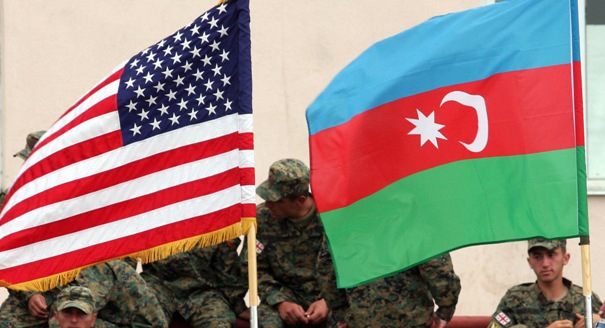
Azerbaijan has picked a fight with the U.S. government. The simplest explanation for this may be that President Aliyev is as paranoid and isolated as their actions suggest. If United States want to maintain influence in Azerbaijan it should find messengers who can get through some thick palace walls.
Here is a conundrum: why, just as Russia’s neighbors are under increasing pressure, has Azerbaijan picked a fight with the United States government?
As Russia intervenes in Eastern Ukraine, you would logically expect Russia’s other neighbors to be reaching out for support to other international partners. Georgia and Moldova are steaming towards Association Agreements with the European Union.
Azerbaijan is much wealthier than either of those two, and there are many advocates of a stronger American-Azerbaijan relationship.
Yet, in the last year, Azerbaijan has embarked on a crackdown targeted specifically against Western-leaning human rights, civil society activists and opposition politicians. The victims have included two opposition leaders, Ilgar Mammadov and Tofiq Yaqublu, jailed in March; Anar Mammadli, head of a respected election monitoring organization, recently imprisoned for five and a half years; prominent Russian-language journalist Rauf Mirkadirov, arrested in April; and, as I have written, well-known experts Arif and Leyla Yunus, who have been stopped from leaving the country and are under investigation.
Critical statements have rained down from the United States and the European Union, Azerbaijan is the subject of hearings in the Helsinki Commission in Congress on June 11.
But when Western officials have sounded the alarm they have been accused of “interfering in the internal affairs of Azerbaijan.”
This has made for an ongoing clash between U.S. Ambassador to Baku, Richard Morningstar and the Azerbaijani government. The hawkish presidential official Ali Hasanov condemned the ambassador’s interview to Radio Liberty as an attempt to foment a “Maidan” in Azerbaijan.
The attacks, some of them quite personal in tone, have been made even though Morningstar is the man the Azerbaijanis specifically requested to be ambassador, having been the United States’ envoy on Caspian Sea oil and gas issues and one of the architects of the Baku-Tbilisi-Ceyhan pipeline project, which is the cornerstone of the country’s independence.
The Azerbaijani elite has many factions. There is a Western-leaning group, in the Foreign Ministry and some other ministries, which has clearly been losing the argument in recent months. But it is not as though Baku has made a strong pivot to Moscow either. The Baku-Moscow relationship remains quite strong but Azerbaijan voted with Ukraine and against Russia at the United Nations.
It may be that the Azerbaijanis feel they can compartmentalize the relationship. Thirty five Congressional representatives attended the recent Azerbaijan-U.S. Convention in Washington D.C. There is a good relationship with the Pentagon as Azerbaijan provides a transit route for U.S. troops in the Northern Distribution Network. Yet, it should be obvious that you cannot have a good relationship with Washington if you declare war on the main interlocutor, the State Department.
When it looks to Washington, Azerbaijan has reasons to feel aggrieved. The Armenian lobby still makes its life difficult. Section 907 of the Freedom Support Act, passed by the U.S. Congress in October 1992 during the Karabakh conflict, barring many types of U.S government aid to Azerbaijan was never repealed, even though the Azerbaijanis were defeated in the conflict. Yet, of course, the latest actions only strengthen the anti-Azerbaijani message of the Armenian lobby.
There are currently few prospects of a thaw. Ambassador Morningstar leaves in the summer after a scheduled two-year posting and there may well be another long hiatus before his replacement is appointed. The relationship is likely to become even more transactional and piecemeal.
The simplest explanation for the recent crackdown may be that, after more than a decade in power, President Ilham Aliyev and his inner circle are as paranoid and isolated as their actions suggest. In that case the challenge for those in the U.S. administration who want to maintain influence in Azerbaijan is to find messengers who can get through some thick palace walls.

Senior Fellow, Carnegie Europe
Thomas de Waal is a senior fellow at Carnegie Europe, specializing in Eastern Europe and the Caucasus.
Recent Work
Thomas de Waal

Thomas de Waal, Areg Kochinyan, Zaur Shiriyev
Carnegie India does not take institutional positions on public policy issues; the views represented herein are those of the author(s) and do not necessarily reflect the views of Carnegie, its staff, or its trustees.

This piece argues that India’s central challenge is not managing a single flashpoint but resolving the underlying tension between expansion and institutional coherency of the BRICS grouping.

Vrinda Sahai

A partnership between India, a country of subcontinental size, and Africa, a continent of fifty-four countries, may seem asymmetric until one notes that both are home to nearly the same number of people—1.4 billion. This essay spells out the existing challenges to the partnership, its optimal potential, and the possible pathways to realize it over the next quarter-century.

Rajiv Bhatia

The U.S.–India semiconductor cooperation story is well-stocked with top-level strategic intent. What remains unresolved, however, are some underlying challenges that will determine whether the cooperation actually functions. Three such friction points stand out.

Shruti Mittal

The India–EU Free Trade Agreement (FTA) is shaping up to be one of the most consequential trade negotiations, both economically and strategically. But, what’s in the agreement, what’s missing, and what will determine its success in the years ahead
Vrinda Sahai, Nicolas Köhler-Suzuki

Trump 2.0 has unsettled India’s external environment—but has not overturned its foreign policy strategy, which continues to rely on diversification, hedging, and calibrated partnerships across a fractured order.



Milan Vaishnav, ed., Sameer Lalwani, Tanvi Madan, …