

In The Media
Lina Khatib
{
  "authors": [
    "Lina Khatib"
  ],
  "type": "legacyinthemedia",
  "centerAffiliationAll": "dc",
  "centers": [
    "Carnegie Endowment for International Peace",
    "Malcolm H. Kerr Carnegie Middle East Center"
  ],
  "collections": [],
  "englishNewsletterAll": "menaTransitions",
  "nonEnglishNewsletterAll": "",
  "primaryCenter": "Malcolm H. Kerr Carnegie Middle East Center",
  "programAffiliation": "MEP",
  "programs": [
    "Middle East"
  ],
  "projects": [],
  "regions": [
    "Levant",
    "Syria",
    "Middle East"
  ],
  "topics": [
    "Political Reform",
    "Democracy"
  ]
}
Source: Getty
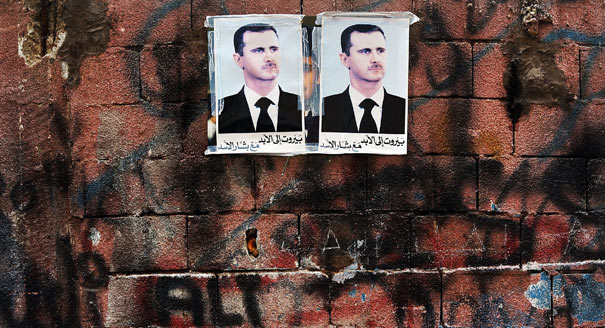
The Syrian presidential election is not free or fair. It is Bashar al-Assad’s attempt to legitimize his presidency.
Source: Associated Press
Lina Khatib, the director of the Carnegie Middle East Center in Beirut, called Tuesday’s presidential vote in Syria a “non-election” and said they were an attempt by Assad to find some legitimacy.
“We all know that what is happening is not free or fair,” said Khatib.
“The two candidates who are supposedly running against Assad are unknown, they have been handpicked by the regime just to pretend that this is a free election, they do not have a political programme, no one is actually going to vote for them, even though the results may be skewed by the regime to make it look like some people at least voted for them.”
Khatib, who follows the Syrian refugee community in Lebanon, said the high turnout numbers that have been reported among Syrian refugee communities abroad are the result of the government loyalists’ tactics and attempts at coercion.
Former Director, Middle East Center
Khatib was director of the Carnegie Middle East Center in Beirut. Previously, she was the co-founding head of the Program on Arab Reform and Democracy at Stanford University’s Center on Democracy, Development, and the Rule of Law.
Recent Work
Lina Khatib
Lina Khatib
Carnegie India does not take institutional positions on public policy issues; the views represented herein are those of the author(s) and do not necessarily reflect the views of Carnegie, its staff, or its trustees.

An Israeli response to Iran’s October 1 attack is imminent. The key question is of its intensity and potential fallout, both within Iran, in terms of nuclear security policy changes, and across the broader region. The coming days are likely to reshape West Asia irreversibly.
Gaddam Dharmendra

Experts weigh in on whether the United States is too hostile toward China.

Stephen Wertheim, Evan S. Medeiros, Vijay Gokhale
As India’s economy recovers from the coronavirus pandemic, Indian businesses need efficient financial structures to regain their ground. Key reforms to India’s Insolvency and Bankruptcy Code could fill these gaps.

Anirudh Burman

Access to cross-border data is an integral piece of the law enforcement puzzle. India is well placed to lead the discussions on international data agreements subject to undertaking necessary surveillance reforms.

Smriti Parsheera, Prateek Jha
After the coronavirus pandemic wanes, how will China’s reorientation of the Belt and Road Initiative to address global health concerns influence its relationships with South Asian countries?
Deep Pal, Rahul Bhatia