

Commentary
Nathan J. Brown
{
  "authors": [
    "Nathan J. Brown"
  ],
  "type": "legacyinthemedia",
  "centerAffiliationAll": "dc",
  "centers": [
    "Carnegie Endowment for International Peace",
    "Malcolm H. Kerr Carnegie Middle East Center"
  ],
  "collections": [],
  "englishNewsletterAll": "menaTransitions",
  "nonEnglishNewsletterAll": "",
  "primaryCenter": "Carnegie Endowment for International Peace",
  "programAffiliation": "MEP",
  "programs": [
    "Middle East"
  ],
  "projects": [],
  "regions": [
    "North Africa",
    "Egypt"
  ],
  "topics": [
    "Political Reform"
  ]
}
Source: Getty
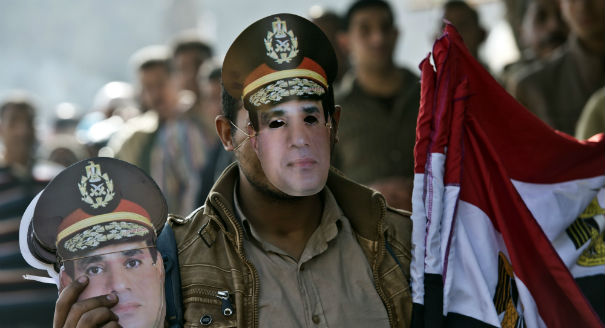
In Egypt, “reconciliation” has become an unspeakable word. In international circles, the need for inclusion is all one hears.
Source: Al Jazeera
Abdel Fattah el-Sisi has campaigned on a platform that, vague as it is, seems to rule out inclusiveness. It is not simply his words for the Brotherhood, harsh as they are - he seems to verge on expressing the paternalistic view that he knows Egyptians' needs and therefore will not require a democratic process for them to inform and guide him. Will he reverse himself in office?
There will certainly be strong pressures for him to do so. An attempt to turn his popular mandate into a blank check to rule as he sees fit is likely to fail. There are four factors that might make some kind of reconciliation necessary.
In order to govern effectively, Sisi will need support from a more politicised and active society. His popular support is broad but shallow; he has no movement, party, or organised constituency behind him. If he offers most actors a seat at the table, he might be able to secure their support for his policies.Second, the Egyptian state apparatus is powerful, entrenched, and difficult to control. The only way to counterbalance the security and the judiciary, for instance, is with broad popular support.
Third, the security environment has deteriorated since the July 2012 coup and Egypt's leaders are (or should be) learning the shortcomings of a purely military strategy. Political inclusiveness might be the only way to dry up support for those pursuing a violent path.
Fourth, Egypt desperately needs international investment from the private sector and diplomatic support if it is going to make any progress on the economic front; few investors or powerful governments are likely to want to sink much economic or political capital into a leadership that appears isolated and authoritarian.
Yet despite all these factors, full reconciliation seems unlikely at present. Of course, Sisi will make polite noises upon taking office, but those will likely remain limited and symbolic. Even if Sisi wished to do more, it is not clear that he can force the state apparatus (especially the security forces) to follow his path. And the opposition may be just as difficult. The collective memory of martyrdom so prominent in some circles in Egypt is simply not shared with most of the society.
In Egypt, “reconciliation” has become an unspeakable word. In international circles, the need for inclusion is all one hears. And that will be a problem for Egypt - not only is the country deeply divided but its leaders will operate under an international cloud because of the path they have chosen.

Nonresident Senior Fellow, Middle East Program
Nathan J. Brown, a professor of political science and international affairs at George Washington University, is a distinguished scholar and author of nine books on Arab politics and governance, as well as editor of five books.
Recent Work
Nathan J. Brown
Nathan J. Brown
Carnegie India does not take institutional positions on public policy issues; the views represented herein are those of the author(s) and do not necessarily reflect the views of Carnegie, its staff, or its trustees.

A partnership between India, a country of subcontinental size, and Africa, a continent of fifty-four countries, may seem asymmetric until one notes that both are home to nearly the same number of people—1.4 billion. This essay spells out the existing challenges to the partnership, its optimal potential, and the possible pathways to realize it over the next quarter-century.

Rajiv Bhatia

As India’s economy recovers from the coronavirus pandemic, Indian businesses need efficient financial structures to regain their ground. Key reforms to India’s Insolvency and Bankruptcy Code could fill these gaps.

Anirudh Burman

Access to cross-border data is an integral piece of the law enforcement puzzle. India is well placed to lead the discussions on international data agreements subject to undertaking necessary surveillance reforms.

Smriti Parsheera, Prateek Jha
After the coronavirus pandemic wanes, how will China’s reorientation of the Belt and Road Initiative to address global health concerns influence its relationships with South Asian countries?

Deep Pal, Rahul Bhatia
Early in the outbreak, government researchers forecast several high-risk scenarios that were downplayed or ignored in public messaging.
Gautam I. Menon