

Commentary
Thomas de Waal
{
  "authors": [
    "Thomas de Waal"
  ],
  "type": "commentary",
  "centerAffiliationAll": "",
  "centers": [
    "Carnegie Endowment for International Peace",
    "Carnegie Europe",
    "Carnegie Russia Eurasia Center"
  ],
  "collections": [],
  "englishNewsletterAll": "",
  "nonEnglishNewsletterAll": "",
  "primaryCenter": "Carnegie Europe",
  "programAffiliation": "",
  "programs": [],
  "projects": [],
  "regions": [
    "Caucasus",
    "Russia",
    "Azerbaijan",
    "Armenia"
  ],
  "topics": [
    "Security",
    "Military",
    "Foreign Policy"
  ]
}
Source: Getty
Putin enjoyed his moment in the media limelight as a peace-maker over Karabakh. But the lack of substance from the summit suggests that Russia is as out of ideas as anyone else on the Karabakh conflict.
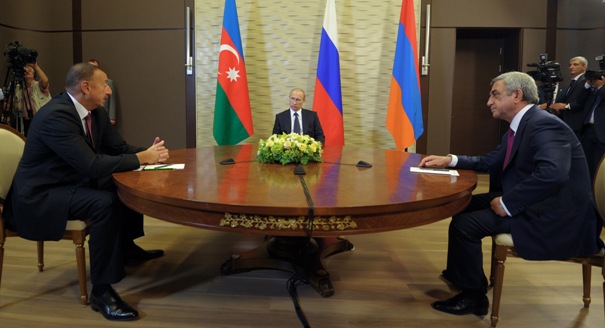
On August 10 Russian leader Vladimir Putin convened a trilateral meeting between himself, Armenian president Serzh Sargsyan and Azerbaijani president Ilham Aliyev in Sochi.
The immediate aim seems to have been successful. That was to dampen down the fighting that flared up on the Nagorny Karabakh Line of Contact and Armenian-Azerbaijani border and killed several dozen soldiers in the last two weeks.
But it was striking how vague the public statements after the meeting were. Aliyev and Sargsyan did their host the favor of saying they supported a peaceful resolution of the conflict, while exchanging a few barbs with one another about historical details.
Likewise, there was no public commitment to re-invigorate the negotiations over the Basic Principles framework document—or, as some Azerbaijanis suggest, skip that discussion and move to comprehensive peace talks.
There was much speculation on social media prior to the Sochi meeting that Russia was acting as “puppet-master” over the conflict—or in some more conspiratorial versions had even instigated the spike in violence in order to step in and regulate it.
Certainly, Putin enjoyed his moment in the media limelight as peace-maker. And Russia has profited from the protracted conflict over the last year by selling weapons to both sides.
But the Sochi meeting seemed to confirm the basic truth of the Karabakh conflict: that it remains unresolved because of internal dynamics, not external factors. Neither side will let Russia dictate to them on this issue, which is fundamental to the security and identity of both nations. Not even, Russia’s military ally, Armenia. President Sargsyan found time in a television interview after the meeting to squash the idea that a Russian peacekeeping force was on its way.
Those internal dynamics are getting worse, not better. There are new reports of weapons purchases by Azerbaijan from Israel and Pakistan.
Azerbaijan flexes its muscles and emits ever more bellicose noises. Before he left for Sochi, President Ilham Aliyev launched an astonishing barrage of 57 tweets, with declarations such as, “We will restore our sovereignty. The flag of Azerbaijan will fly in all the occupied territories, including Shusha and Khankandi.”
That was probably more a piece of theater than an indication that war is about to start. But the increase in aggression has real victims. Alongside the casualties on the ceasefire line, there are also disturbing reports that an unarmed Armenian villager named Karen Petrosian who crossed the border in unexplained circumstances on August 7 was later killed by his Azerbaijani captors.
After Sochi, Sargsyan responded in macho style. He said that his country had missiles with a 300-km-radius which could turn Azerbaijani towns into “Aghdam”—a chilling reference to the leveled Azerbaijani city outside Karabakh under Armenian control.
All this suggests that Russia is as out of ideas as anyone else on how to control the conflict. The Russians will take what benefits they can from the status quo, while seeking to stop a new war from beginning. In the fall the United States will try to convene a meeting on the margins of the United Nations General Assembly and French President Francois Hollande will invite Aliyev and Sargsyan to Paris. Putin meanwhile will get back to dealing with Ukraine. There was no suggestion that he plans another Karabakh summit any time soon.

Senior Fellow, Carnegie Europe
Thomas de Waal is a senior fellow at Carnegie Europe, specializing in Eastern Europe and the Caucasus.
Recent Work
Thomas de Waal
Thomas de Waal
Carnegie India does not take institutional positions on public policy issues; the views represented herein are those of the author(s) and do not necessarily reflect the views of Carnegie, its staff, or its trustees.

In any defense establishment, change is an ongoing process. However, despite the best of intentions, existing bureaucracies, bound by habit and years of socialization, have their limits in implementing transformative change.

Anit Mukherjee

After the chill in ties between 2020 and 2024 that brought India–China relations to their lowest point in several decades, the two countries have engaged each other afresh. This paper argues that there are predominantly four imperatives guiding India’s approach to China, and they exist in an order of priority.

Saheb Singh Chadha

This piece argues that India’s central challenge is not managing a single flashpoint but resolving the underlying tension between expansion and institutional coherency of the BRICS grouping.

Vrinda Sahai

A partnership between India, a country of subcontinental size, and Africa, a continent of fifty-four countries, may seem asymmetric until one notes that both are home to nearly the same number of people—1.4 billion. This essay spells out the existing challenges to the partnership, its optimal potential, and the possible pathways to realize it over the next quarter-century.

Rajiv Bhatia

The India–EU Free Trade Agreement (FTA) is shaping up to be one of the most consequential trade negotiations, both economically and strategically. But, what’s in the agreement, what’s missing, and what will determine its success in the years ahead
Vrinda Sahai, Nicolas Köhler-Suzuki