

Q&A
Eugene Rumer
{
  "authors": [
    "Eugene Rumer"
  ],
  "type": "legacyinthemedia",
  "centerAffiliationAll": "dc",
  "centers": [
    "Carnegie Endowment for International Peace",
    "Carnegie Russia Eurasia Center"
  ],
  "collections": [],
  "englishNewsletterAll": "ctw",
  "nonEnglishNewsletterAll": "",
  "primaryCenter": "Carnegie Endowment for International Peace",
  "programAffiliation": "russia",
  "programs": [
    "Russia and Eurasia"
  ],
  "projects": [],
  "regions": [
    "Russia",
    "Eastern Europe",
    "Ukraine"
  ],
  "topics": [
    "Security",
    "Foreign Policy"
  ]
}
Source: Getty
Kyiv and Moscow are on a collision course. They may already be past the point of no return where a negotiated solution might have kept the crisis from escalating.
Source: POLITICO Magazine
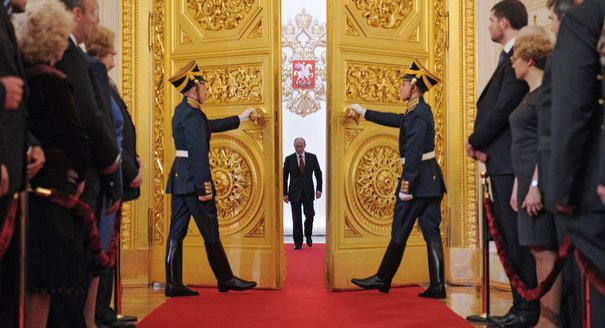
The conflict in eastern Ukraine is entering a new and highly dangerous phase. The Ukrainian army is poised for the final drive into Donetsk, the capital of Russian-backed separatists. A convoy of some 40 Russian vehicles, including two dozen armored personnel carriers and support trucks, was reported entering Ukrainian territory where it was shelled by Ukrainian artillery. The Ukrainian government says it destroyed several vehicles, and almost certainly there have been losses among Russian military personnel. Russian President Vladimir Putin, meanwhile, addressed Russian parliamentarians in Crimea, apparently assembled there to demonstrate that the Black Sea territory is Russian, period. Kyiv and Moscow are on a collision course. Neither is willing to yield. They may be past the point of no return where a negotiated solution might have kept the crisis from escalating.
Kyiv’s desire for a victory on the battlefield is understandable. An outright defeat of the separatists would vindicate the new Ukrainian government’s military and political strategy, which has painted the Russian-backed rebellion in eastern Ukraine as “terrorism.” One does not negotiate with terrorists. A battlefield victory would also help the new government unite the country on the eve of the parliamentary election set for late October. It would deliver a humiliating blow to the Kremlin and raise Kyiv’s international prestige.But the very same incentives that are driving Kyiv’s all-or-nothing push for a battlefield victory are likely to make Putin do all he can to prevent it. Is the man who crushed the Chechen rebellion and carved up Georgia prepared to accept a humiliating political and military defeat from a weaker neighbor whose government has been branded in the Russian media as illegitimate, and led by a political novice? With the overwhelming majority of Russians—87 percent—approving of Putin’s present course, defeat is not an option.
According to NATO, Russia has assembled a strike force of some 20,000 on the border with Ukraine. Secretary-General Anders Fogh Rasmussen has stated, “there is a high probability of a Russian military intervention.” Last week, Russian diplomats called an urgent session of the U.N. Security Council and appealed to the international community to intervene in the humanitarian crisis in eastern Ukraine, where, they claimed, indiscriminate actions by the Ukrainian army have resulted in civilian casualties, human suffering and thousands of refugees. Members of the Security Council rejected the appeal, but not before Russian envoy Vitaliy Churkin said that Russia had the means and the will to undertake such an operation on its own—a thinly veiled threat to intervene. A Russian humanitarian convoy of some 300 vehicles has stopped near the border with Ukraine, awaiting Red Cross and Ukrainian government approval to proceed to Luhansk.
The risk of an outright Russian invasion of eastern Ukraine is all too real. The lack of a Security Council mandate will not stop Russia from intervening if the Kremlin deems it necessary either as a humanitarian gesture or as a cover for direct military intervention. Russian leaders do not fear international condemnation and reputational risks, as their actions in Crimea and eastern Ukraine make clear. Domestic public opinion is what matters. To defend its action, Kremlin spokesmen will probably point to the NATO air campaign against Serbia over Kosovo and the U.S. invasion of Iraq, both of which lacked Security Council approval. Putin’s war cabinet may conclude that the damage to Russia’s reputation abroad has already been done, and it has little or nothing to lose in the international arena. And a humanitarian relief operation to save fellow Russians from the Ukrainian army and paramilitary groups branded in the Russian media as “fascist” would be enormously popular in Russia.
Putin may be “cornered,” as some are describing his position after the Ukrainian forces’ recent gains, but this is no cause for celebration. Past experience suggests that when “cornered,” Putin does not give up, but instead ups the ante. Should he decide to launch a direct military attack on Ukraine, it is the West that would likely be “cornered,” as the United States and its allies have few, if any options to counter Putin’s move.
From the very beginning of the crisis, Western leaders have ruled out direct military involvement in the conflict. Despite its battlefield success, the Ukrainian army would find a much tougher opponent in the Russian army than the ragtag militias it has been fighting so far. Would the West intervene to help Kyiv’s forces? No—President Obama made clear it would not when he spoke on Aug. 1: “But short of going to war, there are going to be some constraints in terms of what we can do if President Putin and Russia are ignoring what should be their long-term interests.” Even Russia’s harshest critics in the United States are not advocating going to war with Russia.
With force off the table, the West’s response to Putin’s actions in Ukraine has been sanctions and more sanctions. They have failed to dissuade and deter Russian support for the separatists. Yet, the West is threatening more sanctions if Russia attacks. Albert Einstein supposedly described insanity as doing the same thing over and over again and expecting different results. The West can double down on sanctions and threaten more of the same, but the result is also going to be the same. The United States and its allies have made it clear that Ukraine is not as important to them as it is to Russia. Russia is prepared to go to war for it. They are not.
It is tempting to say that all parties need to talk and reach a reasonable, mutually acceptable compromise. But it looks less and less likely or feasible at this stage of the conflict. Kyiv senses victory and appears poised to go for it. Putin fears defeat and is not prepared to accept it. In the end, Ukraine has the most to lose in this conflict. The threat of more war in eastern Ukraine makes the prospect of national reconciliation even more distant. Ukraine’s economy, already expected to shrink by nearly 10 percent this year, will suffer even more, struggling under the burden of debt, politically unpopular reforms and the costs of reconstruction. More Ukrainian and Russian lives will be lost. Ukraine’s hopes for a normal future, united, prosperous and at peace with itself and its neighbors will once again be shattered.
Director and Senior Fellow, Russia and Eurasia Program
Rumer, a former national intelligence officer for Russia and Eurasia at the U.S. National Intelligence Council, is a senior fellow and the director of Carnegie’s Russia and Eurasia Program.
Recent Work
Eugene Rumer
Eugene Rumer
Carnegie India does not take institutional positions on public policy issues; the views represented herein are those of the author(s) and do not necessarily reflect the views of Carnegie, its staff, or its trustees.

This piece argues that India’s central challenge is not managing a single flashpoint but resolving the underlying tension between expansion and institutional coherency of the BRICS grouping.

Vrinda Sahai

A partnership between India, a country of subcontinental size, and Africa, a continent of fifty-four countries, may seem asymmetric until one notes that both are home to nearly the same number of people—1.4 billion. This essay spells out the existing challenges to the partnership, its optimal potential, and the possible pathways to realize it over the next quarter-century.

Rajiv Bhatia

The India–EU Free Trade Agreement (FTA) is shaping up to be one of the most consequential trade negotiations, both economically and strategically. But, what’s in the agreement, what’s missing, and what will determine its success in the years ahead
Vrinda Sahai, Nicolas Köhler-Suzuki

This piece argues that the present Indian strategy, based on opportunistic diversification and utilization of limited strategic reserves, remains inadequate when confronting supply disruptions. It evaluates India’s options in the short, medium, and long terms.
Vrinda Sahai

Trump 2.0 has unsettled India’s external environment—but has not overturned its foreign policy strategy, which continues to rely on diversification, hedging, and calibrated partnerships across a fractured order.



Milan Vaishnav, ed., Sameer Lalwani, Tanvi Madan, …