

Commentary
Dmitri Trenin
{
  "authors": [
    "Dmitri Trenin"
  ],
  "type": "commentary",
  "centerAffiliationAll": "",
  "centers": [
    "Carnegie Endowment for International Peace",
    "Carnegie Russia Eurasia Center"
  ],
  "collections": [],
  "englishNewsletterAll": "",
  "nonEnglishNewsletterAll": "",
  "primaryCenter": "Carnegie Russia Eurasia Center",
  "programAffiliation": "",
  "programs": [],
  "projects": [],
  "regions": [
    "Russia",
    "Eastern Europe",
    "Ukraine",
    "Western Europe"
  ],
  "topics": [
    "Security",
    "Military",
    "Foreign Policy"
  ]
}
Source: Getty
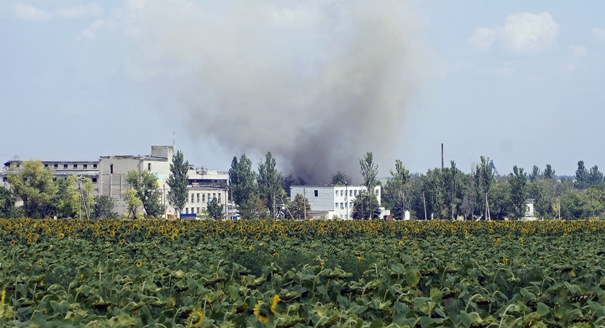
While European mainstream media’s focus has been on the developments in Gaza and in northern Iraq, they have been giving only scant attention recently to the humanitarian situation in eastern Ukraine.
Europe's mainstream media have been giving only scant attention recently to the humanitarian situation in eastern Ukraine. Their focus instead has been on the developments in Gaza and in northern Iraq. There are different explanations for this choice. Today's Europe has become a home to millions of Muslims. The Islamic State in Iraq and Syria has replaced in the popular mind the threat posed earlier by Al Qaeda. There are also very few Western reporters in eastern Ukraine, which is viewed (correctly) as a highly dangerous environment. With Russia's hand behind the rebels, as well as Moscow's complicity in the downing four weeks ago of the Malaysia Airlines Flight MH17 firmly imprinted in the Western readers' and viewers' minds, the media can safely move to other issues.
The geopolitics behind these humanitarian concerns or the lack thereof are clear. Moscow calls for attention to the situation in Donbass in order to put Kiev on the spot for the massive suffering and damage the Ukrainian army and paramilitary forces are causing. The rebels whom Russia supports call for a cease-fire, on humanitarian grounds, to win a breathing space now that Kiev's forces are on the offensive. Once the cease-fire takes effect, they also hope to engage Kiev in negotiations about the future status of Donbass, which is anathema to the Ukrainian leadership. Under these circumstances, media spotlight would definitely help Moscow's cause and hinder Kiev's actions.
Of course, pretending that there is no humanitarian crisis and quietly letting Kiev to finish off the rebels and re-establish control over Donbass is a gamble. While the Western media are looking elsewhere, the Russian ones are heavily focused on what is going on in Donetsk and Lugansk and the many small towns in between. When a certain level of suffering is reached, the situation may become intolerable, in President Putin's view. As a result, a Russian humanitarian intervention, with some military backing, may ensue. If this were to happen, this would raise the stakes dramatically for everyone: Ukraine, Russia, and the West.
It is not clear at this point that the West has a strategy beyond sanctioning Russia and giving Kiev support to re-establish control over the country's rebellious east. Luring Russia's military into Ukraine and trapping them there, while bleeding and maiming them—what the Kremlin suspects is Washington's hidden agenda—would be a highly risky proposition. It is more likely that a grand strategy is simply missing—as it was six years ago during Georgia's then U.S.-backed President Mikheil Saakashvili's ill-fated operation to "liberate" South Ossetia.
It is thus not just ironic, but truly worrisome that precisely at the time when Europe's dignitaries solemnly remember the Great War of a hundred years ago and vow not to repeat the mistakes that led their countries into that war, the European media's gaze is far away from the place which might again disturb the peace in Europe, and do so in a big way. Silence in the air can end in a deafening blast.
Former Director, Carnegie Moscow Center
Trenin was director of the Carnegie Moscow Center from 2008 to early 2022.
Recent Work
Dmitri Trenin
Dmitri Trenin
Carnegie India does not take institutional positions on public policy issues; the views represented herein are those of the author(s) and do not necessarily reflect the views of Carnegie, its staff, or its trustees.

In any defense establishment, change is an ongoing process. However, despite the best of intentions, existing bureaucracies, bound by habit and years of socialization, have their limits in implementing transformative change.

Anit Mukherjee

After the chill in ties between 2020 and 2024 that brought India–China relations to their lowest point in several decades, the two countries have engaged each other afresh. This paper argues that there are predominantly four imperatives guiding India’s approach to China, and they exist in an order of priority.

Saheb Singh Chadha

This piece argues that India’s central challenge is not managing a single flashpoint but resolving the underlying tension between expansion and institutional coherency of the BRICS grouping.

Vrinda Sahai

A partnership between India, a country of subcontinental size, and Africa, a continent of fifty-four countries, may seem asymmetric until one notes that both are home to nearly the same number of people—1.4 billion. This essay spells out the existing challenges to the partnership, its optimal potential, and the possible pathways to realize it over the next quarter-century.

Rajiv Bhatia

The India–EU Free Trade Agreement (FTA) is shaping up to be one of the most consequential trade negotiations, both economically and strategically. But, what’s in the agreement, what’s missing, and what will determine its success in the years ahead
Vrinda Sahai, Nicolas Köhler-Suzuki