

Commentary
Sarah Chayes
{
  "authors": [
    "Sarah Chayes"
  ],
  "type": "legacyinthemedia",
  "centerAffiliationAll": "dc",
  "centers": [
    "Carnegie Endowment for International Peace",
    "Malcolm H. Kerr Carnegie Middle East Center"
  ],
  "collections": [],
  "englishNewsletterAll": "democracy",
  "nonEnglishNewsletterAll": "",
  "primaryCenter": "Carnegie Endowment for International Peace",
  "programAffiliation": "DCG",
  "programs": [
    "Democracy, Conflict, and Governance",
    "Middle East"
  ],
  "projects": [],
  "regions": [
    "Middle East",
    "Gulf",
    "Levant",
    "Syria"
  ],
  "topics": [
    "Political Reform",
    "Democracy",
    "Foreign Policy"
  ]
}
Source: Getty
Stop cozying up to the Middle Eastern regimes that spawned the very discontent feeding the extremism the U.S. now wants them to fight.
Source: Defense One
“Our objective is clear: we will degrade, and ultimately destroy,ISIL through a comprehensive and sustained counter-terrorism strategy.”
President Barack Obama, in his address to the nation on Wednesday, sought to conjure the conflicting pressures upon him from the rise of the Islamic State group and its gruesome butchering of two American journalists, and pledged to rally a coalition of Arab regimes. Yet, in trying to satisfy public impulses to fight terrorism but avoid a war, Obama formulated a policy trade-off likely in the long run to stoke, not defuse, the threat of extremism.
Calls for strategy and leadership—in the form of visible military action—had built to a roar by the time Obama strode to the microphone on the eve of September 11. Commentators slammed his “dithering,” his “strategic drift,” or the decline in his aspirations from “hope and change” down to a timid “don’t do stupid stuff.” Yet simultaneously, Americans (not to mention Europeans) remain broadly isolationist, skeptical of the value for money and tears of Western military action to resolve crises abroad.
To the first group Obama offered muscular air strikes, the virile threat to “hunt down terrorists” wherever they may shelter, and repetitions of the word “strategy.” To the second he emphasized modesty: U.S. forces will, with 1,000 exceptions, stay far from the fray.
But a counterterrorism approach, no matter how “comprehensive,” has never destroyed a movement like ISIS. Obama’s own signal achievement, the tracking and killing of Osama bin Laden, proves this point. As tactically brilliant as that operation was, and as psychologically satisfying, it did not destroy al-Qaeda. Adapting its business model since the raid, the movement has instead morphed into a potentially more threatening force. Obama cited Yemen and Somalia as successful examples of this approach, whereas violent extremism has arguably expanded in those countries over the past decade, not declined. Counterterrorism has proven effective in destroying extremists, but it has hardly made a dent on extremist movements.
Supporting proxy forces from the air doesn’t work either. In Afghanistan, that was President George W. Bush’s approach to a conflict he was impatient to be done with. The initial collapse of the Taliban government resembled success, but the resulting vacuum of power—and the international community’s persistent reluctance to address the abusive character of the Afghan government—allowed for a Taliban revival that would have been unimaginable in 2002. In Iraq, the fate of the Anbar Awakening suggests a similar conclusion. It’s not enough to work with proxies to degrade and destroy a terrorist group. The group’s hold over territory and people must be replaced by that of a government the population can be proud of—or at least can tolerate.
That is the signal lesson from the past dozen years in which theU.S. has been at war. Stop cozying up to the Middle Eastern regimes that spawned the very discontent feeding the extremism the U.S. now wants them to fight. In both Iraq and Afghanistan, that approach allowed extremism to flare back to life after an initial defeat, as indignant populations joined up, or profiteering political leaders sidelined U.S.-trained military officers, reducing armies that were painstakingly built up to hollow shells. The militaries of self-serving governments—be they authoritarian like Algeria’s or Egypt’s or Saudi Arabia’s, or fractured like Libya’s or Somalia’s—make counterproductive allies.
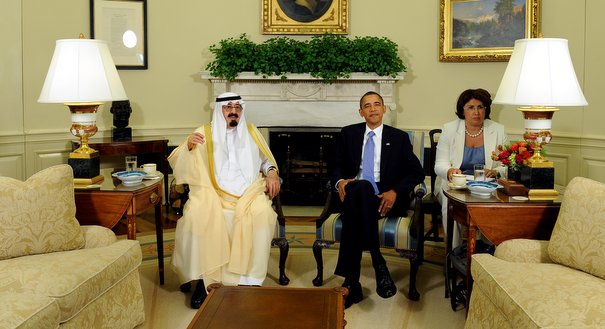
And yet, ally with them is precisely what Obama proposes to do. Far from substantively redrawing the map of the Middle East, as some have suggested might now be possible, the U.S. will be reinforcing precisely the archaic order that has given rise to much of the recent turmoil. Secretary of State John Kerry has been confabbing with U.S.“friends” from such places as Bahrain, Egypt, Saudi Arabia, and Turkey—all highly contested governments—to cobble together an anti-Islamic State coalition.
By allying with such regimes and dubbing them “friends,” the U.S. reinforces their power, enables crackdowns against non-violent opposition, channeling victims’ anger toward more extreme outlets, and becomes identified with these governments‘ behavior—and is therefore, to many, a legitimate target.
Such identification is one of al-Qaeda’s rationales for the 9/11 attacks. In 2009, its No. 2 leader, Abd al-Rahman Atiya, who was killed in a U.S. drone strike in 2011, blamed the West for “appointing collaborative regimes…in our countries. Then they support those regimes and corruptive governments against their people.
Obama was right, in other words, to hold off on assistance to the Iraqi army so long as the exclusive and venal regime of former Prime Minister Nuri Kamal al-Maliki remained in power. Obama’s willingness to hold out, moreover, did help force a political transformation.
He was right to observe, at the National Defense University in May 2013, that ”in the absence of a strategy that reduces the wellsprings of extremism…a perpetual war…will prove self-defeating.” Those wellsprings include the active support for extremist groups provided by such U.S. friends as Saudi Arabia, Qatar, and Pakistan, but they also include the behavior of these and other abusive, corrupt, or autocratic governments toward their people—governments that are sustained today by claims that the only alternative to them is terrorism.
Against his own better instincts, perhaps, Obama has been drawn into this binary trap. Despite those ringing 2013 words, he has never articulated a coherent policy for promoting better governance in countries facing terrorism. In the absence of such a policy, the military actions he has announced amount to tactics, not strategy—and tactics that are likely to backfire, at that.
Former Senior Fellow, Democracy, Conflict, and Governance Program
Sarah Chayes is internationally recognized for her innovative thinking on corruption and its implications. Her work explores how severe corruption can help prompt such crises as terrorism, revolutions and their violent aftermaths, and environmental degradation.
Recent Work
Sarah Chayes
Carnegie India does not take institutional positions on public policy issues; the views represented herein are those of the author(s) and do not necessarily reflect the views of Carnegie, its staff, or its trustees.

After the chill in ties between 2020 and 2024 that brought India–China relations to their lowest point in several decades, the two countries have engaged each other afresh. This paper argues that there are predominantly four imperatives guiding India’s approach to China, and they exist in an order of priority.

Saheb Singh Chadha

This piece argues that India’s central challenge is not managing a single flashpoint but resolving the underlying tension between expansion and institutional coherency of the BRICS grouping.

Vrinda Sahai

A partnership between India, a country of subcontinental size, and Africa, a continent of fifty-four countries, may seem asymmetric until one notes that both are home to nearly the same number of people—1.4 billion. This essay spells out the existing challenges to the partnership, its optimal potential, and the possible pathways to realize it over the next quarter-century.

Rajiv Bhatia

The India–EU Free Trade Agreement (FTA) is shaping up to be one of the most consequential trade negotiations, both economically and strategically. But, what’s in the agreement, what’s missing, and what will determine its success in the years ahead
Vrinda Sahai, Nicolas Köhler-Suzuki

Trump 2.0 has unsettled India’s external environment—but has not overturned its foreign policy strategy, which continues to rely on diversification, hedging, and calibrated partnerships across a fractured order.



Milan Vaishnav, ed., Sameer Lalwani, Tanvi Madan, …