

Article
Amr Adly, Hamza Meddeb
{
  "authors": [
    "Amr Adly"
  ],
  "type": "legacyinthemedia",
  "centerAffiliationAll": "dc",
  "centers": [
    "Carnegie Endowment for International Peace",
    "Malcolm H. Kerr Carnegie Middle East Center"
  ],
  "collections": [],
  "englishNewsletterAll": "menaTransitions",
  "nonEnglishNewsletterAll": "",
  "primaryCenter": "Carnegie Endowment for International Peace",
  "programAffiliation": "MEP",
  "programs": [
    "Middle East"
  ],
  "projects": [],
  "regions": [
    "Egypt",
    "North Africa"
  ],
  "topics": [
    "Economy",
    "Political Reform"
  ]
}
Source: Getty
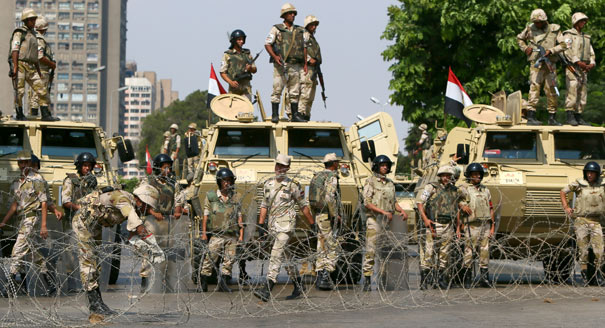
The number and size of economic ventures carried out by affiliates of the Egyptian armed forces will have long-term negative effects on the future of Egypt’s private sector.
Source: Al Shorouk
Many economic researchers and observers consider that the unprecedented expansion in the number and size of economic ventures carried out by affiliates of the armed forces will have long-term negative effects on the future of the private sector. They argue that the military establishment and its affiliates enjoy a competitive advantage over private companies. As one of the most important state institutions, the Egyptian armed forces have extensive powers and access to financial, human, and administrative resources that are not available to private companies. For this reason, their post-July 30 development role is perceived by some as a revival of the state’s monopoly on the economy—with the military maintaining a pivotal role in producing and distributing goods and services. It is also considered as a departure from economic liberalization measures under Hosni Mubarak’s government.
However, this article contends that the military’s recent economic role is exaggerated, as are the possible implications of its expansion for the future of the private sector. Although the military has come to occupy an increasingly central position in the state’s economic plans, particularly the ones geared to generating job opportunities and increasing growth rates, its economic expansion does not represent a major shift in its relation with the economy. Under current circumstances, this expanding role is very likely to be temporary, dictated as it is by the exigencies of ending recession. In addition, the military’s mounting economic role will affect private companies at varying degrees. Its effect on small and medium-sized enterprises will also be different than on large companies. I will elaborate on these points further.
The significant expansion in the military’s economic activities is inextricably linked to the post-July takeover and the economic and political conjuncture in Egypt that followed it, as well as the urgency to recover economic growth and boost employment and investment rates after years of slowdown, turmoil, and outward flight of domestic and foreign investments. After all, the legitimacy and popularity of the new ruling regime—following the road map’s implementation—hinge directly on achieving economic recovery. For this reason, the government launched stimulus packages with funding from Gulf allies or private sources, at a time when national and foreign capital owners froze their activities at home, divesting their capitals from Egypt since January 2011. As uncertainty continued to engulf the future of public policies, the private sector was not much responsive to the early stimulus plans of the Government of el-Beblawi, hence the reliance on state institutions. After the overthrow of former president Mohammad Morsi, the military dominated the political landscape and attempted to regain growth and trust, paving the way for a broader economic recovery. Amid political turmoil, the military seemed to be the safest partner for Gulf capitalists seeking investment opportunities and means to boost the new political transition process in Egypt.The military has thus become the largest recipient of capital flows from the Gulf, entering into partnerships for major development projects, including the one-million-housing-units project in partnership between the Engineering Authority and Arabtec of the United Arab Emirates (UAE). For this reason, it was assumed that the military would withhold foreign capitals from the private sector in the future. This is not a valid assumption. If Egypt’s economy picks up and recovers its pre-revolution foreign investment levels, the military establishment will lose its current role. The latter is, after all, temporary and dependent on the political and economic partnership with the UAE and the Kingdom of Saudi Arabia. This pattern cannot be expected to persist in the future.
In addition, the direct economic role of the military and its affiliates can be traced back to the 1980s, when Egypt set on the path to economic transformation. This military economy has coexisted with the multi-faceted expansion of the private sector and the emergence of a major capitalist class in the past two decades. The clear division of labor also continues to hold. The military establishment concentrates its economic activities in the infrastructure sector (roads, bridges, and tunnels), but does not have any stake in other significant active sectors, including heavy industries (cement, iron, steel, and aluminum) or services (tourism, telecom and transportation). In a nutshell, the military’s economic expansion is still confined to traditional sectors. Its involvement in few housing projects remains an exception.
The military’s focus on infrastructure projects seeks primarily to increase employment rates for these projects are labor-intensive and rely mostly on outsourcing to small and medium-sized companies. This leads us to the concluding remark: the recent expansion in the role of Egypt’s armed forces will have an unequal effect on the private sector and will most likely be detrimental to Egypt’s capitalist class, particularly with stakes in the construction sector.
This article was originally published in Arabic by Al Shorouk.

Former Nonresident Scholar, Middle East Center
Adly was a nonresident scholar at the Carnegie Middle East Center, where his research centers on political economy, development studies, and economic sociology of the Middle East, with a focus on Egypt.
Recent Work

Amr Adly, Hamza Meddeb

Robert Springborg, Ishac Diwan, Amr Adly, …
Carnegie India does not take institutional positions on public policy issues; the views represented herein are those of the author(s) and do not necessarily reflect the views of Carnegie, its staff, or its trustees.

A partnership between India, a country of subcontinental size, and Africa, a continent of fifty-four countries, may seem asymmetric until one notes that both are home to nearly the same number of people—1.4 billion. This essay spells out the existing challenges to the partnership, its optimal potential, and the possible pathways to realize it over the next quarter-century.

Rajiv Bhatia

On March 10, 2026, India’s Union Cabinet approved amendments to Press Note 3, a regulation that mandated government approval on all foreign direct investment (FDI) from countries sharing a land border with India. This amendment raises questions primarily about whether its stated benefits will materialize and if the risks have been adequately weighed. This piece will address the same.

Konark Bhandari

This piece examines India’s response to U.S. sanctions and tariffs, specifically assessing the immediate market consequences, such as alterations in import costs, and the broader strategic implications for India’s energy security and foreign policy orientation.

Vrinda Sahai

This paper examines the evolution of India-China economic ties from 2005 to 2025. It explores the impact of global events, bilateral political ties, and domestic policies on distinct spheres of the economic relationship.

Santosh Pai
The India-U.S. relationship currently appears buffeted between three “Ts”—TRUST, Tariffs, and Trump.
Arun K. Singh