• Research
  • About
  • Experts
Carnegie India logoCarnegie lettermark logo
AI
{
  "authors": [
    "David Rothkopf"
  ],
  "type": "legacyinthemedia",
  "centerAffiliationAll": "",
  "centers": [
    "Carnegie Endowment for International Peace",
    "Malcolm H. Kerr Carnegie Middle East Center"
  ],
  "collections": [],
  "englishNewsletterAll": "",
  "nonEnglishNewsletterAll": "",
  "primaryCenter": "Carnegie Endowment for International Peace",
  "programAffiliation": "",
  "programs": [],
  "projects": [],
  "regions": [
    "Middle East",
    "Iraq",
    "Syria",
    "Gulf",
    "Levant"
  ],
  "topics": [
    "Security",
    "Military",
    "Foreign Policy"
  ]
}
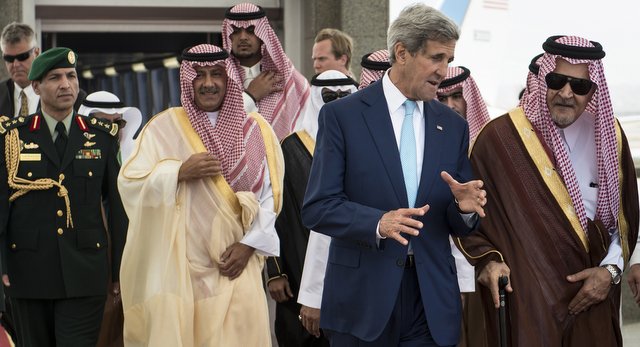
Source: Getty

In The Media

How to Beat ISIS

If Washington is leading a coalition against the Islamic State, and it is, then the United States must be on the ground as well. There is no other way.

Link Copied
By David Rothkopf
Published on Oct 30, 2014

Source: Time

The Islamic State of Iraq and Greater Syria (ISIS) is a pernicious, brutal organization that directly threatens the stability of the Middle East, and ultimately, nations worldwide. It is also roughly the size of a small American state university, fielding no more than 30,000. It doesn’t have an air force, a navy, a reliable tax base or any of the other resources found in even the smallest and most fragile of nations.

The U.S. needed only 31⁄2 years to defeat the Axis in World War II. During that war Germany alone was able to field more than 20 million soldiers. So why, when U.S. Admiral John Kirby, the spokesperson for the most powerful military force the world has ever known, was asked how long it might take to defeat the modest threat posed by ISIS, did he say that it could take five years, six years or even more?
While it’s well known that fighting insurgencies is challenging—witness the 13-year war against the Taliban—that’s not the whole answer. Unlike al-Qaeda and the Taliban in Afghanistan, ISIS isn’t fighting purely guerrilla-style, fading in and out of the background. ISIS is seeking to claim and hold territory, build and maintain supply chains, protect illicit oil shipments—all in the effort to construct a state. ISIS is a hybrid force—part insurgency and part traditional army—and the U.S. should have no trouble defeating a traditional army.

But to do that, you need to rely on more than just air strikes. Ground forces are needed to seize and hold territory where ISIS has been weakened. While those troops needn’t be entirely or even primarily American, if Washington is leading a coalition against ISIS, and it is, then the U.S. must be on the ground as well. There is no other way.

That leadership can’t be left up to the rest of the U.S. coalition. Most of the participants have really only signed up for secondary duty, far from the battles on the ground. Virtually none have made meaningful commitments to field the troops and take the risks needed not only to degrade ISIS but to defeat it. With some—like Turkey and Qatar—it can be hard to tell whose side they’re really on.

The coalition and the U.S. have repeatedly shown they lack the two things needed to ensure a decisive victory. The first is will. That means the will to commit the right ­forces in the right numbers, with the associated risks—and the will to work allies to ensure they do their part as well. Turkey, for instance, needs to know that failure to be a dependable partner against ISIS will call its NATO membership into question.

The second issue is a question of strategy. When President Obama admitted in August that “we don’t have a strategy yet” on ISIS, he lived up to the old Washington maxim that a gaffe is just a politician accidentally telling the truth. But his later assurance that the U.S. did indeed have a strategy was unconvincing. Absent the will to win, there is no strategy that will work.

Even if the U.S. manages to defeat ISIS militarily in Iraq or Syria, there is no clear plan to fill the political, economic and social void that will be created by its elimination. In Syria victory over ISIS might end up empowering the brutal regime of President Bashar Assad, which is already responsible for a war that’s produced 200,000 deaths and a massive humanitarian catastrophe. In Iraq, if the only result is a Shi‘ite-led regime in Baghdad that acts much like the last one, it won’t be long before Sunni unrest invites the rise of a new insurgency. We’ve seen that movie once before.

We need a broader strategy to curb the alarming spread of violent extremism, which currently takes the form of dozens of groups from West Africa to Asia. Insiders call it “squeezing the balloon”—getting rid of the problem in one place only to see it burst forth in another. It’s not enough, as the President recently suggested, to simply see this as a “generational problem.”

And that’s the rub. One can’t help but look at the current ad hoc, halfhearted effort against ISIS without thinking that the goal isn’t really beating ISIS, but beating back bad press. It’s a policy built around keeping a lid on public criticism—at least until the President has cleaned out his desk in the Oval Office.

This article originally appeared in Time. 

About the Author

David Rothkopf

Former Visiting Scholar

David Rothkopf was a visiting scholar at the Carnegie Endowment as well as the former CEO and editor in chief of the FP Group.

    Recent Work

  • In The Media
    How Bush, Obama, and Trump Ended Pax Americana

      David Rothkopf

  • In The Media
    A Bigger Clubhouse

      David Rothkopf

David Rothkopf
Former Visiting Scholar
David Rothkopf
SecurityMilitaryForeign PolicyMiddle EastIraqSyriaGulfLevant

Carnegie India does not take institutional positions on public policy issues; the views represented herein are those of the author(s) and do not necessarily reflect the views of Carnegie, its staff, or its trustees.

More Work from Carnegie India

  • Article
    Managing Divergence: India’s BRICS Presidency in 2026

    This piece argues that India’s central challenge is not managing a single flashpoint but resolving the underlying tension between expansion and institutional coherency of the BRICS grouping.

      Vrinda Sahai

  • Article
    India–Africa Strategic Partnership: Challenges, Potential, and Possible Pathways

    A partnership between India, a country of subcontinental size, and Africa, a continent of fifty-four countries, may seem asymmetric until one notes that both are home to nearly the same number of people—1.4 billion. This essay spells out the existing challenges to the partnership, its optimal potential, and the possible pathways to realize it over the next quarter-century.

      Rajiv Bhatia

  • Commentary
    Emerging From the “Zombie State” of Trade Agreements: The India-EU FTA

    The India–EU Free Trade Agreement (FTA) is shaping up to be one of the most consequential trade negotiations, both economically and strategically. But, what’s in the agreement, what’s missing, and what will determine its success in the years ahead

      Vrinda Sahai, Nicolas Köhler-Suzuki
  • Commentary
    The Coming of Age of India’s Nuclear Triad

    The induction of INS Aridhaman, which features several technological enhancements, now gives India the third nuclear ballistic missile submarine to ensure continuous at-sea deterrent.

      Dinakar Peri

  • Article
    India’s Oil Security Strategy: Structural Vulnerabilities and Strategic Choices

    This piece argues that the present Indian strategy, based on opportunistic diversification and utilization of limited strategic reserves, remains inadequate when confronting supply disruptions. It evaluates India’s options in the short, medium, and long terms.

      Vrinda Sahai

Get more news and analysis from
Carnegie India
Carnegie India logo, white
Unit C-4, 5, 6, EdenparkShaheed Jeet Singh MargNew Delhi – 110016, IndiaPhone: 011-40078687
  • Research
  • About
  • Experts
  • Projects
  • Events
  • Contact
  • Careers
  • Privacy
  • For Media
Get more news and analysis from
Carnegie India
© 2026 Carnegie Endowment for International Peace. All rights reserved.