

Commentary
Dmitri Trenin
{
  "authors": [
    "Dmitri Trenin"
  ],
  "type": "commentary",
  "centerAffiliationAll": "",
  "centers": [
    "Carnegie Endowment for International Peace",
    "Carnegie Russia Eurasia Center"
  ],
  "collections": [],
  "englishNewsletterAll": "",
  "nonEnglishNewsletterAll": "",
  "primaryCenter": "Carnegie Russia Eurasia Center",
  "programAffiliation": "",
  "programs": [],
  "projects": [],
  "regions": [
    "Russia",
    "Eastern Europe",
    "Ukraine",
    "Western Europe"
  ],
  "topics": [
    "Political Reform",
    "Foreign Policy",
    "Global Governance"
  ]
}
Source: Getty
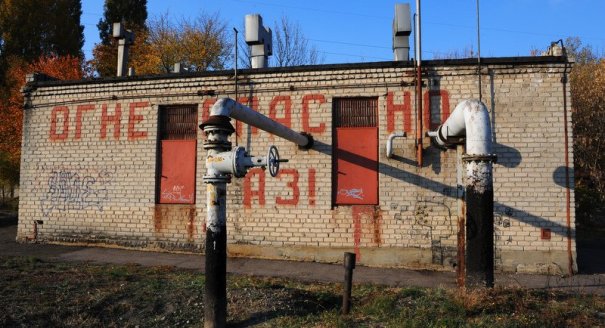
If Ukraine is allowed to become a failed state, the consequences for Europe will be serious, even dire. Making sure that Ukraine keeps itself warm this winter is an absolutely necessary step.
If Minsk was about halting the fighting in Donbass, Milan has been essentially about ensuring uninterrupted supply of Russian gas to the European Union via Ukraine. It appears that Europe will likely guarantee the supply, by having agreed to pay Kiev's past debt and new gas bills to Gazprom. Moscow, for its part, has conceded on the price it charges for gas used by Ukraine. Much of the discussion in Milan has evidently centered on the intricate schemes to be used for payment. As a result, the transit gas purchased by the Europeans will not be diverted en route by the Ukrainians; Ukraine will get Russian gas paid for by the EU; and Russia will get the money.
It will be up to Russia to bail out the part of Donbass which its friends hold and would not give up. Coming on top of the Crimea commitment, and in the context of the Western sanctions, which are more likely to be toughened than eased, caring for a couple of million more people in a depressed and war-devastated region with an unrecognized status and murky conditions on the ground will not be easy. The European Union, however, will have to take care of Ukraine as a whole, with its 40-plus million residents, a ruined and heavily indebted economy and complex political and social environment. The cost of the required effort is anyone's guess. EU member Greece, with its 10 million people, recently needed 240 billion euro to avoid default. 16-million-stong East Germany, on the other hand, has used 1.5 trillion over 25 years, to integrate into the Federal Republic.
Ukraine, of course, is not an EU member, nor is it going to become one soon. Yet, if it is allowed to become a failed state, the consequences for Europe will be serious, even dire. Making sure that Ukraine keeps itself warm this winter is an absolutely necessary step, but much, much more will be needed on top of that. This is the harsh reality one has to face up to.
Former Director, Carnegie Moscow Center
Trenin was director of the Carnegie Moscow Center from 2008 to early 2022.
Recent Work
Dmitri Trenin
Dmitri Trenin
Carnegie India does not take institutional positions on public policy issues; the views represented herein are those of the author(s) and do not necessarily reflect the views of Carnegie, its staff, or its trustees.

After the chill in ties between 2020 and 2024 that brought India–China relations to their lowest point in several decades, the two countries have engaged each other afresh. This paper argues that there are predominantly four imperatives guiding India’s approach to China, and they exist in an order of priority.

Saheb Singh Chadha

This piece argues that India’s central challenge is not managing a single flashpoint but resolving the underlying tension between expansion and institutional coherency of the BRICS grouping.

Vrinda Sahai

A partnership between India, a country of subcontinental size, and Africa, a continent of fifty-four countries, may seem asymmetric until one notes that both are home to nearly the same number of people—1.4 billion. This essay spells out the existing challenges to the partnership, its optimal potential, and the possible pathways to realize it over the next quarter-century.

Rajiv Bhatia

The India–EU Free Trade Agreement (FTA) is shaping up to be one of the most consequential trade negotiations, both economically and strategically. But, what’s in the agreement, what’s missing, and what will determine its success in the years ahead
Vrinda Sahai, Nicolas Köhler-Suzuki
Trump 2.0 has unsettled India’s external environment—but has not overturned its foreign policy strategy, which continues to rely on diversification, hedging, and calibrated partnerships across a fractured order.



Milan Vaishnav, ed., Sameer Lalwani, Tanvi Madan, …