

Paper
James M. Acton, Ankit Panda
{
  "authors": [
    "James M. Acton"
  ],
  "type": "legacyinthemedia",
  "centerAffiliationAll": "dc",
  "centers": [
    "Carnegie Endowment for International Peace"
  ],
  "collections": [
    "U.S. Nuclear Policy"
  ],
  "englishNewsletterAll": "ctw",
  "nonEnglishNewsletterAll": "",
  "primaryCenter": "Carnegie Endowment for International Peace",
  "programAffiliation": "NPP",
  "programs": [
    "Nuclear Policy"
  ],
  "projects": [],
  "regions": [
    "North America",
    "United States",
    "East Asia",
    "China",
    "Russia"
  ],
  "topics": [
    "Nuclear Policy"
  ]
}
Source: Getty
Clear evidence has recently emerged that a new arms race in ultra-fast, long-range weapons may be brewing between the United States, China, and Russia.
Source: Independent Military Review
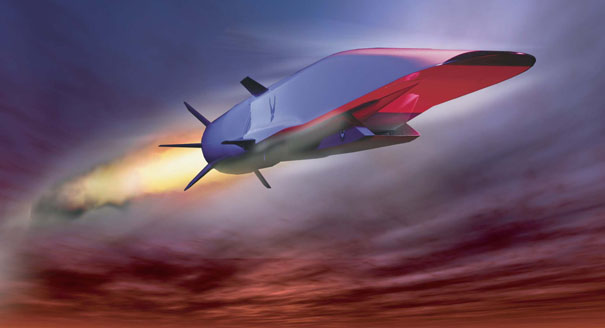
Clear evidence has recently emerged that a new arms race in ultra-fast, long-range weapons may be brewing. In August, both the United States and China tested “boost-glide” weapons within 18 days of one another. Meanwhile, statements from senior Russian leaders, including President Putin, suggest that Russia is interested in joining the competition.
A boost-glide weapon is launched like a normal ballistic missile. However, rather than arcing high above the earth, it re-enters the atmosphere quickly before deploying a glider. This glider, which is unpowered, can travel for huge distances—potentially many thousands of kilometers—at hypersonic speeds (at least five times faster than the speed of sound). Boost-glide weapons were first imagined in the 1930s. However, the technology is so challenging that the first successful test of a long-range system did not take place until 2011 when the U.S. Advanced Hypersonic Weapon flew for 3,800 km.
The U.S. Department of Defense tested the Advanced Hypersonic Weapon again in August 2014. The weapon was launched from Alaska and was intended to reach a target in the Pacific Ocean more than 6,000 km away—but the test was terminated within four seconds. Because the problem was related to the booster, this failure reveals nothing about the capability of the glider itself. It seems likely that, following an investigation, this test will be re-run—although there has not been an official announcement to this effect.The Advanced Hypersonic Weapon is part of the U.S. Conventional Prompt Global Strike program. In fact, it has effectively become the Conventional Prompt Global Strike program as it now attracts almost all of the available funding. Nonetheless, this funding is still at a relatively modest level. It seems unlikely that, even if a political decision is made to do so, the Advanced Hypersonic Weapon could be deployed in anything less than a decade.
Speculation that China is developing boost-glide weapons was confirmed this year. In January 2014, Beijing tested a glider labeled WU-14 by the U.S. Department of Defense. In August 2014, a second test, across of a planned range of 1,750 km, appears to have ended in failure, probably as the result of a booster problem.
Very little is known about the Chinese program and its goals—although it is clear that the WU-14 is significantly less ambitious than the Advanced Hypersonic Weapon. One interesting data point, however, is the public assessment by a U.S. official that China’s immediate goal is the delivery of nuclear weapons. This assessment may, in part at least, be based on China’s use of a liquid-fueled booster for the WU-14. (After all, today, Chinese liquid-fueled missiles are used exclusively to deliver nuclear warheads.)
Russia, meanwhile, has continued to emphasize its concerns about conventional strategic weapons. Most significantly, President Putin stated, in his State of the Nation address in December 2013, that in combination with ballistic missile defense, Conventional Prompt Global Strike weapons “could negate all previous agreements on the limitation and reduction of strategic nuclear weapons, and disrupt the strategic balance of power.” He went on to add that
Russia will respond to all these challenges, both political and technological. We have all we need in order to do so. Our military doctrine and advanced weapons, weapons that are being and will be deployed, will unconditionally allow us to ensure the security of the Russian state.
This statement—together with others from the commander of Russia's Strategic Rocket Forces, Lieutenant General Karakayev, and Deputy Defense Minister Antonov—reinforce the impression that Russia is engaged in the development of its own prompt, long-range, conventional weapons. Moreover, there is considerable evidence that Russia is continuing to test a hypersonic maneuvering re-entry vehicle, although it remains unclear whether this particular system is intended to deliver a conventional or nuclear warhead.
These developments create the clear impression that a new arms race is in the offing. It could prove to be dangerous. Most seriously, the use of conventional boost-glide weapons in a conflict could create new risks of escalation—including to the nuclear level.
It is hard to be optimistic that Russia, the United States and China will cooperate to curtail this competition. To be sure, there is plenty that could be done. Declarations of procurement plans, inspections to verify whether warheads were nuclear or non-nuclear, launch notifications, and even formal arms control to limit numbers should all be possible. However, given the parlous state of U.S.-Russian relations, bilateral (let alone trilateral) cooperation is difficult to imagine right now.
The difficulty of solving these problems should, however, not lead us to ignore them. At the very least, Russia, the United States and China should individually explore the risks and aim to develop and deploy weapons in ways that mitigate them. These states should also develop proposals for cooperative confidence-building so that when the political thaw comes, as it surely will, progress can be made quickly.
This article was originally published in Russian in the Independent Military Review.

Jessica T. Mathews Chair, Co-director, Nuclear Policy Program
Acton holds the Jessica T. Mathews Chair and is co-director of the Nuclear Policy Program at the Carnegie Endowment for International Peace.
Recent Work

James M. Acton, Ankit Panda
James M. Acton
Carnegie India does not take institutional positions on public policy issues; the views represented herein are those of the author(s) and do not necessarily reflect the views of Carnegie, its staff, or its trustees.

How is AI reshaping space security, creating governance challenges, and where does international diplomacy stand today?


Tejas Bharadwaj, Almudena Azcárate Ortega

After the chill in ties between 2020 and 2024 that brought India–China relations to their lowest point in several decades, the two countries have engaged each other afresh. This paper argues that there are predominantly four imperatives guiding India’s approach to China, and they exist in an order of priority.

Saheb Singh Chadha

This piece argues that India’s central challenge is not managing a single flashpoint but resolving the underlying tension between expansion and institutional coherency of the BRICS grouping.

Vrinda Sahai

The U.S.–India semiconductor cooperation story is well-stocked with top-level strategic intent. What remains unresolved, however, are some underlying challenges that will determine whether the cooperation actually functions. Three such friction points stand out.

Shruti Mittal
India and the United States are close to concluding a Reciprocal Defense Procurement Agreement (RDPA) that will allow firms from the two countries to sell to each other’s defense establishments more easily. While this may not remedy the specific grievances both sides may have regarding larger bilateral issues, an RDPA could restore some momentum, following the trade deal announcement.

Konark Bhandari