

Q&A
Matt Ferchen
{
  "authors": [
    "Matt Ferchen"
  ],
  "type": "questionAnswer",
  "centerAffiliationAll": "",
  "centers": [
    "Carnegie Endowment for International Peace",
    "Carnegie China"
  ],
  "collections": [
    "China and the Developing World",
    "China’s Foreign Relations"
  ],
  "englishNewsletterAll": "",
  "nonEnglishNewsletterAll": "",
  "primaryCenter": "Carnegie China",
  "programAffiliation": "",
  "programs": [],
  "projects": [],
  "regions": [
    "North America",
    "South America",
    "East Asia",
    "China"
  ],
  "topics": [
    "Economy",
    "Foreign Policy"
  ]
}
Source: Getty
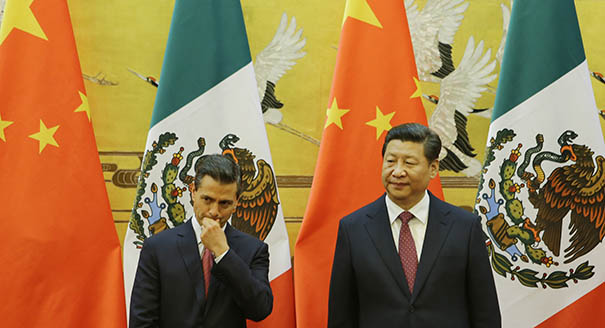
Mexico City’s cancellation of a rail contract with Beijing underscores why Chinese government and commercial actors must demonstrate a sophisticated grasp of Mexican political and regulatory realities.
Source: World Politics Review
Mexico’s recent decision to cancel a high-speed rail contract with the China Railway Construction Company (CRCC) is the latest example of the unsettled relationship between two of the largest emerging economies. In an email interview, Matt Ferchen, associate professor at Tsinghua University in Beijing and resident scholar at the Carnegie-Tsinghua Center for Global Policy, discussed China’s economic ties with Mexico.
The takeoff in China-Latin America commercial and diplomatic relations began just about a decade ago in response to booming Chinese demand for the region’s commodities. Chilean copper, Brazilian iron ore, Argentine soybeans and Venezuelan oil were all flowing to China to feed Chinese industry and consumers.
However, these were all resource-rich South American countries, and Mexico was the one major Latin American country that was conspicuously left out of the excitement. This is because even before China’s accession to the WTO, the Mexican and Chinese economies had become direct competitors, including for production and export to the U.S. Until recently, Mexico was losing that competition, as seen in Mexico’s massive trade deficits with China. However, in the last couple of years these imbalances have begun to change, due in part to rising labor costs in China and increased Mexican competitiveness. At the same time, under Presidents Enrique Pena Nieto in Mexico and Xi Jinping in China, both countries have made a concerted effort to deepen Chinese investment in Mexico, including in the reformed energy sector.In the near term, TPP is probably less important for China-Mexico economic ties than the outcome of Mexico’s ongoing economic reforms and Mexico’s role in the Pacific Alliance. In a sense, all of these reflect a Mexican commitment to further domestic and regional economic liberalization and integration, processes that have been underway since the 1980s. For China, interest in increased investment in Mexican manufacturing, in the automobile sector for instance, is on the rise. But the primary source of excitement and interest is in the Mexican energy sector, where Chinese financial and energy firms hope to be a major player.
Regionally, Mexico’s role in the liberal Pacific Alliance—along with Chile, Peru, Colombia and soon Costa Rica—symbolizes how for China, Latin America’s Pacific coast is the most dynamic and open regional grouping in terms of trade and investment. For China-Mexico ties, Mexico’s role in that bloc would mostly be an extension of these trends toward greater domestic and regional openness and integration.
From the point of view of Mexico’s diplomatic ties to China, the cancellation of the train contract amounts to a major faux pas and a blow to the positive momentum of China-Mexico ties built during the last couple of years. The Chinese firms and government ministries involved in the deal have been clear to declare that they did nothing wrong in the bidding process.
However, whatever the final story of why exactly the contract was canceled, there are two important lessons for China. First, Chinese firms, especially those that are state-owned, must work extra hard to guarantee that the legal and public relations aspects of such high-profile contracts both adhere to local laws and are seen to do so. Second, and more difficult, Chinese foreign policy in Latin America and elsewhere in the developing world is keen to emphasize the win-win benefits of infrastructure investment and cooperation. Yet in this case, as in other much more unstable parts of the world, domestic concerns about good governance will require China to have a much more sophisticated understanding of local politics.
This interview was originally published by World Politics Review.

Former Nonresident Scholar, Carnegie-Tsinghua Center for Global Policy
Ferchen specializes in China’s political-economic relations with emerging economies. At the Carnegie–Tsinghua Center for Global Policy, he ran a program on China’s economic and political relations with the developing world, including Latin America.
Recent Work
Matt Ferchen
Matt Ferchen, Anarkalee Perera
Carnegie India does not take institutional positions on public policy issues; the views represented herein are those of the author(s) and do not necessarily reflect the views of Carnegie, its staff, or its trustees.

After the chill in ties between 2020 and 2024 that brought India–China relations to their lowest point in several decades, the two countries have engaged each other afresh. This paper argues that there are predominantly four imperatives guiding India’s approach to China, and they exist in an order of priority.

Saheb Singh Chadha

This piece argues that India’s central challenge is not managing a single flashpoint but resolving the underlying tension between expansion and institutional coherency of the BRICS grouping.

Vrinda Sahai

A partnership between India, a country of subcontinental size, and Africa, a continent of fifty-four countries, may seem asymmetric until one notes that both are home to nearly the same number of people—1.4 billion. This essay spells out the existing challenges to the partnership, its optimal potential, and the possible pathways to realize it over the next quarter-century.

Rajiv Bhatia

The India–EU Free Trade Agreement (FTA) is shaping up to be one of the most consequential trade negotiations, both economically and strategically. But, what’s in the agreement, what’s missing, and what will determine its success in the years ahead
Vrinda Sahai, Nicolas Köhler-Suzuki

On March 10, 2026, India’s Union Cabinet approved amendments to Press Note 3, a regulation that mandated government approval on all foreign direct investment (FDI) from countries sharing a land border with India. This amendment raises questions primarily about whether its stated benefits will materialize and if the risks have been adequately weighed. This piece will address the same.

Konark Bhandari