

Article
C. Raja Mohan, Darshana M. Baruah
{
  "authors": [
    "C. Raja Mohan"
  ],
  "type": "legacyinthemedia",
  "centerAffiliationAll": "dc",
  "centers": [
    "Carnegie Endowment for International Peace",
    "Carnegie India"
  ],
  "collections": [],
  "englishNewsletterAll": "ctw",
  "nonEnglishNewsletterAll": "",
  "primaryCenter": "Carnegie India",
  "programAffiliation": "SAP",
  "programs": [
    "South Asia"
  ],
  "projects": [],
  "regions": [
    "North America",
    "United States",
    "South Asia",
    "India"
  ],
  "topics": [
    "Foreign Policy"
  ]
}
Source: Getty
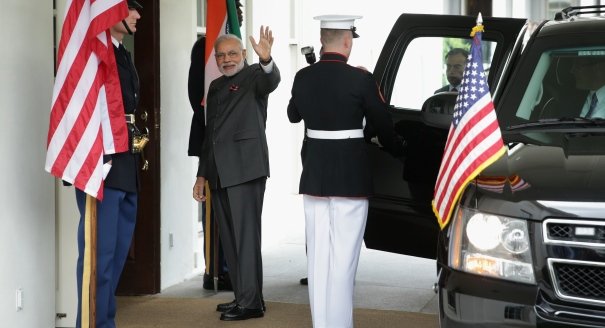
Modi’s decision to invite Obama to India, and the American president’s acceptance, reveal the mutual understanding level between two leaders.
Source: Indian Express
The presence of US President Barack Obama at the Republic Day celebrations next year is likely to mark the long-awaited moment of transformation in India’s relations with America and an extraordinary shift in Delhi’s world view.
Prime Minister Narendra Modi’s decision to invite Obama, and the American president’s acceptance reveal the scale and scope of the mutual understanding that appears to have emerged out of the meeting between the two leaders in September.
Over the next two months, Delhi and Washington will have the opportunity to clinch a broad set of ambitious agreements — ranging from defence and counter-terrorism at one end to economic agreements at the other — that will lay the foundation for a genuine strategic partnership between India and the United States.That this is the first time Delhi has invited an American president to join the Republic Day celebrations highlights enduring Indian ambivalence towards the United States.
The reluctance of the world’s largest democracy to share the most important day in its national life with the world’s most powerful democracy underlined how estranged the two republics had become over the decades. It was indeed commonplace to suggest that anti-Americanism was deeply embedded within the DNA of the Indian political and bureaucratic classes.
This jinx has now been broken by an Indian Prime Minister who has had the greatest reason to turn his back on America; for Washington had denied him entry into the United States for more than a decade.
Unlike many in Delhi, who were advising the PM to ignore America, Modi has understood the centrality of the United States in accelerating India’s economic growth and elevating its position in the international system.
Whatever might have been his personal grievance, Modi said, it has no bearing on on his government’s pursuit of India’s national interests with the United States.
Atal Bihari Vajpayee, India’s first prime minister from the BJP, saw far enough to declare in 1998 that India and America were ‘natural allies’ despite the then prevailing tensions over the nuclear issue. Modi now appears determined to translate Vajpayee’s sentiment into a durable partnership.
Obama, too, moved quickly to seize the moment when Modi won the elections in May. Recognizing the mistakes made on the visa issue, Obama chose to call Modi even before he was sworn in as the PM and invite him to Washington.
When he shows up in Delhi in January, Obama will be the only American president to visit India twice. Obama had visited India in November 2010.
Contrary to the widespread perception that Obama’s warm reception to Modi at the White House was just a photo op, the two leaders appeared to have decided to resolve all outstanding issues — from trade and climate change to nuclear liability and nonproliferation — and clear the path for new and consequential initiatives.
The recent deal on WTO that came out of the intense negotiations that followed Modi’s visit to the White House suggests that the two leaders had personally driven their bureaucracies to bring the dispute on trade facilitation to an end.
That the news of the invitation to Obama came first from Modi’s personal twitter handle and not from either the Prime Minister’s Office or the Ministry of External Affairs, reveals the extraordinary personal attention that PM has devoted to the relationship with America.
The latest development takes us back to 2005-06, when Bush offered a rare opportunity to Prime Minister Manmohan Singh to transform the partnership between the two countries. But self-doubt in the Congress leadership and opportunistic opposition from the BJP saw India squander that rare moment.
With stronger authority over his own party and government and a clear vision of India’s international goals, Modi is all set to pick up the ball that was dropped by the UPA government a decade ago.
Although many in Delhi say Obama is a lame-duck president, Modi knows that the American President has considerable freedom to conduct foreign policy until the very last day in office and has immense executive power to effect change the relations with India.
Strong Republican support for India in the US Congress, the new tensions in America’s ties with China and Russia, and the unfolding geopolitical flux in Middle East and Asia, make it possible for Modi and Obama to boldly reimagine the bilateral partnership.
This article was originally published in the Indian Express.
Former Nonresident Senior Fellow, Carnegie India
A leading analyst of India’s foreign policy, Mohan is also an expert on South Asian security, great-power relations in Asia, and arms control.
Recent Work

C. Raja Mohan, Darshana M. Baruah


Alexander Gabuev, Paul Haenle, C. Raja Mohan, …
Carnegie India does not take institutional positions on public policy issues; the views represented herein are those of the author(s) and do not necessarily reflect the views of Carnegie, its staff, or its trustees.

This piece argues that the present Indian strategy, based on opportunistic diversification and utilization of limited strategic reserves, remains inadequate when confronting supply disruptions. It evaluates India’s options in the short, medium, and long terms.

Vrinda Sahai
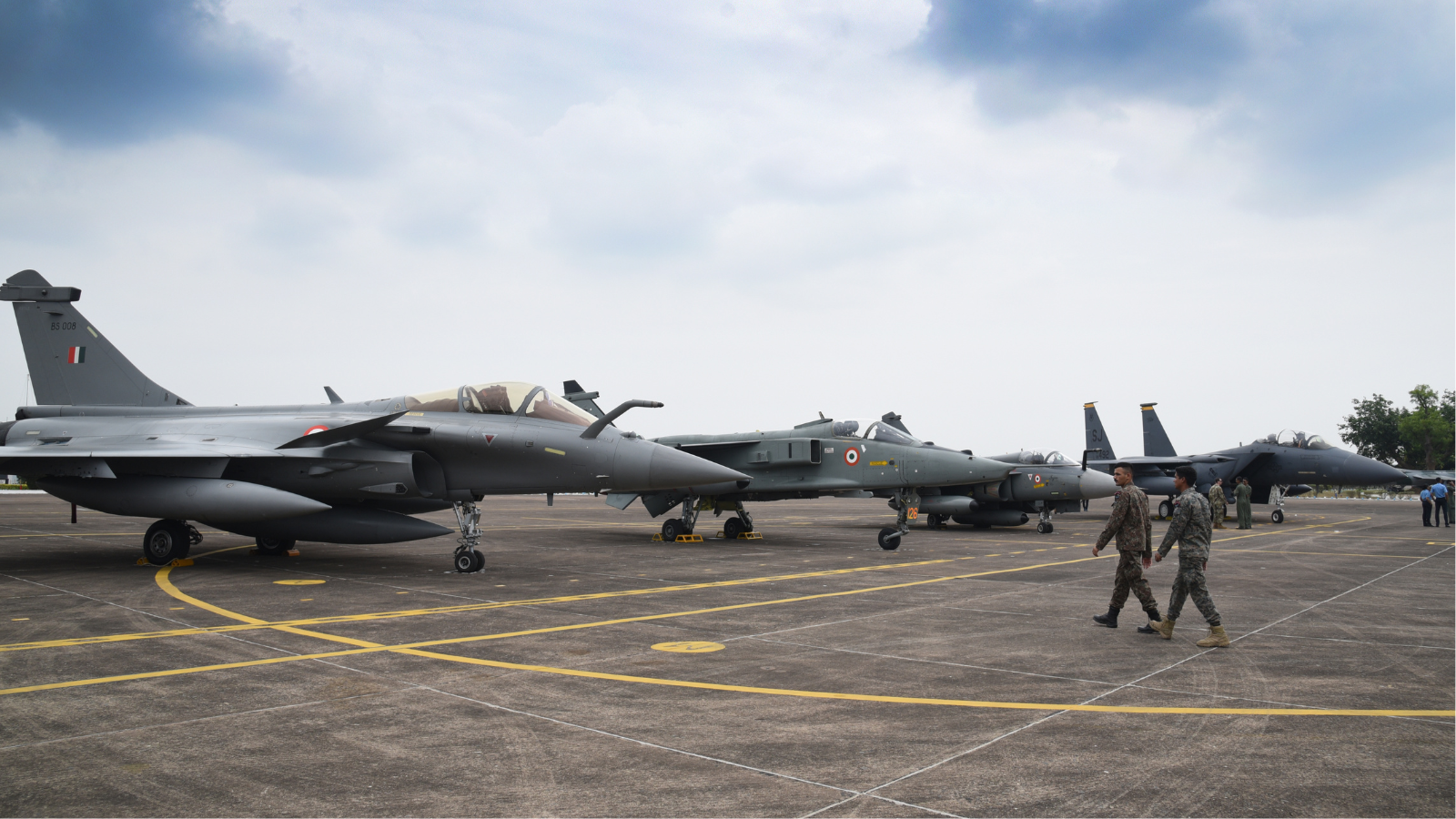
India and the United States are close to concluding a Reciprocal Defense Procurement Agreement (RDPA) that will allow firms from the two countries to sell to each other’s defense establishments more easily. While this may not remedy the specific grievances both sides may have regarding larger bilateral issues, an RDPA could restore some momentum, following the trade deal announcement.

Konark Bhandari
On the last day of the India AI Impact Summit, India signed Pax Silica, a U.S.-led declaration seemingly focused on semiconductors. While India’s accession to the same was not entirely unforeseen, becoming a signatory nation this quickly was not on the cards either.
Konark Bhandari

On January 12, 2026, India's "workhorse," the Polar Satellite Launch Vehicle, experienced a consecutive mission failure for the first time in its history. This commentary explores the implications of this incident on India’s space sector and how India can effectively address issues stemming from the incident.

Tejas Bharadwaj
Connecting real-world AI use cases across sectors such as health, education, agriculture, and livelihoods can help policymakers, innovators, and institutions align around a shared goal. This article looks at a framework ensuring that AI works for everyone.
Shalini Kapoor, Tanvi Lall