

Commentary
Thomas de Waal
{
  "authors": [
    "Thomas de Waal"
  ],
  "type": "commentary",
  "centerAffiliationAll": "",
  "centers": [
    "Carnegie Endowment for International Peace",
    "Carnegie Europe",
    "Carnegie Russia Eurasia Center"
  ],
  "collections": [],
  "englishNewsletterAll": "",
  "nonEnglishNewsletterAll": "",
  "primaryCenter": "Carnegie Europe",
  "programAffiliation": "",
  "programs": [],
  "projects": [],
  "regions": [
    "Caucasus",
    "Russia",
    "Armenia"
  ],
  "topics": [
    "Foreign Policy"
  ]
}
Source: Getty
The political fallout of the horrible murders in Gyumri will not result in a strategic re-orientation by Armenia away from Russia. However, it will undermine public support for Armenian President Serzh Sargsyan and his government.
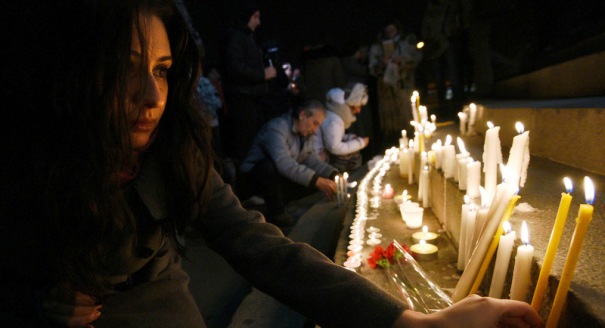
For two weeks, Armenians have had time for only one issue: the horrible murder of a whole family in the town of Gyumri and outrage at the way politicians have dealt with it.
At first it was just a tragic murder. On January 12, a soldier broke out of Russia’s 102 military base in Armenia’s second city of Gyumri and, for reasons that are still unexplained, made his way to a family house in the middle of the city. He broke in and shot and killed six members of the Avetisian family, including a two-year-old girl. Then he fled on foot and was detained several hours later near the Armenian-Turkish border.
By then, the alleged murderer, a 19-year-old named Valery Permyakov, was in custody at the Russian military base and the subject of a growing political row.
The public reacted much more quickly to the tragedy than did either Armenian or Russian politicians. On the day of the family funeral, angry crowds demonstrated outside the Russian consulate in Gyumri demanding that the soldier be handed over to the Armenian authorities. At least 14 people were injured as the police beat back the demonstrators.
The protesters voiced anger not just with the Russians but with their own leaders. On the fourth day after the murders, a veterans’ group criticized both President Serzh Sargsyan and the leader of the Armenian Apostolic Church Karekin II for not speaking in public about the killings.
We can presume that there were many private Armenian-Russian official conversations about what should be done with the alleged killer. Even though the crime had been committed against Armenian victims on Armenian soil, Russian officials displayed an amazing stubbornness in insisting that he should be tried under Russian law.
In the first few days after the killings, the Russian media barely mentioned them. When Russian presidential spokesman Dmitry Peskov eventually spoke on the issue, he said that the trial would be held in a Russian military court. When Russian Foreign Minister Sergey Lavrov was asked about the killings at a press conference on January 21, he condemned them in the strongest terms but also stirred up resentment by talking about a “provocation” by “those willing to use this tragedy to obtain some geopolitical advantages,” implying that the demonstrators were working to a Western agenda.
Russia is Armenia’s economic and political patron and sole provider of foreign security. On January 1, Armenia entered the Russian-led Eurasian Union. The Gyumri base, home to 4,000 soldiers and their families, is also the mainstay of the local economy. In 2010 its lease was extended until 2044.
But that does not mean the relationship is an easy one. Periodically Armenian resentment at Moscow’s perceived high-handedness and colonial mentality boils over. That was the case in 1988, the year of Armenia’s anti-Soviet revolt, when Soviet troops opened fire on Armenian nationalist demonstrators at Zvartnots airport.
On the Armenian side, the Russian alliance is in large part a forced marriage which Armenia has entered in order to maintain military parity in the Karabakh conflict with Azerbaijan.
Currently none of the political elite questions it. The three political parties associated with the current president and his two predecessors—the Republican Party, Prosperous Armenia and the Armenian National Congress—all swear loyalty to Moscow. The relationship deepened last year with the appointment of a new prime minister in the oligarch mold, Hovik Abrahamian. In October a prominent American-Armenian columnist wrote that the close relationship with Russia was founded on “existential strategic and economic realities” and that it was pointless to criticize Armenia’s joining of the Eurasian Union.
The protests show that the Armenian public has a much broader spectrum of views than do their political leaders. The political fallout of the horrible Gyumri massacre will not result in a strategic orientation away from Russia. But it will further hollow out public support for President Sargsyan and his government.

Senior Fellow, Carnegie Europe
Thomas de Waal is a senior fellow at Carnegie Europe, specializing in Eastern Europe and the Caucasus.
Recent Work
Thomas de Waal
Thomas de Waal
Carnegie India does not take institutional positions on public policy issues; the views represented herein are those of the author(s) and do not necessarily reflect the views of Carnegie, its staff, or its trustees.

After the chill in ties between 2020 and 2024 that brought India–China relations to their lowest point in several decades, the two countries have engaged each other afresh. This paper argues that there are predominantly four imperatives guiding India’s approach to China, and they exist in an order of priority.

Saheb Singh Chadha

This piece argues that India’s central challenge is not managing a single flashpoint but resolving the underlying tension between expansion and institutional coherency of the BRICS grouping.

Vrinda Sahai

A partnership between India, a country of subcontinental size, and Africa, a continent of fifty-four countries, may seem asymmetric until one notes that both are home to nearly the same number of people—1.4 billion. This essay spells out the existing challenges to the partnership, its optimal potential, and the possible pathways to realize it over the next quarter-century.

Rajiv Bhatia

The India–EU Free Trade Agreement (FTA) is shaping up to be one of the most consequential trade negotiations, both economically and strategically. But, what’s in the agreement, what’s missing, and what will determine its success in the years ahead
Vrinda Sahai, Nicolas Köhler-Suzuki

Trump 2.0 has unsettled India’s external environment—but has not overturned its foreign policy strategy, which continues to rely on diversification, hedging, and calibrated partnerships across a fractured order.



Milan Vaishnav, ed., Sameer Lalwani, Tanvi Madan, …