
• Research
  • About
  • Experts
Carnegie India logoCarnegie lettermark logo
{
  "authors": [
    "Farea Al-Muslimi",
    "Laura Kasinof"
  ],
  "type": "legacyinthemedia",
  "centerAffiliationAll": "",
  "centers": [
    "Carnegie Endowment for International Peace",
    "Malcolm H. Kerr Carnegie Middle East Center"
  ],
  "collections": [],
  "englishNewsletterAll": "",
  "nonEnglishNewsletterAll": "",
  "primaryCenter": "Malcolm H. Kerr Carnegie Middle East Center",
  "programAffiliation": "",
  "programs": [],
  "projects": [],
  "regions": [
    "Gulf",
    "Yemen",
    "Middle East"
  ],
  "topics": [
    "Political Reform",
    "Security"
  ]
}

Source: Getty

In The Media
Malcolm H. Kerr Carnegie Middle East Center

Attack by Yemen Insurgents Undermining the President Heralds Insecurity

The violence in Sanaa has pushed the Yemeni government to the brink, and what is happening inside will almost certainly reverberate across the globe.

Link Copied
By Farea Al-Muslimi and Laura Kasinof
Published on Jan 22, 2015

Source: CBC Radio The Current

This week, rebel fighters of Yemen—the Houthis—attacked the president's residence. It seems President Abed Rabbu Mansour Hadi barely had much power anyway. Yemen is a patchwork quilt of militias from Al Qaeda to the Houthis, whose support comes from Iran. All of which sets the stage for a confrontation that will make Western leaders sit up and notice ... nervously.

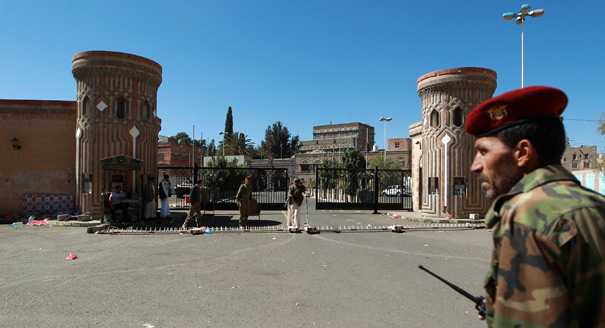
The violence in Sanaa, the capital of Yemen, has pushed the government to the brink, and what's happening inside the small country on the southern tip of the Arabian peninsula, will almost certainly reverberate across the globe.

Its neighbor, Saudi Arabia, is wary of Houthi rebels with Iranian backing gaining the upper hand.

And as for the rest of the world, there was a vivid reminder in Paris this month that Yemen remains home to one of the most vicious terror cells on the globe—Al Qaeda in the Arabian Peninsula—or AQAP—having claimed responsibility for the deadly attack on Charlie Hebdo.

Farea al-Muslimi is a visiting scholar at the Carnegie Middle East Center and an expert on Yemen and Gulf state politics. He was in Sanaa, Yemen.

Politics in Yemen can be complicated and fluid at the best of times. And it's not a country with a strong international media presence. That all adds up to make the country a rather opaque place to the rest of the world.

Laura Kasinof is a freelance journalist who has lived in and reported extensively from Yemen. She is also the author of "Don't Be Afraid of the Bullets: An Accidental War Correspondent in Yemen." Laura Kasinof was in Washington, DC.

This segment was produced by CBC Radio The Current's Howard Goldenthal and Naheed Mustafa.

About the Authors

Farea Al-Muslimi

Research fellow at Chatham House’s Middle East and North Africa Programme

Farea Al-Muslimi is a research fellow at Chatham House’s Middle East and North Africa Programme.

Laura Kasinof

Authors

Farea Al-Muslimi
Research fellow at Chatham House’s Middle East and North Africa Programme
Farea Al-Muslimi
Laura Kasinof
Political ReformSecurityGulfYemenMiddle East

Carnegie India does not take institutional positions on public policy issues; the views represented herein are those of the author(s) and do not necessarily reflect the views of Carnegie, its staff, or its trustees.

More Work from Carnegie India

  • Commentary
    The Impact of U.S. Sanctions and Tariffs on India’s Russian Oil Imports

    This piece examines India’s response to U.S. sanctions and tariffs, specifically assessing the immediate market consequences, such as alterations in import costs, and the broader strategic implications for India’s energy security and foreign policy orientation.

      Vrinda Sahai

  • Article
    Military Lessons from Operation Sindoor

    The India-Pakistan conflict that played out between May 6 and May 10, 2025, offers several military lessons. This article presents key takeaways from Operation Sindoor and breaks down how India’s preparations shaped the outcome and what more is needed to strengthen future readiness.

      Dinakar Peri

  • Book
    India and the Sovereignty Principle: The Disaggregation Imperative

    This book offers a comprehensive analysis of India's evolving relationship with sovereignty in a complex global order. Moving beyond conventional narratives, it examines how the sovereignty principle shapes India's behavior across four critical domains—from traditional military power to contemporary data governance.

      Rudra Chaudhuri, Nabarun Roy

  • Article
    Hidden Tides: IUU Fishing and Regional Security Dynamics for India

    This article examines the scale and impact of Chinese IUU fishing operations globally and identifies the nature of the challenge posed by IUU fishing in the Indian Ocean Region (IOR). It also investigates why existing maritime law and international frameworks have struggled to address this growing threat.

      Ajay Kumar, Charukeshi Bhatt

  • Book
    Violence and Development Along the India-Pakistan Border in Jammu and Kashmir

    This book examines the impact of cross-border violence on communities living along the Line of Control and the International Border in Jammu and Kashmir, India.

      Deep Pal, Surya Valliappan Krishna, Saheb Singh Chadha

Get more news and analysis from
Carnegie India
Carnegie India logo, white
Unit C-4, 5, 6, EdenparkShaheed Jeet Singh MargNew Delhi – 110016, IndiaPhone: 011-40078687
  • Research
  • About
  • Experts
  • Projects
  • Events
  • Contact
  • Careers
  • Privacy
  • For Media
Get more news and analysis from
Carnegie India
© 2026 Carnegie Endowment for International Peace. All rights reserved.