

Commentary
Dmitri Trenin
{
  "authors": [
    "Dmitri Trenin"
  ],
  "type": "legacyinthemedia",
  "centerAffiliationAll": "",
  "centers": [
    "Carnegie Endowment for International Peace",
    "Carnegie Russia Eurasia Center"
  ],
  "collections": [],
  "englishNewsletterAll": "",
  "nonEnglishNewsletterAll": "",
  "primaryCenter": "Carnegie Russia Eurasia Center",
  "programAffiliation": "",
  "programs": [],
  "projects": [],
  "regions": [
    "North America",
    "South America",
    "South Asia",
    "India",
    "East Asia",
    "China",
    "Russia"
  ],
  "topics": [
    "Foreign Policy",
    "Global Governance"
  ]
}
Source: Getty
By hosting the seventh summit of the BRICS group, Vladimir Putin will demonstrate to the Russian people and the world that his country is anything but isolated.
Source: Global Times
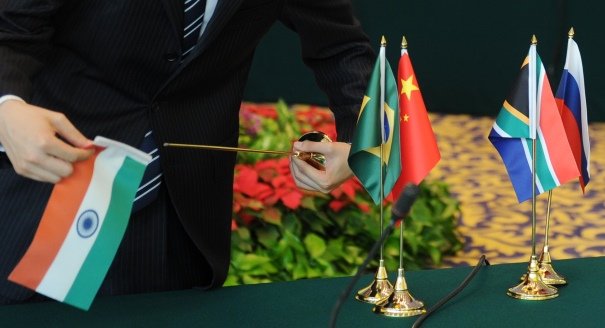
Next July, Russia will be hosting the seventh summit of the BRICS group, which includes Brazil, Russia, India, China and South Africa. Back in 2009, Russia hosted the group's first summit, in Yekaterinburg in the Urals. This time, President Vladimir Putin has chosen Ufa, the capital of Bashkortostan, a short distance west of the Urals.
The political distance Russia has traveled in the last six years, and particularly in 2014, is much greater. As a result, Moscow is likely to pay more attention to BRICS than before. During the Russian presidency, BRICS will take another step toward pushing for reforms in global governance and enhancing the member states' impact on global issues.
By hosting the leaders of the leading non-Western nations, Putin will demonstrate to the Russian people and the world that his country is anything but isolated. BRICS, after all, brings together countries whose combined population is 3 billion, 40 percent of the world's total. They also account for a quarter of the global GDP and nearly a fifth of international trade.At the UN General Assembly vote last spring, none of the BRICS countries condemned Russian actions in Crimea, or joined the anti-Russian sanctions coalition. They successfully resisted Western attempts to bar Russia from participating in the recent G20 summit in Brisbane, Australia.
All these richly confirm Moscow's argument that its problems are primarily with the US and its allies, while much of the world remains friendly to Russia and increases cooperation with it.
After the Western countries abandoned the G8 formula last year, which included Russia, and reverted to the old G7, Moscow has dropped the notion of being a "bridge" between the West and the non-West, and has begun to identify itself more with the latter.
In the informal hierarchy of international institutions developed by the Russian Foreign Ministry, BRICS takes third position, after the UN and G20. The issues it used to push for within G8 are now exported to other forums, among them BRICS. This includes, among other things, international security and countering drugs-trafficking.
Russia sees BRICS's mission as "an alliance of reformers" set to rebuild the international financial institutions, such as the IMF, as well as to raise the level of economic interaction among the group's members and to promote modernization. In the context of Western sanctions against Russia, this becomes even more relevant.
Even as Russia's economic ties with Europe and other Western countries have weakened, it has signed important energy and infrastructure deals with China, and allowed Brazilian meat to its domestic market. By agreeing to do some transactions in the national currencies, Russia and its partners are also reducing demand for dollars: important, given the halving of the oil price and the commensurate devaluation of the ruble.
Russia, however, is well aware of the fact that it is China which is the economic and financial powerhouse of BRICS. Moscow's specialty is more political and security issues. Russia can be expected to work toward more policy coordination among BRICS countries, at the UN level and beyond.
In close tandem with Beijing, Moscow has long been seeking to raise the primary role of the UN Security Council, to which both China and Russia belong, as the sole legitimizing organ within the global system.
Russia and China have been coordinating their policies on some of the most important international issues, such as the Syrian conflict, the Iranian nuclear program and the nuclear conundrum on the Korean Peninsula.
In 2011, all BRICS countries took the same stance on the Libyan conflict. A "virtual secretariat" of BRICS which will probably be established in Ufa will take this coordination one step further.
This year, Ufa will host not one, but two summits back-to-back. Next to BRICS, Putin will be chairing the annual meeting of the Shanghai Cooperation Organization (SCO) there. That other meeting will likely see a major enlargement of the organization, which will soon include India and Pakistan.
With Delhi's membership, there will be even more of an overlap between BRICS and the SCO. As a result, global competition in all fields, finance and economics, security and values, will get stronger, and the diversity of the world become more visible and palpable.
Former Director, Carnegie Moscow Center
Trenin was director of the Carnegie Moscow Center from 2008 to early 2022.
Recent Work
Dmitri Trenin
Dmitri Trenin
Carnegie India does not take institutional positions on public policy issues; the views represented herein are those of the author(s) and do not necessarily reflect the views of Carnegie, its staff, or its trustees.

In any defense establishment, change is an ongoing process. However, despite the best of intentions, existing bureaucracies, bound by habit and years of socialization, have their limits in implementing transformative change.

Anit Mukherjee

As AI grows more sophisticated, as the supply chains that power it become more contested, and as access to frontier models becomes geopolitically charged, India must begin to ask a different set of questions. Not what applications it can build on someone else’s infrastructure but what the world needs.

Konark Bhandari

The Indian Ocean Region hosts one of the densest concentrations of subsea cables in the world. Yet, despite accounting for a significant share of global internet traffic, India’s participation remains limited.

Charukeshi Bhatt

How is AI reshaping space security, creating governance challenges, and where does international diplomacy stand today?


Tejas Bharadwaj, Almudena Azcárate Ortega

After the chill in ties between 2020 and 2024 that brought India–China relations to their lowest point in several decades, the two countries have engaged each other afresh. This paper argues that there are predominantly four imperatives guiding India’s approach to China, and they exist in an order of priority.

Saheb Singh Chadha