

Commentary
Alexey Malashenko
{
  "authors": [
    "Alexey Malashenko"
  ],
  "type": "commentary",
  "centerAffiliationAll": "",
  "centers": [
    "Carnegie Endowment for International Peace",
    "Carnegie Russia Eurasia Center"
  ],
  "collections": [],
  "englishNewsletterAll": "",
  "nonEnglishNewsletterAll": "",
  "primaryCenter": "Carnegie Russia Eurasia Center",
  "programAffiliation": "",
  "programs": [],
  "projects": [
    "Eurasia in Transition"
  ],
  "regions": [
    "Central Asia",
    "Kazakhstan",
    "Russia",
    "Eastern Europe",
    "Ukraine"
  ],
  "topics": [
    "Foreign Policy"
  ]
}
Source: Getty
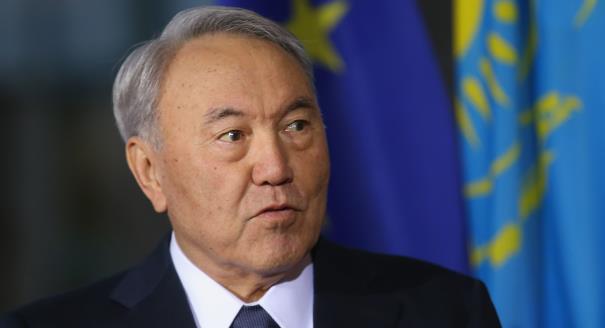
Kazakh President Nursultan Nazarbayev has managed to use the Ukraine crisis as a sort of stepping stone to elevate his international profile and Kazakhstan’s geopolitical status.
The Ukraine crisis has created a host of problems for a number of countries, but one state has managed to use it as a sort of stepping stone to elevate its geopolitical status and its leader’s international profile. I am talking about Kazakhstan and its president, Nursultan Nazarbayev.
Playing the role of an independent intermediary yields substantial dividends for Nazarbayev. First, it insures him against excessively sharp political moves on Russia’s part, which were plentiful in 2014. For its part, Russia will have to reckon with Nazarbayev’s views, which will remain independent and objective in relation to the opposing sides of the conflict. In other words, Kazakhstan’s behavior confirms its commitment to a multi-vector foreign policy.
Second, Nazarbayev’s freestanding position indicates to Russia’s Western opponents that Astana should not be identified with Moscow’s policies, and thus there is no point to pressuring Kazakhstan in any way. At the same time, the Kazakh president is emphasizing that the sanctions against Russia do not work, adding that that there is nothing good about them because “Russia is our [Kazakhstan’s] partner.”
Third, Nazarbayev demonstrates that no matter how the Ukraine crisis develops, Kazakhstan’s relations with the European Union will remain normal. In fact, the EU leaders, particularly the Western members of the “Normandy Four,” hope that Nazarbayev can be the figure who manages to help the parties achieve at least some progress in the implementation of the Minsk agreements.
Apart from mediating between Russia and Ukraine, Nazarbayev’s mission has another, less publicized aspect: the Kazakh leader serves as a bridge between Russia and the European Union, seeking to improve understanding between the sides.
It is commonly believed that both Russia and Ukraine have a positive and even hopeful outlook on Nazarbayev’s mediation. But things are actually not that clear. True, Ukraine is rather well-disposed toward Nazarbayev’s initiatives. Kiev generally interprets any drift away from Russia’s position as a pro-Ukrainian move. But Moscow sees any mediation in a conflict between Russia and another state in the post-Soviet space as testifying to the Kremlin’s weakness and inability to solve foreign policy problems without outside help. Putin only reluctantly accepts Nazarbayev’s mediation, which in a sense humiliates him, since it undermines Russian ambitions.
There is an important personal aspect. Nursultan Nazarbayev has been in power since 1991 and is one of the most experienced and successful post-Soviet heads of states. He is also respected on the international stage. At 74, he enjoys playing the part of a senior statesman.
We have no way of knowing whether Nazarbayev will be able to help resolve the Ukraine crisis. He is likely to stay on as a mediator even if negotiations stall, since neither party will benefit from an end to his involvement. As for the Eurasian patriarch himself, the end result does not seem to be all that critical. It is far more important for him to remain the authoritative and sought-after wise man which the Ukraine crisis has helped him to become.
Former Scholar in Residence, Religion, Society, and Security Program
Malashenko is a former chair of the Carnegie Moscow Center’s Religion, Society, and Security Program.
Recent Work
Alexey Malashenko
Alexey Malashenko
Carnegie India does not take institutional positions on public policy issues; the views represented herein are those of the author(s) and do not necessarily reflect the views of Carnegie, its staff, or its trustees.

After the chill in ties between 2020 and 2024 that brought India–China relations to their lowest point in several decades, the two countries have engaged each other afresh. This paper argues that there are predominantly four imperatives guiding India’s approach to China, and they exist in an order of priority.

Saheb Singh Chadha

This piece argues that India’s central challenge is not managing a single flashpoint but resolving the underlying tension between expansion and institutional coherency of the BRICS grouping.

Vrinda Sahai

A partnership between India, a country of subcontinental size, and Africa, a continent of fifty-four countries, may seem asymmetric until one notes that both are home to nearly the same number of people—1.4 billion. This essay spells out the existing challenges to the partnership, its optimal potential, and the possible pathways to realize it over the next quarter-century.

Rajiv Bhatia

The India–EU Free Trade Agreement (FTA) is shaping up to be one of the most consequential trade negotiations, both economically and strategically. But, what’s in the agreement, what’s missing, and what will determine its success in the years ahead
Vrinda Sahai, Nicolas Köhler-Suzuki
Trump 2.0 has unsettled India’s external environment—but has not overturned its foreign policy strategy, which continues to rely on diversification, hedging, and calibrated partnerships across a fractured order.



Milan Vaishnav, ed., Sameer Lalwani, Tanvi Madan, …