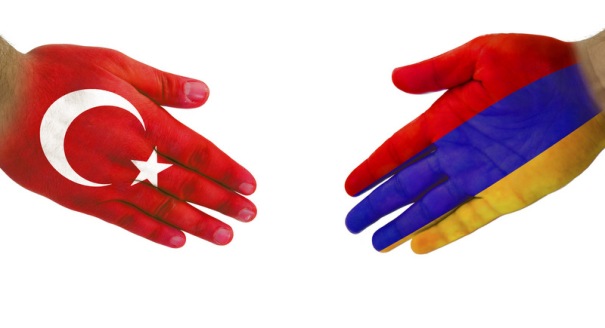
Recently the normalization of Turkish-Armenian relations has often and increasingly drawn the attention of both Turkish and world media. Turkish politicians have also not been shirking from speaking about this topic publicly. The recent press conference of Turkish prime minister and current leader of the ruling Justice and Development Party (AKP) Ahmet Davutoğlu in London only proved this tendency. Davutoğlu predicted that Turkish-Armenian relations would normalize in 2015: “Turkey and Armenia must make an effort to build a new world for peace.” The Turkish politician also declared that Turkey shares the sufferings of the Armenians and sincerely strives to heal wounds by restoring friendly relations with Armenia: “Only by breaking taboos can we hope to begin addressing the great trauma that froze time in 1915. For its part, Turkey has transcended this critical threshold and relinquished the generalizations and stereotypical assertions of the past.”
Prime Minister Davutoğlu’s statement is hardly unexpected, as some media hurried to portray it. Even in December 2012 Davutoğlu (who was then minister of foreign affairs) noted in his traditional address on foreign policy strategy to the members of the Turkish Grand National Assembly that “normalization of Turkish-Armenian relations would become a factor of stability and cooperation in the South Caucasus.” In addition, the recently advanced project of “Just memory” (Adil Hafıza İnisiyatifi) represents another proof that the AKP government is working on a new “Armenian opening.” In a spring 2014 article, Davutoğlu defined and elaborated the concept of “just memory” as a denial of unilateral approaches to history and an effort to strive to comprehend the scale of Armenian tragedy. However, according to Davutoğlu, one of the essential conditions of such an approach is mutual respect, implying Armenians must also respect the historical memory of the Turks.
The October 2014 appointment of Etyen Mahçupyan, a famous journalist of Armenian origin, as a key advisor to the Turkish prime minister also signals that a new “Armenian opening” is in preparation. An initiative to build a new Christian Church in Istanbul “for the first time in the history of the Turkish Republic” should be seen as part of this new push as well.
Within the last year the Turkish public showed a distinct expectation that a qualitative breakthrough in the relations between Ankara and Yerevan was coming. This public mood is partly based on the statements of Davuloğlu, who was one of the main players in 2009 talks aimed at political reconciliation (notable for so called football diplomacy and un-ratified Zurich protocols), and on Recep Tayyip Erdoğan’s surprising statement timed to the 99-year anniversary of the 1915 events. Erdoğan virtually became the first Turkish leader to present official condolences for the numerous victims among the Armenian population under the Ottoman Empire. Erdoğan didn’t use, and even studiously avoided, the word “Genocide,” preferring to call the massacres and forced deportations of 1915 “the events of the early 20th century.” Nonetheless, recent Turkish media reports suggest that there are currently attempts to come to an agreement that would allow for the opening of the borders between the two states before April 24—the 100-year anniversary of the 1915 Armenian Genocide.
The normalization of Turkish-Armenian relations has implications for both foreign policy and domestic politics. On January 18, Turkey commemorated the 8th anniversary of the assassination of Hrant Dink, the editor in chief of the bilingual Armenian-Turkish newspaper “Agos” who had been known for advocating Turkish-Armenian reconciliation, human rights and rights for minorities in Turkey. That almost all of Turkey’s central newspapers published large editorials about these memorials to Dink testifies to a distinct trend in Turkish public opinion. Erdoğan and Davutoğlu are both striving to make progress on the issue. Kurdish political parties also support the normalization of Turkish-Armenian relations and the recognition of the Armenian genocide (Sebahat Tuncel, a Kurdish politician and member of parliament, for instance, submitted a proposal seeking condemnation of the Armenian Genocide in the Ottoman Empire to the Grand National Assembly). Generally in today’s Turkey one would be hard-pressed to find manifestations of mass anti-Armenian sentiment.
Armenia’s joining the Eurasian Economic Union (EAEU) in January 1, 2015 may bring additional opportunities to start the normalization process between Yerevan and Ankara. The rising political tensions in the Turkey-EU relationship together with the serious economic dependence of Turkey on the European economy may prompt Turkey to develop its cooperation with the EAEU, which, by today’s estimates, has an economy with a total volume in excess of four trillion dollars. Turkey is highly unlikely to pursue economic alienation regarding Armenia as it did in 2003 when Yerevan joined the WTO and Ankara declared that it wouldn’t apply WTO norms in relation to Armenia.
Standing in the way of the new “Armenia Opening” are both the official position and the interests of Azerbaijan. The political decision of Moscow to offer broad political and economic assistance to Armenia within the framework of the EAEU will obviously force Baku to alter its policy toward Yerevan. It may also facilitate the realization of Davutoğlu’s “Armenia Opening.”
The international pressure on Turkey by the influential Armenian diaspora must also be taken into account. The forthcoming 100-year anniversary of the 1915 events will lead to an increase in the Armenian diaspora’s activities. And, in the United States, where 43 out of 50 states recognize the Armenian genocide, a new resolution on the Armenian genocide may be on the agenda, potentially creating legal grounds for numerous compensation claims against the Turkish government.
Nowadays the Turkish political elite appears preoccupied with normalizing Armenian-Turkish relations, in consideration of this process’s potential diplomatic, political, and economic risks and benefits. Furthermore, in the run up to summer 2015 parliamentary elections, when political tensions will rise and a political struggle accelerate, a diplomatic success for the AKP government and for the new AKP party leader Davutoğlu will obviously help to distract people’s attention from a tendency toward economic crisis (for which the AKP government has been criticized in recent years) and make people associate the party with a positive agenda once again.
However, current activities around the “Armenian question” cannot help but bring a feeling of déjà vu, recalling the situation in 2005, when, on the eve of the 90-year anniversary of the events of 1915, the Turkish government also made great efforts to mend relations with Armenia. At that time the culmination of these efforts became a declaration of the Turkish Grand National Assembly. In this document the tragic events of 1915 were described and analyzed quite objectively (this was a real breakthrough in the Turkish perception of the Armenian genocide), but the word “genocide” was not used. This word proved to be a red line for Turkey, a distinct limit of Turkey’s flexibility. These steps failed to reach even the most minimal demands from the Armenian perspective. Thus all these initiatives failed to create solid ground for real compromise between the two states. And the current situation surrounding dueling invitations—Armenian President Serzh Sargsyan invited his Turkish colleague for the commemoration of the Armenian genocide on April 24, while Erdoğan plans a celebration of the Turkish victory in the Dardanelles Operation on the same date—doesn’t inspire confidence that the situation today can bear the fruit of a sound and mutually acceptable compromise.
Pavel Shlykov is a senior research fellow at the Institute of Asian and African Studies, Moscow State University.