

In The Media
Lina Khatib
{
  "authors": [
    "Lina Khatib"
  ],
  "type": "legacyinthemedia",
  "centerAffiliationAll": "dc",
  "centers": [
    "Carnegie Endowment for International Peace",
    "Malcolm H. Kerr Carnegie Middle East Center"
  ],
  "collections": [],
  "englishNewsletterAll": "menaTransitions",
  "nonEnglishNewsletterAll": "",
  "primaryCenter": "Malcolm H. Kerr Carnegie Middle East Center",
  "programAffiliation": "MEP",
  "programs": [
    "Middle East"
  ],
  "projects": [],
  "regions": [
    "Gulf",
    "Saudi Arabia",
    "Middle East"
  ],
  "topics": [
    "Political Reform",
    "Democracy"
  ]
}
Source: Getty
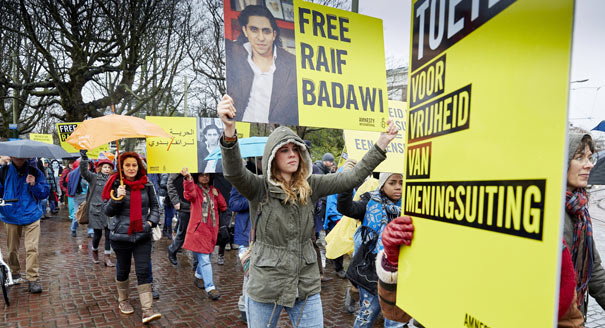
The public flogging of Raif Badawi has come at a critical time for the Kingdom, with many drawing parallels between the Islamic State’s brutality and law enforcement practices in Saudi Arabia.
Source: Independent
The public flogging of Raif Badawi has drawn attention to Saudi Arabia’s opaque judicial system, leading to questions about who has the power to revoke Badawi’s sentence.
Saudi Arabia’s courts are mainly sharia courts that issue sentences based on a strict, Wahhabi interpretation of Islamic law. In fact, the highest authority in the judiciary is the Grand Mufti, who is also the head of the Senior Council of Ulema (scholars of religious law), the highest religious authority in the country. While non-sharia courts also exist, they only apply to administrative cases like those dealing with commerce and labour issues. Badawi was charged with apostasy, among other charges such as undermining the regime, and his case was therefore strictly handled by the sharia court.
But the kingdom’s court system is far from consistent. Case law does not apply, leaving sentences up to the discretion of individual judges. In addition, political and tribal considerations play a role in determining the outcomes. Above all else, the King has the final say in all court judgments. On several occasions, people escaped sentences or had them revised as a result of royal discretion.Badawi’s flogging has come at a critical time for Saudi Arabia. Following the rise of jihadism in Syria, the kingdom is trying to reposition itself as a leader on counterradicalisation in the Middle East. Fearing internal instability, the Minister of the Interior, Mohamed bin Nayef, who used to oversee Saudi Arabia’s homegrown deradicalization programs, is trying to steer Saudi policy away from supporting jihadism as a way to topple the Syrian regime. The Grand Mufti has also denounced ISIS.
However, many have drawn parallels between ISIS’s brutality and law enforcement practices in Saudi Arabia, where public beheadings are still common.
The ministry of the interior is therefore under pressure to demonstrate a move towards moderation while not upsetting the country’s influential council of ulema. It is therefore justifiable that the sole avenue for Saudi Arabia to save itself from the Badawi case would be a royal pardon or at least a revision of his sentence on medical or other grounds. This would save face for the judiciary and ulema and present the kingdom in a more favorable light internationally at a time when its credibility in countering radicalization is critically at stake.
Former Director, Middle East Center
Khatib was director of the Carnegie Middle East Center in Beirut. Previously, she was the co-founding head of the Program on Arab Reform and Democracy at Stanford University’s Center on Democracy, Development, and the Rule of Law.
Recent Work
Lina Khatib
Lina Khatib
Carnegie India does not take institutional positions on public policy issues; the views represented herein are those of the author(s) and do not necessarily reflect the views of Carnegie, its staff, or its trustees.

An Israeli response to Iran’s October 1 attack is imminent. The key question is of its intensity and potential fallout, both within Iran, in terms of nuclear security policy changes, and across the broader region. The coming days are likely to reshape West Asia irreversibly.

Gaddam Dharmendra

Experts weigh in on whether the United States is too hostile toward China.


Stephen Wertheim, Evan S. Medeiros, Vijay Gokhale

As India’s economy recovers from the coronavirus pandemic, Indian businesses need efficient financial structures to regain their ground. Key reforms to India’s Insolvency and Bankruptcy Code could fill these gaps.

Anirudh Burman

Access to cross-border data is an integral piece of the law enforcement puzzle. India is well placed to lead the discussions on international data agreements subject to undertaking necessary surveillance reforms.

Smriti Parsheera, Prateek Jha
After the coronavirus pandemic wanes, how will China’s reorientation of the Belt and Road Initiative to address global health concerns influence its relationships with South Asian countries?
Deep Pal, Rahul Bhatia