

Commentary
Thomas de Waal
{
  "authors": [
    "Thomas de Waal"
  ],
  "type": "commentary",
  "centerAffiliationAll": "",
  "centers": [
    "Carnegie Endowment for International Peace",
    "Carnegie Europe",
    "Carnegie Russia Eurasia Center"
  ],
  "collections": [],
  "englishNewsletterAll": "",
  "nonEnglishNewsletterAll": "",
  "primaryCenter": "Carnegie Europe",
  "programAffiliation": "",
  "programs": [],
  "projects": [],
  "regions": [
    "Caucasus",
    "Azerbaijan",
    "Armenia",
    "Georgia"
  ],
  "topics": [
    "Economy",
    "Foreign Policy"
  ]
}
Source: Getty
Devaluing its currency, Azerbaijan follows its neighbors into a time of economic struggle.
On February 21, Azerbaijan became the latest post-Soviet country to be infected by the economic malaise emanating from Russia, when its Central Bank devalued the manat by around a third against the dollar and euro.
Armenia and Georgia are also facing economic struggles—and all three countries will see political consequences. As the three are now so different they will be manifested in very different ways.
In Azerbaijan the downturn is spectacular for being so sudden. For months the government declared that the country was immune to the economic problems of its neighbors. Then the Central Bank abruptly announced a currency devaluation of 33 percent against the dollar and 30 percent against the euro.
Azerbaijani President Ilham Aliyev sought to reassure the public. He said that the devaluation was a result of “regional processes,” and that the devaluation was carried out to thwart “speculators” who were buying up 500 million dollars a day.
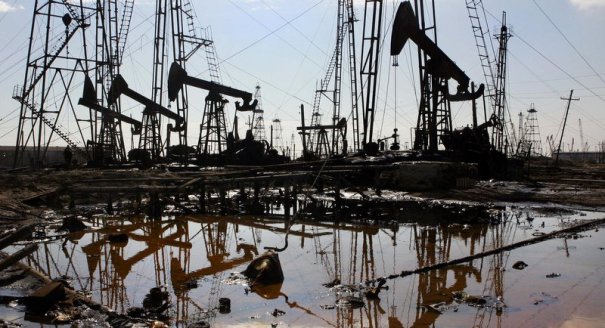
The country has a strong buffer in the form of the State Oil Fund of Azerbaijan, valued at 37 billion dollars at the end of 2014. But low oil prices are also delivering a heavy blow. Oil and gas comprise 95 per cent of export revenues and the 2015 state budget was predicated on an oil price of 90 dollars a barrel.
The damage is as much about perception as reality. For a decade, Azerbaijanis have experienced an oil boom and growing sense of prosperity. As in many European countries prior to the Eurozone crisis, many people had accumulated big bank debts and credit card bills and used them to buy property and consumer durables.
That golden age is ending. Oil exports are falling. The largest Western oil company in the country BP has cut jobs. And now the currency is devalued.
Expensive prestige projects like this summer’s European Games look more and more like hubris, especially with a new report in The Guardian that the Azerbaijani government is even spending its money on flying British athletes to Baku.
Azerbaijan is an authoritarian state and there are only sporadic reports of protests. But the public is complaining at home, if not in the streets, and we can already expect that the political elite will start to fight each other over the diminishing economic pie.
In Georgia, a country with real democratic politics, the lari has lost about 30 percent of its value against the dollar in the last four months. That makes the Georgian Dream government more politically vulnerable, set against a generally disappointing performance on the economy since it took power in 2012. But there is as yet no strong opposition force ready to challenge them.
Armenia starts with an overall weaker economy, heavily intertwined with Russia. Its currency, the dram, has also weakened over the past year, but, ironically, the fact that it has devalued less than the ruble has had negative effects on Armenia, cutting Armenian exports to Russia and forcing thousands of migrant workers resident in Russia to come home. All this, just as the Armenian government has yoked the country even more strongly to Russia by joining the Eurasian Economic Union.
A political drama has played out in Armenia over the past two weeks in which leading oligarch and leader of the country’s main alternative political party Gagik Tsarukian first challenged President Serzh Sargsyan and then capitulated. It is to be assumed that the price of Tsarukian’s capitulation was that a threatened investigation into his monopolies will be called off.
In Armenia a few powerful individuals, such as Tsarukian, dominate the economy and manipulate prices of key goods, buffering themselves against misfortune, such as a falling dram, and exposing the population to more misery. Economic analyst Garen Yegparian says, “They are... privatizing the benefits and socializing the costs of the dram’s fluctuations in value. They can do this because they also control the levers of political power, and make the rules to suit their own personal, not the country’s and broad population’s, interests.”
The Armenian leadership, in contrast to its Azerbaijani adversaries, should no longer fear a revolt of the oligarchs. But Armenian population is indignant and less intimidated. Trust in politics as a whole has reached an all-time low. We can expect angry public voices to be heard this spring.

Senior Fellow, Carnegie Europe
Thomas de Waal is a senior fellow at Carnegie Europe, specializing in Eastern Europe and the Caucasus.
Recent Work
Thomas de Waal
Thomas de Waal
Carnegie India does not take institutional positions on public policy issues; the views represented herein are those of the author(s) and do not necessarily reflect the views of Carnegie, its staff, or its trustees.

After the chill in ties between 2020 and 2024 that brought India–China relations to their lowest point in several decades, the two countries have engaged each other afresh. This paper argues that there are predominantly four imperatives guiding India’s approach to China, and they exist in an order of priority.

Saheb Singh Chadha

This piece argues that India’s central challenge is not managing a single flashpoint but resolving the underlying tension between expansion and institutional coherency of the BRICS grouping.

Vrinda Sahai

A partnership between India, a country of subcontinental size, and Africa, a continent of fifty-four countries, may seem asymmetric until one notes that both are home to nearly the same number of people—1.4 billion. This essay spells out the existing challenges to the partnership, its optimal potential, and the possible pathways to realize it over the next quarter-century.

Rajiv Bhatia

The India–EU Free Trade Agreement (FTA) is shaping up to be one of the most consequential trade negotiations, both economically and strategically. But, what’s in the agreement, what’s missing, and what will determine its success in the years ahead
Vrinda Sahai, Nicolas Köhler-Suzuki

On March 10, 2026, India’s Union Cabinet approved amendments to Press Note 3, a regulation that mandated government approval on all foreign direct investment (FDI) from countries sharing a land border with India. This amendment raises questions primarily about whether its stated benefits will materialize and if the risks have been adequately weighed. This piece will address the same.

Konark Bhandari