

Commentary
Dmitri Trenin
{
  "authors": [
    "Dmitri Trenin"
  ],
  "type": "legacyinthemedia",
  "centerAffiliationAll": "",
  "centers": [
    "Carnegie Endowment for International Peace",
    "Carnegie Russia Eurasia Center"
  ],
  "collections": [],
  "englishNewsletterAll": "",
  "nonEnglishNewsletterAll": "",
  "primaryCenter": "Carnegie Russia Eurasia Center",
  "programAffiliation": "",
  "programs": [],
  "projects": [],
  "regions": [
    "Russia",
    "Eastern Europe",
    "Ukraine",
    "Western Europe"
  ],
  "topics": [
    "Economy",
    "Security",
    "Foreign Policy"
  ]
}
Source: Getty
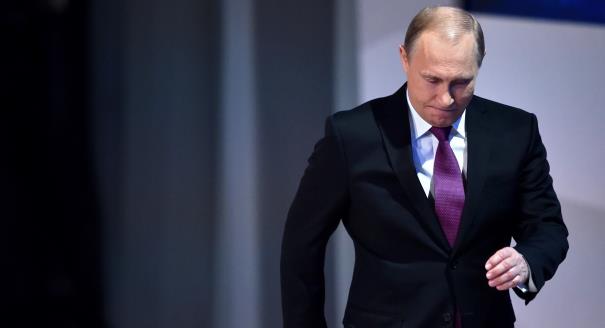
Through its actions in Ukraine, Russia wants to consolidate its new strategic perimeter without being drawn into a full-scale war.
Source: German Times
This year promises to be the most difficult for Russia since the beginning of the new century. A combination of three forces is hitting the country very hard: structural economic problems; Western sanctions; and the plunge in the oil price. As a result, Russia’s GDP is likely to contract by 5 to 7 percent, inflation may rise to 15 to 20 percent, unemployment climb to 7 percent, and the capital flight reach $130 billion on top of $150 billion in 2014. Since last summer, the ruble has already lost nearly half its value against the major currencies.
Yet Russia looks generally calm, if increasingly concerned about what the near future might bring. If presidential elections were held now, polls indicate President Vladimir Putin would win with 71 percent of the vote, compared with 63 percent in 2012. Opposition to the system that Putin has constructed remains weak and lacking broad support. Government ministers are working round the clock as crisis managers. Some are even hoping to use the dire situation to launch a new round of reforms, which are essentially impossible when the oil price is high. Neither the ministers nor Putin, however, have any doubt that the challenge they are facing is more serious than anything they have seen since 2000.There is no illusion either as to the seriousness of the rupture between Russia and the West. A consensus of sorts exists within the Russian establishment that the sanctions the United States has imposed on Russia for its actions in Crimea and Eastern Ukraine will stay for many years, possibly decades. The European Union is believed to be too weak to begin easing its own sanctions unilaterally. Much as the Kremlin regrets the deterioration of relations with Europe, particularly with Germany, which it did not regard as an opponent (unlike the United States), Moscow will not simply abandon Donetsk and Lugansk to Kiev, and will not even think of handing back Crimea.
The Russian formula for a peace settlement in Ukraine sounds simple: Crimea is ours, while Eastern Ukraine is Ukrainian – on certain conditions. The conditions make this formula more complex. They include direct negotiations between Kiev, on the one hand, and Donetsk and Lugansk on the other, on a special status for the region within Ukraine’s “common political space”. This special status would include a degree of financial autonomy for Donbas; wide cultural autonomy, i.e. the use of the Russian language and of its own history textbooks; and security autonomy, with the police and security forces reporting to the regional authority rather than Kiev.
These conditions remain unacceptable to Kiev, which treats the self-proclaimed Donetsk and Lugansk people’s republics as terrorist organizations run by “bandits,” and insists on full re-integration of the territories within Ukraine’s unitary state. Kiev clearly fears giving Moscow a foot in the door through Donbas. A compromise between the two positions looks extremely remote, the more so as Moscow does not see itself as a party to the inter-Ukrainian conflict, and Kiev is only prepared to discuss technical issues, not political ones, with Donetsk and Lugansk. However, the more the situation stalls, with the only real contact between Kiev and the rebels being exchanges of fire along the frontline, the more it looks like Donbas is turning into another Transnistria.
Through its actions in Ukraine, Russia did break out of the post-Cold War order in Europe. It demonstrated a willingness to protect and defend its national interests the way the Kremlin defines them. Yet Moscow’s challenge to the US-dominated, NATO-centric Euro-Atlantic security order does not mean that Russia will now seek to restore the Soviet Union, or the Soviet sphere of influence in Eastern Europe. Rather, Russia will consolidate its new strategic perimeter, which now includes Crimea, as well as Abkhazia and South Ossetia. And it will continue to provide support to Donbas, while avoiding being drawn into a full-scale war in Ukraine. As for the idea of a Novorossiya (New Russia) from Kharkiv to Odessa, it has been shelved indefinitely, if not forever.
Relations between Russia and Europe will never be the same after 2014, but Russia and Europe cannot afford not to have a relationship. At the core of that relationship lies security. The Normandy format – France, Germany, Russia and Ukraine – has not been able yet to produce a settlement to the Ukraine crisis, but it is the most appropriate mechanism for hammering out a formula for an eventual compromise. Holding open the lines of communication between Berlin and Moscow, Paris and Moscow is a key prerequisite for this, but the Europeans also need to work hard with Kiev to move it toward a more realistic stance toward Donbas. Preventing the conflict in Eastern Ukraine from escalating to a European war is the most important task that responsible statesmen are facing this year.
If they succeed, Europe and Russia can move on to the next target: repairing European security writ large. Using the 40th anniversary this year of the Helsinki Final Act, members of the Organization for Security and Co-operation in Europe (OSCE) need to start a serious conversation about the continent’s current security agenda, and set the stage for a new European security summit, possibly during the period of the German OSCE presidency in 2016.
Former Director, Carnegie Moscow Center
Trenin was director of the Carnegie Moscow Center from 2008 to early 2022.
Recent Work
Dmitri Trenin
Dmitri Trenin
Carnegie India does not take institutional positions on public policy issues; the views represented herein are those of the author(s) and do not necessarily reflect the views of Carnegie, its staff, or its trustees.

This piece argues that the present Indian strategy, based on opportunistic diversification and utilization of limited strategic reserves, remains inadequate when confronting supply disruptions. It evaluates India’s options in the short, medium, and long terms.

Vrinda Sahai

This piece examines India’s response to U.S. sanctions and tariffs, specifically assessing the immediate market consequences, such as alterations in import costs, and the broader strategic implications for India’s energy security and foreign policy orientation.
Vrinda Sahai
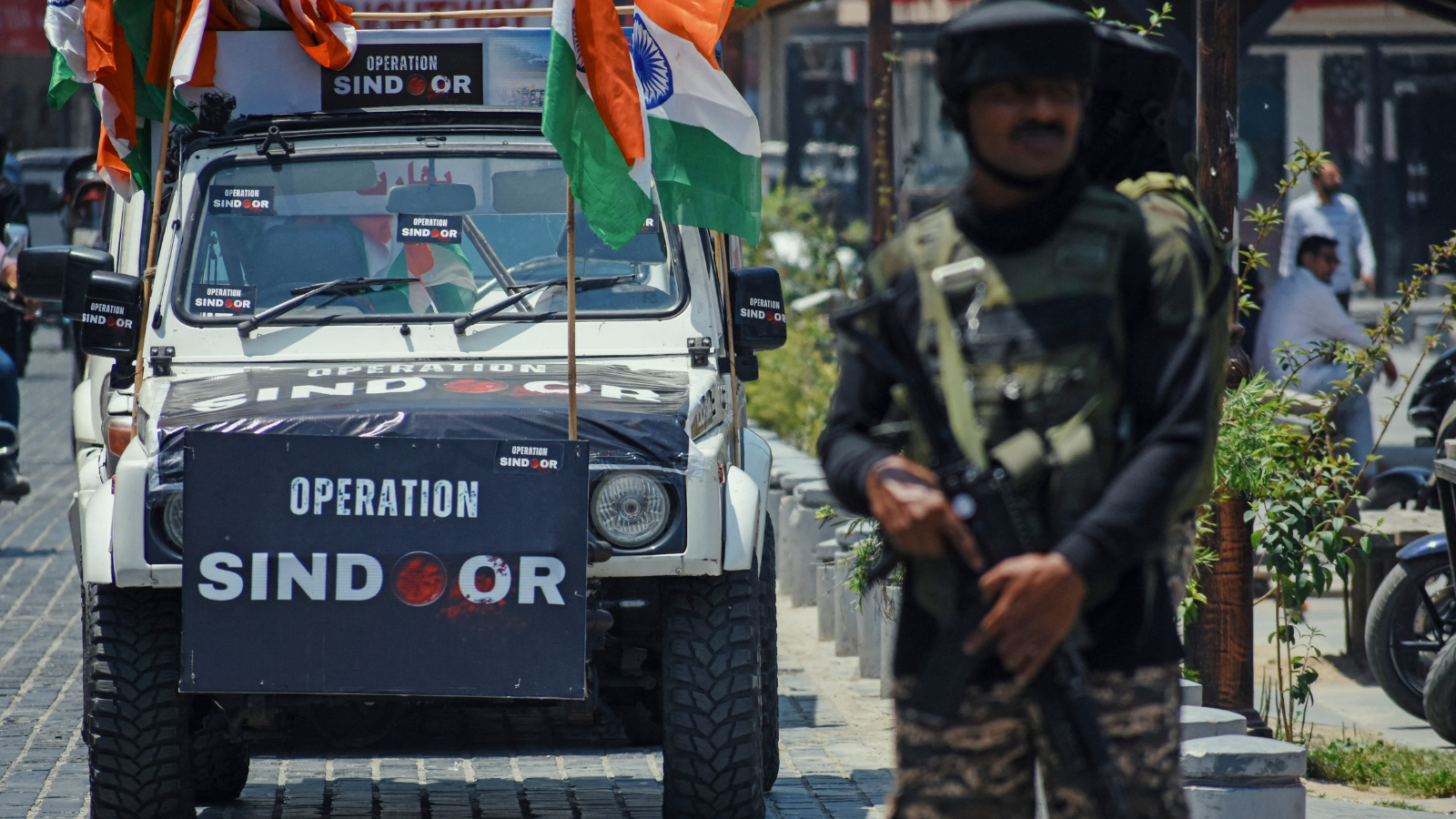
The India-Pakistan conflict that played out between May 6 and May 10, 2025, offers several military lessons. This article presents key takeaways from Operation Sindoor and breaks down how India’s preparations shaped the outcome and what more is needed to strengthen future readiness.

Dinakar Peri
This book offers a comprehensive analysis of India's evolving relationship with sovereignty in a complex global order. Moving beyond conventional narratives, it examines how the sovereignty principle shapes India's behavior across four critical domains—from traditional military power to contemporary data governance.

Rudra Chaudhuri, Nabarun Roy

This paper examines the evolution of India-China economic ties from 2005 to 2025. It explores the impact of global events, bilateral political ties, and domestic policies on distinct spheres of the economic relationship.

Santosh Pai