

In The Media
Jessica Tuchman Mathews
{
  "authors": [
    "Jessica Tuchman Mathews"
  ],
  "type": "other",
  "centerAffiliationAll": "",
  "centers": [
    "Carnegie Endowment for International Peace"
  ],
  "collections": [],
  "englishNewsletterAll": "",
  "nonEnglishNewsletterAll": "",
  "primaryCenter": "Carnegie Endowment for International Peace",
  "programAffiliation": "",
  "programs": [],
  "projects": [],
  "regions": [
    "North America",
    "United States"
  ],
  "topics": [
    "Political Reform",
    "Foreign Policy"
  ]
}
Source: Getty
Almost from the beginning of its history, America has struggled to find a balance in its foreign policy between narrowly promoting its own security and idealistically serving the interests of others.
Source: New York Review of Books
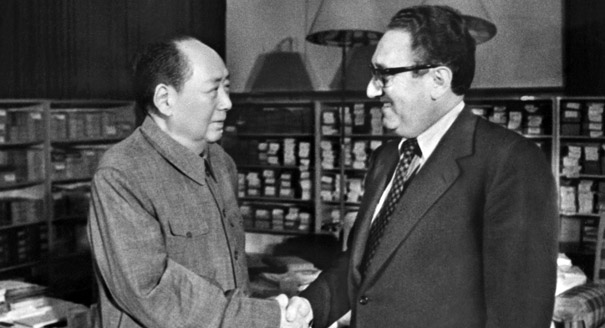
Almost from the beginning of its history, America has struggled to find a balance in its foreign policy between narrowly promoting its own security and idealistically serving the interests of others; between, as we’ve tended to see it in shorthand, Teddy Roosevelt’s big stick and the ideals of Woodrow Wilson. Just as consistently, the US has gone through periods of embracing a leading international role for itself and times when Americans have done all they could to turn their backs on the rest of the world.Two new books now join this never-ending debate: Henry Kissinger’s World Order and America in Retreat by Bret Stephens, a Pulitzer Prize–winning foreign affairs columnist for The Wall Street Journal. Both sound a call for more powerful and more engaged US leadership around the globe. Both Stephens and Kissinger appear to be worried about a return to isolationism, or at least a more inward-looking American policy, and are doing what they can to head it off. Both offer their own view of the relation between US interests and US values. Stephens’s formula, roughly speaking, is 90 percent interests, 10 percent values, when convenient. Kissinger frames the debate more elegantly as one of power vs. principle, but he often comes down on both sides of the fence.
Read the full text of this article on the New York Review of Books.

Distinguished Fellow
Mathews is a distinguished fellow at the Carnegie Endowment for International Peace. She served as Carnegie’s president for 18 years.
Recent Work
Jessica Tuchman Mathews
Jessica Tuchman Mathews
Carnegie India does not take institutional positions on public policy issues; the views represented herein are those of the author(s) and do not necessarily reflect the views of Carnegie, its staff, or its trustees.

How is AI reshaping space security, creating governance challenges, and where does international diplomacy stand today?


Tejas Bharadwaj, Almudena Azcárate Ortega

After the chill in ties between 2020 and 2024 that brought India–China relations to their lowest point in several decades, the two countries have engaged each other afresh. This paper argues that there are predominantly four imperatives guiding India’s approach to China, and they exist in an order of priority.

Saheb Singh Chadha

This piece argues that India’s central challenge is not managing a single flashpoint but resolving the underlying tension between expansion and institutional coherency of the BRICS grouping.

Vrinda Sahai

A partnership between India, a country of subcontinental size, and Africa, a continent of fifty-four countries, may seem asymmetric until one notes that both are home to nearly the same number of people—1.4 billion. This essay spells out the existing challenges to the partnership, its optimal potential, and the possible pathways to realize it over the next quarter-century.

Rajiv Bhatia

The U.S.–India semiconductor cooperation story is well-stocked with top-level strategic intent. What remains unresolved, however, are some underlying challenges that will determine whether the cooperation actually functions. Three such friction points stand out.

Shruti Mittal