

In The Media
Jessica Tuchman Mathews
{
  "authors": [
    "Jessica Tuchman Mathews"
  ],
  "type": "commentary",
  "blog": "Strategic Europe",
  "centerAffiliationAll": "",
  "centers": [
    "Carnegie Endowment for International Peace",
    "Carnegie Europe"
  ],
  "collections": [],
  "englishNewsletterAll": "",
  "nonEnglishNewsletterAll": "",
  "primaryCenter": "Carnegie Endowment for International Peace",
  "programAffiliation": "",
  "programs": [],
  "projects": [],
  "regions": [
    "North America",
    "United States"
  ],
  "topics": [
    "Foreign Policy"
  ]
}
Source: Getty
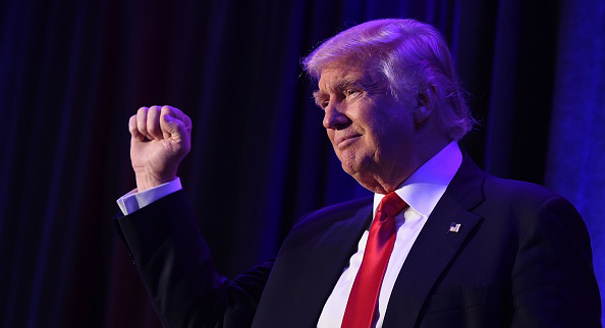
A lot is known about U.S. President-elect Donald Trump the man, but astonishingly little about his policy views, especially on foreign policy.
It will be some time before the important questions about this year’s U.S. presidential election can be answered, most particularly whether the outcome was an affirmative embrace of Donald Trump or a rejection of Hillary Clinton. All we know on this shocking day after is that Trump got fewer votes than either of the preceding Republican candidates—John McCain in 2008 and Mitt Romney in 2012—both of whom suffered crushing defeats.
The difference was that Clinton fell short of U.S. President Barack Obama’s 2012 total by an enormous 5–6 million votes, suggesting that the result was more a rejection than an embrace. To what degree was that caused by the stream of hacked Clinton e-mails revealed by WikiLeaks? Were the leaks orchestrated, as U.S. intelligence believes, by Russia? Did FBI Director James Comey determine the outcome of the election through his unprecedented and utterly wrong reintroduction of the e-mail issue ten days before the vote—at a time when Clinton looked to be heading to a sweeping win? All of that will take a long time to unravel.
The question remains, however, what over 59 million Americans were thinking in choosing for the toughest job in the world a man who is completely unprepared for it in terms of knowledge, experience, and temperament. At this point, the most telling answer comes from the candidate himself—and it explains nothing. “I could stand in the middle of Fifth Avenue,” he said in January 2016, “and shoot somebody and I wouldn’t lose any voters.”
He has done everything short of shooting since then. He lied, he insulted, he made gaffes that revealed the canyon-like depths of his policy ignorance, he threatened to stomp on the constitution, he suggested violence as a means of political expression. And he was right: voters didn’t care. But why they didn’t remains a mystery. The answers that are pouring in are, at this point, only guesses.
Looking ahead, a lot is known about Trump the person but astonishingly little about his policy views, especially on foreign policy. This is in part because so little attention was paid to foreign policy in the campaign, particularly by Trump, and in part because he has no prior record to refer to. It is also because candidate Trump took several, sometimes contradictory, positions on the few issues he did address. And it is because senior aides and advisers have not been shy about characterizing many of his positions as opening bids, even going so far as to say in some cases that everything is negotiable. And finally, it is because a glaring contradiction lies at the heart of everything Trump has said about the world and the U.S. role in it.
On the one hand, he has consistently argued that the United States does too much in the world—carries too much of the burden of assuring peace, financial stability, and economic growth. Others—Germans, Saudis, Japanese, South Koreans, even the tiny Baltic states—are going to pay more for their security in a Trumpian world. His rhetoric has been narrowly nationalist: the United States will pursue its own interests, tightly defined. Others’ problems, in Europe, Asia, NATO, and Syria, are for others to worry about. All of this resonated powerfully with his supporters.
On the other hand, Trump’s slogan “Make America Great Again!” portrays an avenging superpower with the clout and the will to dictate events. We’ll “take the oil” from the self-proclaimed Islamic State, “bomb the shit out of ’em,” “take out” the families of terrorists, force Mexico to pay for our wall, force China to accept changed terms of trade, and so on. This is not the picture of a less engaged America. These two worldviews could be resolved in one direction or another or could co-exist in a chaotic policy jumble.
There are a few areas about which one can be more clear. The new administration will try to act quickly on immigration and deportation. Trade deals are off the table. Neither the Trans-Pacific Partnership (TPP) nor the Transatlantic Trade and Investment Partnership (TTIP) is likely to reemerge. Perhaps the North American Free Trade Agreement (NAFTA) will be somehow renegotiated. New bilateral trade agreements seem highly unlikely. But whether a Trump administration will, as the candidate has threatened, slap punishing tariffs on China or whether that falls into the category of opening bid is unknowable now.
The Paris Agreement on climate change appears to be in serious jeopardy. Trump has made it clear that he would like to personally undo as many of Obama’s achievements as he can and has described global climate change as a hoax somehow perpetrated on the world’s best scientists by China.
The Iran nuclear deal also seems unlikely to survive unless new administration appointees discover, when they study it in detail, that they have a hard time coming up with a more effective alternative. The United States cannot renegotiate a deal that involves Russia, China, and the EU on its own. Indeed, short of war, Washington has little leverage to force Iran to renegotiate even on a bilateral basis. The new administration could quickly find itself playing into the hands of the deal’s fiercest opponents in Iran, the Revolutionary Guards. This most anti-American element in Iran would love nothing better than to be able to renounce the deal on the ground that it was violated first by evil America. And an administration of businessmen will find it somewhat painful to kill $20 billion worth of Boeing airplane sales.
It is not too soon to say that the Trump administration will bring a pause and even a reversal in economic globalization. But whether it represents the end of seventy years of a postwar order led and underpinned by the United States as the leading provider of global public goods in security and the economy, I believe it is too soon to know. Early cabinet appointments may provide an indication. A Senator Bob Corker as U.S. secretary of state, for example, would signal a very different approach from a John Bolton, former U.S. ambassador to the UN.
It is depressingly easy to find evidence of the more apocalyptic view in much of what Trump said during the campaign. But it is also true that the Oval Office brings its weight to bear on its occupants. And there are constraints that campaign rhetoric ignores. Candidate Trump’s take-it-or-leave-it attitude toward NATO’s core commitment may change in office. So, one may hope, will his positive attitude toward a world with more rather than fewer nuclear states.
Seventy-year-olds seldom change their convictions. We can only pray that President Trump will very quickly unlearn in office the lesson he has taken from his business career that “it can be smart to be shallow.”

Distinguished Fellow
Mathews is a distinguished fellow at the Carnegie Endowment for International Peace. She served as Carnegie’s president for 18 years.
Recent Work
Jessica Tuchman Mathews

Deborah Gordon, Jessica Tuchman Mathews
Carnegie does not take institutional positions on public policy issues; the views represented herein are those of the author(s) and do not necessarily reflect the views of Carnegie, its staff, or its trustees.

While the EU and European governments are embracing the much-lauded middle-power moment, this entails three difficult conundrums.

Richard Youngs

Much has been said of the changes Brussels is trying to make to the EU enlargement process. Here’s why gradual integration might—or might not—be the answer.

Dimitar Bechev

The European Commissioner for Trade is headed to China. But after President Xi’s bridge-building visit to Washington, can a more isolated EU overcome Beijing’s stranglehold on critical raw materials? Who will blink first?

Rym Momtaz, ed.

A summer of escalation in the Black Sea has hurt Ukraine economically and is exacerbating world food security. A truce is needed—as is a broader reframing of Europe’s Ukraine strategy.

Thomas de Waal

Are Germany’s economic, industrial, and political struggles becoming a liability for the EU’s ability to rise to the geopolitical moment?
Rym Momtaz, ed.