

Commentary
Thomas de Waal
{
  "authors": [
    "Thomas de Waal"
  ],
  "type": "commentary",
  "centerAffiliationAll": "",
  "centers": [
    "Carnegie Endowment for International Peace",
    "Carnegie Europe",
    "Carnegie Russia Eurasia Center"
  ],
  "collections": [],
  "englishNewsletterAll": "",
  "nonEnglishNewsletterAll": "",
  "primaryCenter": "Carnegie Europe",
  "programAffiliation": "",
  "programs": [],
  "projects": [],
  "regions": [
    "Russia"
  ],
  "topics": [
    "Political Reform",
    "Security"
  ]
}
Source: Getty
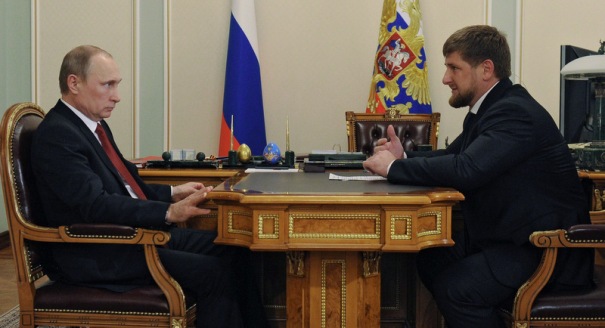
The Chechen connection to the Nemtsov’s murder has split the ruling elite. Putin’s problem is that Kadyrov has completely cleared Chechnya of all rivals, either Chechen or Russian—having fed and groomed his “dragon,” he has no Plan B in Chechnya.
In June 2004, a few weeks after the assassination of pro-Moscow Chechen leader Akhmad Kadyrov, Russian journalist Anna Politkovskaya sought out his son Ramzan in his home village of Tsentoroi.
Ramzan was only 27. Officially he was only head of his father’s security service, but in Politkovskaya’s terrifying account of the meeting, the younger Kadyrov was acting with impunity, as if he was already in charge of Chechnya. He bragged that he would “destroy” his enemies. He took a call from Kremlin spin-doctor Vladislav Surkov. He mocked and threatened Politkovskaya until she made a hasty exit, fearing for her life. Reading her Novaya Gazeta article is all the more chilling now with the knowledge that two years later she would be murdered in Moscow, with Chechen assassins implicated in her killing.
She then writes, “The total failure of the Russian special services in Chechnya, which these special services are trying to present to society as a victory and ‘construction of peaceful life’.”
In 2004, Kadyrov and the men under his control had just crushed another armed group trying to take control of Chechnya, led by the two brothers, Ruslan and Sulim Yamadayev. That battle was also a proxy war between the two Russian intelligence services, the civilian FSB backing Kadyrov and the military GRU.
The Yamadayevs were pushed out of Chechnya. In 2008 and 2009 each was assassinated in turn in Moscow and Dubai. Ramzan Kadyrov then claimed that he was “70 percent certain” that Sulim Yamadayev (and by implication the GRU) had organized the assassination of his father.
Politkovskaya’s comment about the “total failure of the Russian special services” grew more prescient with time. If the “Kadyrovtsy” were initially linked to the FSB, then they slipped that leash as well and became a force accountable to no one but Kadyrov himself.
A grim series of murders all have a trail leading back to Kadyrov’s Chechnya. As well as the Yamadayevs and Politkovskaya, human rights activist Natalya Estemirova was killed in Chechnya and Umar Israilov, a former bodyguard of Kadyrov’s in Vienna in 2009.
Last year an exiled Chechen official Said-Emin Ibragimov said he was abducted and tortured by two Russian-speaking men in Strasbourg (Ibragimov said the two were not Chechens however).
Analysts have used different terminology to describe the phenomenon of the “Kadyrovtsy.” Sergei Markedonov talks about “outsourcing sovereignty.” Yulia Latynina says that President Putin has “lost the monopoly on punishment” in Russia.
Power, wealth and impunity are all fused. Take the case of Adam Delimkhanov, who is a deputy in the State Duma, Kadyrov’s cousin and the man he has named as a potential successor. Delimkhanov was estimated in 2011 by Finans magazine to have a fortune of 300 million dollars. During a fistfight with another parliamentary deputy, he allegedly dropped a golden gun. Most importantly, he was named by the Dubai police as a suspect in the murder of Sulim Yamadayev—but the charges were dismissed in 2012, after Kadyrov visited Dubai.
The murder of Boris Nemtsov has exposed the tensions within the Russian elite about this “third force.”
There are at least three different versions about the arrest of the Chechen suspects for Nemtsov’s murder: that the arrested men directly targeted Nemtsov on their own initiative for his statements on Islam; that they were hired killers sub-contracted by someone in Moscow; or that they are innocent and were set up to deflect suspicion from the real killers inside the Russian political system.
In any case, the Chechen connection has split the ruling elite. Putin faces a backlash from those who object to his reliance on Kadyrov. Anti-Chechen racism is only part of it. Kadyrov’s enemies in the FSB and other places suspect, for good reasons, that the loyalty of the Kadyrovtsy to the Russian state is provisional. They recall that many powerful Chechen warlords, including the Yamadayevs and the elder Kadyrov, fought against Russian forces in the first Chechen war of 1994–1996.
Putin’s problem is that Kadyrov has completely cleared Chechnya of all rivals, either Chechen or Russian—having fed and groomed his “dragon,” he has no Plan B in Chechnya.

Senior Fellow, Carnegie Europe
Thomas de Waal is a senior fellow at Carnegie Europe, specializing in Eastern Europe and the Caucasus.
Recent Work
Thomas de Waal
Thomas de Waal
Carnegie India does not take institutional positions on public policy issues; the views represented herein are those of the author(s) and do not necessarily reflect the views of Carnegie, its staff, or its trustees.

In any defense establishment, change is an ongoing process. However, despite the best of intentions, existing bureaucracies, bound by habit and years of socialization, have their limits in implementing transformative change.

Anit Mukherjee

After the chill in ties between 2020 and 2024 that brought India–China relations to their lowest point in several decades, the two countries have engaged each other afresh. This paper argues that there are predominantly four imperatives guiding India’s approach to China, and they exist in an order of priority.

Saheb Singh Chadha

This piece argues that India’s central challenge is not managing a single flashpoint but resolving the underlying tension between expansion and institutional coherency of the BRICS grouping.

Vrinda Sahai

This piece argues that the present Indian strategy, based on opportunistic diversification and utilization of limited strategic reserves, remains inadequate when confronting supply disruptions. It evaluates India’s options in the short, medium, and long terms.
Vrinda Sahai

This piece examines India’s response to U.S. sanctions and tariffs, specifically assessing the immediate market consequences, such as alterations in import costs, and the broader strategic implications for India’s energy security and foreign policy orientation.
Vrinda Sahai