

Commentary
How is AI reshaping space security, creating governance challenges, and where does international diplomacy stand today?
Tejas Bharadwaj, Almudena Azcárate Ortega
{
  "authors": [
    "Alexey Arbatov"
  ],
  "type": "legacyinthemedia",
  "centerAffiliationAll": "",
  "centers": [
    "Carnegie Endowment for International Peace",
    "Malcolm H. Kerr Carnegie Middle East Center",
    "Carnegie Russia Eurasia Center"
  ],
  "collections": [
    "Iranian Proliferation"
  ],
  "englishNewsletterAll": "",
  "nonEnglishNewsletterAll": "",
  "primaryCenter": "Carnegie Endowment for International Peace",
  "programAffiliation": "",
  "programs": [],
  "projects": [],
  "regions": [
    "North America",
    "United States",
    "Middle East",
    "Iran",
    "Russia"
  ],
  "topics": [
    "Security",
    "Foreign Policy",
    "Nuclear Policy"
  ]
}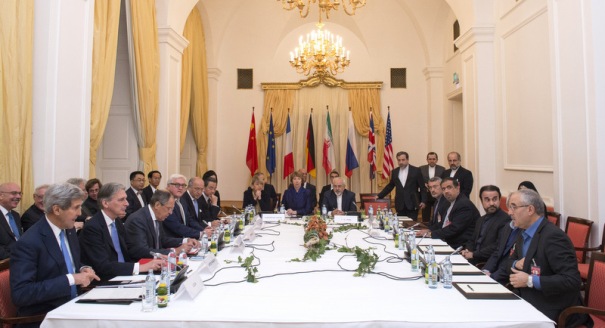
Source: Getty
If the nuclear talks fail, further Russian cooperation on coercing Iran is not likely while Russia and the West remain locked in a standoff over Ukraine. Moreover, Russia and Iran may move to build closer relations in the future.
Source: Belfer Center for Science and International Affairs’ Iran Matters
As the final deadlines for the nuclear negotiations with Iran approach, more consideration should be turned to the aftermath of the possible failure of the talks to produce a workable agreement. An important consideration for American officials for the day after the failure of the negotiations is how Russia will adjust its policy to the post-Geneva world, which will probably see a return to confrontation between Iran and the United States.
Russia will probably not accept some form of ultimatum where Iran must meet certain benchmarks or new sanctions will be imposed. Moscow will be more likely to accept a step-by-step approach, involving Iran implementing increased transparency measures, agreeing to certain levels of enrichment, or restrictions on the Arak reactor in exchange for sanctions relief. Further Russian actions to coerce Iran are unlikely. However, even with this flexibility, an agreement is unlikely at this point.In the event that the negotiations fail, it is doubtful that Russia will consent to future sanctions against Iran. For Russia, applying sanctions against Iran while being the subject of sanctions of the US and EU would be quite a Kafka-ian policy. It is more likely that Russia will increase unilateral cooperation with Iran. A recent example of this shift in direction came in late February, with the news that Russia has offered to sell Iran its advanced Antey-2500v anti-aircraft missiles, which could be used by Iran to defend against Israeli or American attack on its nuclear sites. While this would harm Russia-US relations, it is hard to imagine how the relationship could get worse at this point. As long as the crisis in Ukraine remains ongoing and Russia remains pressured by the US and EU in this area, its cooperation will not be forthcoming.
There is virtually no possibility under President Obama of the United States launching a military strike to destroy Iranian nuclear facilities. At the same time, it is unrealistic to believe that a comprehensive agreement will be reached under the current circumstances. With this in mind, it is critical that American policymakers begin considering their plans for the day after the talks fail, and consider what role Russia will play in America’s Iran strategy going forward.

Alexey Arbatov
Alexey Arbatov is the head of the Center for International Security at the Primakov National Research Institute of World Economy and International Relations.
Carnegie India does not take institutional positions on public policy issues; the views represented herein are those of the author(s) and do not necessarily reflect the views of Carnegie, its staff, or its trustees.

How is AI reshaping space security, creating governance challenges, and where does international diplomacy stand today?


Tejas Bharadwaj, Almudena Azcárate Ortega

After the chill in ties between 2020 and 2024 that brought India–China relations to their lowest point in several decades, the two countries have engaged each other afresh. This paper argues that there are predominantly four imperatives guiding India’s approach to China, and they exist in an order of priority.

Saheb Singh Chadha

This piece argues that India’s central challenge is not managing a single flashpoint but resolving the underlying tension between expansion and institutional coherency of the BRICS grouping.

Vrinda Sahai

A partnership between India, a country of subcontinental size, and Africa, a continent of fifty-four countries, may seem asymmetric until one notes that both are home to nearly the same number of people—1.4 billion. This essay spells out the existing challenges to the partnership, its optimal potential, and the possible pathways to realize it over the next quarter-century.

Rajiv Bhatia

The U.S.–India semiconductor cooperation story is well-stocked with top-level strategic intent. What remains unresolved, however, are some underlying challenges that will determine whether the cooperation actually functions. Three such friction points stand out.

Shruti Mittal