

Article
C. Raja Mohan, Darshana M. Baruah
{
  "authors": [
    "C. Raja Mohan"
  ],
  "type": "legacyinthemedia",
  "centerAffiliationAll": "dc",
  "centers": [
    "Carnegie Endowment for International Peace",
    "Carnegie India",
    "Malcolm H. Kerr Carnegie Middle East Center"
  ],
  "collections": [],
  "englishNewsletterAll": "ctw",
  "nonEnglishNewsletterAll": "",
  "primaryCenter": "Carnegie India",
  "programAffiliation": "SAP",
  "programs": [
    "South Asia"
  ],
  "projects": [],
  "regions": [
    "South Asia",
    "Pakistan",
    "Gulf",
    "Middle East",
    "Yemen"
  ],
  "topics": [
    "Security",
    "Foreign Policy"
  ]
}
Source: Getty
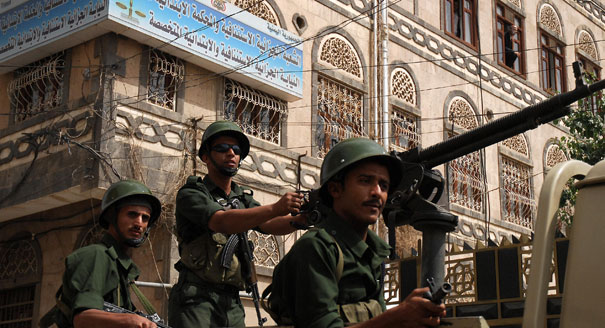
Islamabad is under pressure from Saudi Arabia to join military operations against the Houthi rebels in Yemen, but there is little popular support in Pakistan for jumping into a sectarian war.
Source: Indian Express
Islamabad is under pressure from Saudi Arabia to join the military operations by the Sunni coalition that Riyadh is leading against the Iran-backed Shia Houthi rebels in Yemen. But there is little popular support in Pakistan for jumping into a war that has acquired such a sharp sectarian edge.
Prime Minister Nawaz Sharif was summoned a few weeks ago to Riyadh as King Salman considered muscular options to reverse the Houthi advances in Yemen. Besides Pakistan’s longstanding special relationship with Saudi Arabia, Sharif personally owes much to the House of Saud that saved him from the wrath of General Pervez Musharraf after the army ousted him in a coup at the end of 1999.
After the Saudis launched air strikes on Yemen last Thursday, Riyadh put out the word that Pakistan has agreed to join the campaign. In Islamabad, the foreign office would neither confirm nor deny the reports. It merely stated that the government of Pakistan was “considering” the Saudi request.The defence minister of Pakistan, Khawaja Asif, told the National Assembly that Pakistan has made no promise to Saudi Arabia on joining the coalition. As the government of Pakistan dissimulated in public, there were reports in the Saudi media that 10 Pakistani jets were taking part in the air operations in Yemen and that its navy might be joining the operations.
After King Salman picked up the telephone to call Sharif on Saturday, the official Saudi news agency said the PM had offered to put the full services of the Pakistan army at the disposal of Riyadh. The question was probably never about whether Pakistan would join the operations. It was related to the nature of Pakistan’s contribution and how it should be presented to its public.
Amidst the growing tensions between the Shia and Sunni at home, many in Pakistan argue that it is utterly unwise for Pakistan to join the sectarian strife in the Middle East. Others point to the dangers of being drawn into the proxy wars between Saudi Arabia and Iran that are unfolding in the region.
Although supporting Riyadh will certainly bring some rewards for Pakistan, it also complicates relations with Iran, with which it shares a long and increasingly restive border. Further, Pakistan’s borders with India and Afghanistan are unstable and the army has enough on its hands countering the Islamist insurgency at home. A military adventure far from the borders, many in Pakistan argue, makes little strategic sense.
Finally, there is Pakistan’s self-perception as a leading force in the Islamic world. Much like India’s notions of third-world solidarity, Pakistan’s “Islamic Internationalism” opposes taking sides in the conflicts between Muslim countries and demands that Pakistan promote reconciliation. But the multiple reservations being expressed in public might have no policy consequence for Pakistan. The issue is too big for the civilian government in Islamabad to decide. It will be the Pakistan army, headquartered in Rawalpindi, that will take the call.
The civil war in Yemen and the Saudi demand for military support bring into sharp relief Pakistan’s longstanding security role in the Gulf and the Middle East. Pakistan and its army figured prominently in the plans of Britain and America for securing the (oil) “Wells of Power” in the Gulf after World War II.
Pakistan was drafted into the Central Treaty Organisation (Cento), also called the Baghdad Pact, in the mid-1950s. Although the Cento did not last long, many Gulf kingdoms turned to India and Pakistan for defence cooperation. After all, it was undivided India under the Raj that was the security guarantor for the Gulf and the Middle East for nearly two centuries.
As India consciously limited its military role in the Middle East, Pakistan’s army became a valuable option for many countries in the region in providing security against internal threats, manning and training of military forces and guarding the national borders. Pakistan, of course, is not the Raj. It has a vantage location next to the Middle East and an Islamist ideology, but not the military and economic weight to protect the Gulf regimes on its own. The political equation between Rawalpindi and the Gulf rapidly altered as the kingdoms became rich and Pakistan remained poor.
If the Raj defined the terms of regional security in the Middle East, Pakistan increasingly became dependent on the financial support of the Gulf kingdoms. In the name of Islamic solidarity, Pakistan allowed the Gulf regimes, especially Saudi Arabia, to trample on its national sovereignty. Above all, it had to provide a variety of military services that they demanded.
With Saudi Arabia now so fearful of a rising Iran, it is quite clearly Pakistan’s payback time. And Yemen could mark the beginning of a new and more significant phase in Pakistan’s involvement in the security politics of the Gulf.
This article was originally published in the Indian Express.
Former Nonresident Senior Fellow, Carnegie India
A leading analyst of India’s foreign policy, Mohan is also an expert on South Asian security, great-power relations in Asia, and arms control.
Recent Work

C. Raja Mohan, Darshana M. Baruah


Alexander Gabuev, Paul Haenle, C. Raja Mohan, …
Carnegie India does not take institutional positions on public policy issues; the views represented herein are those of the author(s) and do not necessarily reflect the views of Carnegie, its staff, or its trustees.

In any defense establishment, change is an ongoing process. However, despite the best of intentions, existing bureaucracies, bound by habit and years of socialization, have their limits in implementing transformative change.

Anit Mukherjee

After the chill in ties between 2020 and 2024 that brought India–China relations to their lowest point in several decades, the two countries have engaged each other afresh. This paper argues that there are predominantly four imperatives guiding India’s approach to China, and they exist in an order of priority.

Saheb Singh Chadha

This piece argues that India’s central challenge is not managing a single flashpoint but resolving the underlying tension between expansion and institutional coherency of the BRICS grouping.

Vrinda Sahai

A partnership between India, a country of subcontinental size, and Africa, a continent of fifty-four countries, may seem asymmetric until one notes that both are home to nearly the same number of people—1.4 billion. This essay spells out the existing challenges to the partnership, its optimal potential, and the possible pathways to realize it over the next quarter-century.

Rajiv Bhatia

The India–EU Free Trade Agreement (FTA) is shaping up to be one of the most consequential trade negotiations, both economically and strategically. But, what’s in the agreement, what’s missing, and what will determine its success in the years ahead
Vrinda Sahai, Nicolas Köhler-Suzuki