

Commentary
Chung Min Lee
{
  "authors": [
    "Chung Min Lee"
  ],
  "type": "legacyinthemedia",
  "centerAffiliationAll": "dc",
  "centers": [
    "Carnegie Endowment for International Peace"
  ],
  "collections": [],
  "englishNewsletterAll": "asia",
  "nonEnglishNewsletterAll": "",
  "primaryCenter": "Carnegie Endowment for International Peace",
  "programAffiliation": "AP",
  "programs": [
    "Asia"
  ],
  "projects": [],
  "regions": [
    "East Asia",
    "China",
    "Japan"
  ],
  "topics": [
    "Political Reform",
    "Security"
  ]
}
Source: Getty
A Japan that won’t come to terms with history undermines regional reconciliation.
Source: Wall Street Journal
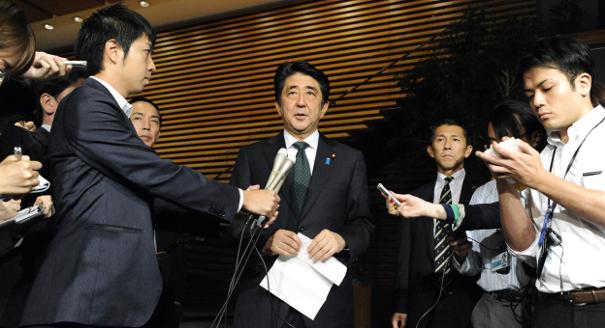
All eyes in Asia are on Japan’s Prime Minister Shinzo Abe as he prepares to address a joint session of the U.S. Congress on April 29. This year being the 70th anniversary of the end of World War II, what historical message will Mr. Abe choose to deliver?
He has roughly three options: admit the horrible wrongdoings of Japan’s military regime before and during World War II; stress a kind of moral equivalence between Japan and the U.S., as Tokyo started the war by attacking Pearl Harbor but Washington ended it by dropping two atomic bombs; or highlight Japan’s postwar history as a model democracy, America’s best friend in Asia and the region’s biggest contributor to economic development.
If Mr. Abe’s previous comments and actions are a guide, he will likely choose the second and third options, which reflect the narrative that most Japanese prefer. Mr. Abe has said that Japan must never go back to its imperialist past, but he has also stressed the solemn duty of honoring Japanese soldiers killed in World War II.Yet if Mr. Abe continues to whitewash and ignore Japan’s wartime atrocities—including sexual slavery and grotesque medical experiments on live prisoners, including Americans—then Japan will lose its claim to being a postwar beacon of democracy, human rights and dignity.
Many Americans feel uneasy, if not fatigued, by the constant Chinese and South Korean focus on history. Yes, they say, Japan made terrible mistakes during the war, but that was 70 years ago and it’s time to move on. Besides, all countries have dark chapters in their histories, and China is hardly an exception. Japan has been a responsible major power since 1945, is one of the largest contributors to the United Nations and stands with the U.S. on virtually all the important issues. South Korea’s wounds are understandable, but a fellow democracy and major U.S. ally should have the courage to look beyond historical grievances.
Such assertions miss a central point: Japan’s benign postwar record doesn’t erase what came before. The still-mighty yen can buy many things, but it can’t buy the collective memory of Asians or even Americans.
Mr. Abe’s revisionism works against U.S. strategic interests—including President Obama’s signature pivot to Asia—because a Japan that won’t come to terms with history undermines regional reconciliation and provides China with its best excuse for growing its military. A Japan that denies history also raises China’s international profile and feeds a perception that China’s official voice is in harmony with the rest of Asia’s.
Amid China’s rise, ensuring security and stability in Asia isn’t just about maintaining effective deterrence and defense. It also requires strengthening Asian democracies and building up soft-power assets such as respect for human rights, civil liberties and historical reconciliation.
No matter how much Japan contributes to the U.S.-Japan alliance or overseas development assistance, a Japanese leader who is moved to tears by a hit movie on the sacrifices made by kamikaze pilots in World War II, or who disputes that 300,000 innocents were butchered in the 1937 Nanjing Massacre, can never win the hearts and minds of fellow Asians.
Mr. Abe may believe that winning hearts and minds isn’t nearly as important as turning Japan into an “unsinkable aircraft carrier.” But if that’s the exclusive message he wishes to convey to the U.S. Congress, he will forsake a golden opportunity to showcase Japan as an indispensable U.S. ally, a responsible counterpart vis-à-vis China and, most importantly, a friend to the rest of Asia.
Senior Fellow, Asia Program
Chung Min Lee is a senior fellow in Carnegie’s Asia Program. He is an expert on Korean and Northeast Asian security, defense, intelligence, and crisis management.
Recent Work
Chung Min Lee
Carnegie India does not take institutional positions on public policy issues; the views represented herein are those of the author(s) and do not necessarily reflect the views of Carnegie, its staff, or its trustees.

In any defense establishment, change is an ongoing process. However, despite the best of intentions, existing bureaucracies, bound by habit and years of socialization, have their limits in implementing transformative change.

Anit Mukherjee

After the chill in ties between 2020 and 2024 that brought India–China relations to their lowest point in several decades, the two countries have engaged each other afresh. This paper argues that there are predominantly four imperatives guiding India’s approach to China, and they exist in an order of priority.

Saheb Singh Chadha

This piece argues that India’s central challenge is not managing a single flashpoint but resolving the underlying tension between expansion and institutional coherency of the BRICS grouping.

Vrinda Sahai

This piece argues that the present Indian strategy, based on opportunistic diversification and utilization of limited strategic reserves, remains inadequate when confronting supply disruptions. It evaluates India’s options in the short, medium, and long terms.
Vrinda Sahai

This piece examines India’s response to U.S. sanctions and tariffs, specifically assessing the immediate market consequences, such as alterations in import costs, and the broader strategic implications for India’s energy security and foreign policy orientation.
Vrinda Sahai