

Paper
James L. Schoff, Douglas E. Rake, Joshua Levy
{
  "authors": [
    "James L. Schoff"
  ],
  "type": "legacyinthemedia",
  "centerAffiliationAll": "dc",
  "centers": [
    "Carnegie Endowment for International Peace",
    "Carnegie China"
  ],
  "collections": [],
  "englishNewsletterAll": "asia",
  "nonEnglishNewsletterAll": "",
  "primaryCenter": "Carnegie China",
  "programAffiliation": "AP",
  "programs": [
    "Asia"
  ],
  "projects": [],
  "regions": [
    "North America",
    "United States",
    "East Asia",
    "Japan"
  ],
  "topics": [
    "Security",
    "Foreign Policy"
  ]
}
Source: Getty
Cementing better security ties between the United States and Japan will pay long-lasting dividends.
Source: U.S. News & World Report
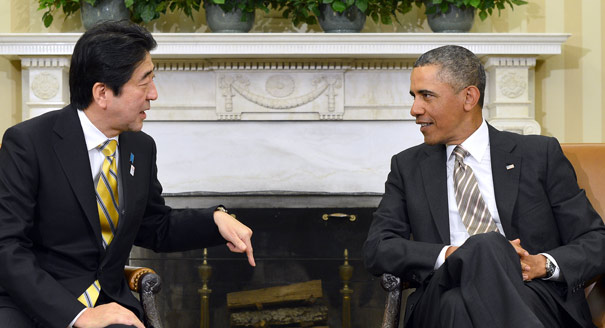
As Japanese Prime Minister Shinzo Abe prepares to visit the United States next week, attention is focused on the historic nature of the trip. Abe will be the first Japanese leader to speak before a joint session of Congress, an event all the more poignant as it occurs in this 70th anniversary year of World War II’s end.
A more lasting and meaningful outcome of the visit, however, will be something different: The approval of revised guidelines for U.S.-Japan defense cooperation. Untouched for nearly two decades, the updated guidelines have been negotiated painstakingly for over a year and will be adopted at a side meeting of the two countries’ defense and foreign policy leaders in conjunction with Abe’s speech. This document – broadly outlining bilateral agreement on security burden sharing – should open a door to more integrated alliance activity in a wider range of contingencies in East Asia and beyond.
Japanese prime ministers have spoken to a single chamber of Congress before. Hayato Ikeda, in 1961, talked briefly at the House of Representatives about Japan’s plans for economic revival and its commitment to democracy and human rights. Notable in Ikeda’s speech was his pledge that Japan would “play a more positive and purposeful role in the international community” to contribute to “world peace and human progress.” True to his word, Japan became the second largest contributor to the United Nations, a consistent top five provider of overseas development assistance, and co-founded the Asian Development Bank, among other economic and foreign policy contributions.Since the end of the Cold War, Japanese leaders and the legislature opened up new legal avenues for Japan to contribute in the security arena as well, albeit in a limited way to remain consistent with Japan’s pacifist constitution. Participation in certain U.N. peacekeeping operations since 1992 is one concrete example, and legislation in 1999 allowed Japanese Self-Defense Forces to provide “rear-area” support to U.S. troops if they were needed to stop North Korean aggression. Japan’s international role on the security front, however, always lagged far behind that of other areas and fell short of its ability.
Today, Abe’s government is preparing new security legislation that will expand the activities Japan can engage in, and the revised U.S.-Japan defense guidelines describe how bilateral cooperation might function in anticipation of the new laws.
The two most important aspects of the updated guidelines are a shift to a more integrated style of security cooperation and a new bilateral coordination team that will help manage the political and operational dynamics of this shift. These changes are increasingly important as North Korea modernizes its nuclear missile force and as emerging military domains of cyber and space blur the lines between “forward area” and “rear area.” China’s rapidly increasing military budget and territorial tensions in the East China Sea are also driving Japan to allow its Self-Defense Forces to do more, and Washington is looking for flexible alliance options to address unpredictable security challenges in the region. Both sides see benefit in modernizing their defense cooperation.
Whereas the current alliance concept creates separate zones of activity that require relatively little joint planning or training, the revised guidelines should enable more integrated operations especially in the areas of missile defense, surveillance and reconnaissance, antisubmarine warfare, counter proliferation and more direct logistical support of each other, depending on the situation. These could apply to the defense of Japan or other situations around the world.
With any luck, the allies will never have to carry out these missions against real threats, but the newfound ability to plan and train for them will strengthen the alliance and enhance deterrence regardless. This is good for both countries and contributes to regional stability. The new guidelines also could facilitate greater multilateral security cooperation and exercises involving countries like Australia, South Korea and India, which can bolster regional confidence and capacity to address collective security challenges. Cooperation might also be possible further afield, if, for example, Japanese surveillance support could assist a U.N.-authorized peace building mission someday in Yemen, with assets stationed in nearby Djibouti.
Overall, the revised guidelines should allow for more comprehensive alliance cooperation that adds a substantive security component to already robust economic and foreign policy coordination (expanding on Ikeda’s 1961 pledge), but there will be political and legal limits to what Japan can do. Japan’s new security legislation will not allow the Self-Defense Forces to use force unless the country is directly threatened or attacked, and its track record suggests that Tokyo will be very selective about joining multilateral coalitions. The new guidelines will provide opportunities for cooperation over time, but these should be explored incrementally in the near term, with due regard for Japanese domestic and regional sensitivities. Change won’t happen overnight.
The evolution of the U.S.-Japan alliance is a remarkable example of the power of reconciliation and partnership in service to common goals and public goods. That does not mean that the allies agree on everything or work exclusively together, but it is a relationship that has broadened and matured over seven decades and has delivered a great deal of value to the global community (while benefiting their citizens as well).
High profile speeches, whether by Ikeda in 1961 or Abe 54 years later, are often forgotten quickly, but they can set important goals for a bilateral relationship and provide direction to and empower policymakers. Abe will no doubt echo Ikeda’s pledge for a “positive and purposeful role” and highlight Japan’s contributions over the years. He might also set new goals for the future. But nothing should obscure the accomplishment of these new defense guidelines or distract our two countries from steadily implementing them for our own security and for global peace and stability.

Former Senior Fellow, Asia Program
James L. Schoff was a senior fellow in the Carnegie Asia Program. His research focuses on U.S.-Japan relations and regional engagement, Japanese technology innovation, and regional trade and security dynamics.
Recent Work
James L. Schoff, Douglas E. Rake, Joshua Levy
James L. Schoff
Carnegie India does not take institutional positions on public policy issues; the views represented herein are those of the author(s) and do not necessarily reflect the views of Carnegie, its staff, or its trustees.

In any defense establishment, change is an ongoing process. However, despite the best of intentions, existing bureaucracies, bound by habit and years of socialization, have their limits in implementing transformative change.

Anit Mukherjee

How is AI reshaping space security, creating governance challenges, and where does international diplomacy stand today?


Tejas Bharadwaj, Almudena Azcárate Ortega

After the chill in ties between 2020 and 2024 that brought India–China relations to their lowest point in several decades, the two countries have engaged each other afresh. This paper argues that there are predominantly four imperatives guiding India’s approach to China, and they exist in an order of priority.

Saheb Singh Chadha

This piece argues that India’s central challenge is not managing a single flashpoint but resolving the underlying tension between expansion and institutional coherency of the BRICS grouping.

Vrinda Sahai

A partnership between India, a country of subcontinental size, and Africa, a continent of fifty-four countries, may seem asymmetric until one notes that both are home to nearly the same number of people—1.4 billion. This essay spells out the existing challenges to the partnership, its optimal potential, and the possible pathways to realize it over the next quarter-century.

Rajiv Bhatia