

Commentary
Yezid Sayigh
{
  "authors": [
    "Yezid Sayigh"
  ],
  "type": "legacyinthemedia",
  "centerAffiliationAll": "dc",
  "centers": [
    "Carnegie Endowment for International Peace",
    "Malcolm H. Kerr Carnegie Middle East Center"
  ],
  "collections": [],
  "englishNewsletterAll": "menaTransitions",
  "nonEnglishNewsletterAll": "",
  "primaryCenter": "Malcolm H. Kerr Carnegie Middle East Center",
  "programAffiliation": "MEP",
  "programs": [
    "Middle East"
  ],
  "projects": [],
  "regions": [
    "Levant",
    "Israel",
    "Palestine",
    "Middle East"
  ],
  "topics": [
    "Political Reform"
  ]
}
Source: Getty
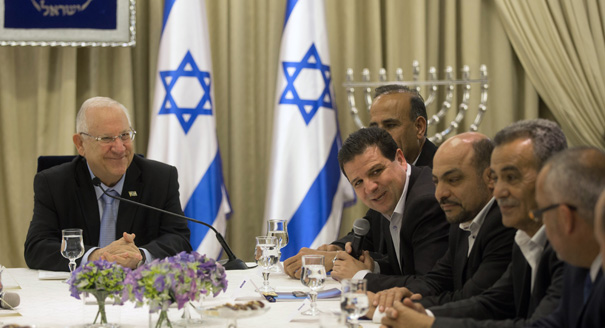
The Joint List’s approach to engagement offers Palestinians a model for political action. But it also highlights the contradictions and tensions inherent to Palestinian approaches over the past 22 years.
Source: Al-Hayat
The emergence of the Joint List, a coalition of four Arab parties, as the third largest parliamentary party in Israel’s recent elections attracted considerable attention, not least among Palestinian activists in the West Bank and Gaza Strip and beyond. This is due in part to the Joint List’s notable success in uniting diverse, indeed ideologically contradictory currents that had previously refused to work with each other.
But what is as significant is the strategy of engagement it has articulated: challenging an Israeli government committed to an ultra-nationalist and discriminatory agenda by seeking common ground with Jewish parties on social, economic, and political issues that affect both communities. The Joint List’s aim is to shape policy and achieve tangible changes for the voters it represents, rather than leave Palestinian citizens of Israel in a permanent ghetto of opposition and enforced marginalization.
The Joint List’s approach to engagement offers Palestinians elsewhere—under Israeli occupation in the West Bank, Gaza Strip, and East Jerusalem, and in refugee exile—a model for political action. But it also highlights the contradictions and tensions inherent to Palestinian approaches over the 22 years since 1993, which combined the politics of engagement with those of non-recognition and boycott towards Israel in an uncomfortable and often counter-productive mix.On one hand, the Palestine Liberation Organization (PLO) chose strategic engagement with Israel in 1993. The Oslo Accords granted the PLO widely expanded admission to international fora—Arafat boasted of being the most frequent foreign leader to visit the U.S. White House, for example—but more importantly they gave PLO spokespersons and activists unprecedented, direct access to Israeli society and media, empowering a genuine peace camp.
At the same time, the PLO continued to exhort Palestinian residents of East Jerusalem to boycott municipal elections of Israeli-controlled greater Jerusalem. There was a clear political argument for this: participation was seen to imply recognition of Israeli control, thereby legitimizing it. However this policy ceded any leverage that local Palestinians might have had to control their own lives, allowing the Israeli Labor, Likud, and religious nationalist parties to maintain control of the municipal council and perpetuate the glaring neglect of services, infrastructure and housing in Arab neighborhoods. The resulting high levels of poverty, unemployment, drug abuse, and other social ills, combined with Israeli policies designed to restrict Palestinian residence and relentless encroachment by Jewish settlers, encouraged a Palestinian exodus from the city. Non-engagement facilitated “judaization” of the city, a key goal of successive Israeli governments.
The PLO also adopted an ambivalent attitude towards Palestinian citizens of Israel after 1993. Occasionally it called on them to “vote for peace” by supporting the Israeli Labor Party in general elections, but it preferred to avoid being accused of interfering in domestic Israeli politics. So it did not invest significant political capital in welding the Arab parties to become a more effective political force inside Israel, although this could have helped influence Israeli public opinion, bridge communal divides, and shore up the peace process.
The PLO’s mixed approach undermined its negotiating position, without gaining anything in domestic legitimacy, as the current disrepute of the Palestinian Authority shows. But its principal rival, Hamas, has not fared much better, despite its own claims. It continues to seek legitimacy among Palestinians by claiming that its strategy of armed resistance has been more effective than PLO diplomacy, while gradually aligning itself with the two-state solution to the conflict with Israel. The fact that it continues to propose moving towards a settlement without negotiating directly with Israel or recognizing it reproduces the self-defeating approach of selective engagement and non-engagement.
These approaches have reached a dead end. The PLO’s ongoing bid to attain Palestinian statehood through UN diplomatic intervention and membership in international bodies and treaties such as the International Criminal Court offers an alternative mode of political action and pressure. So does the grassroots movement to boycott Israeli goods and institutions. Both are commendable as non-violent approaches to build international solidarity and pressure, but in order to be truly effective they must be complemented by direct, political engagement, too.
Clearly, engagement will take different forms for the bodies that dominate Palestinian national politics outside of Israel—nationalist movement Fateh, Islamist movement Hamas, and the Palestinian Authority. The Joint List operates on home ground, within Israeli politics and institutions, and so the avenues open to it for political activism, engagement, and impact are difficult to replicate by Palestinian refugees in exile, those living in the West Bank and Gaza Strip, and even those in East Jerusalem. Adapting and applying its approach is still possible, but the key to this is a fundamental shift in how to think about political action.
Despite the new energy sparked by the Joint List, the most likely response of the incoming rightwing Israeli government will be to marginalize it. The Joint List needs Palestinians elsewhere to also be engaged in a strong, complementary set of activities. The Palestinian Authority, parties like Fateh and Hamas, and Palestinian refugee networks and exile activist groups can help Palestinian citizens inside Israel gain traction, just as the successes of Palestinian citizens of Israel can in turn strengthen Palestinians elsewhere. But all need to converge on a shared strategy of engagement.
This article was originally published in Arabic by Al-Hayat.

Senior Fellow, Malcolm H. Kerr Carnegie Middle East Center
Yezid Sayigh is a senior fellow at the Malcolm H. Kerr Carnegie Middle East Center in Beirut, where he leads the program on Civil-Military Relations in Arab States (CMRAS). His work focuses on the comparative political and economic roles of Arab armed forces, the impact of war on states and societies, the politics of postconflict reconstruction and security sector transformation in Arab transitions, and authoritarian resurgence.
Recent Work
Yezid Sayigh
Yezid Sayigh
Carnegie India does not take institutional positions on public policy issues; the views represented herein are those of the author(s) and do not necessarily reflect the views of Carnegie, its staff, or its trustees.

An Israeli response to Iran’s October 1 attack is imminent. The key question is of its intensity and potential fallout, both within Iran, in terms of nuclear security policy changes, and across the broader region. The coming days are likely to reshape West Asia irreversibly.

Gaddam Dharmendra

As India’s economy recovers from the coronavirus pandemic, Indian businesses need efficient financial structures to regain their ground. Key reforms to India’s Insolvency and Bankruptcy Code could fill these gaps.

Anirudh Burman

Access to cross-border data is an integral piece of the law enforcement puzzle. India is well placed to lead the discussions on international data agreements subject to undertaking necessary surveillance reforms.

Smriti Parsheera, Prateek Jha

After the coronavirus pandemic wanes, how will China’s reorientation of the Belt and Road Initiative to address global health concerns influence its relationships with South Asian countries?


Deep Pal, Rahul Bhatia
Early in the outbreak, government researchers forecast several high-risk scenarios that were downplayed or ignored in public messaging.
Gautam I. Menon