

Article
C. Raja Mohan, Darshana M. Baruah
{
  "authors": [
    "C. Raja Mohan"
  ],
  "type": "legacyinthemedia",
  "centerAffiliationAll": "dc",
  "centers": [
    "Carnegie Endowment for International Peace",
    "Carnegie India"
  ],
  "collections": [],
  "englishNewsletterAll": "ctw",
  "nonEnglishNewsletterAll": "",
  "primaryCenter": "Carnegie India",
  "programAffiliation": "SAP",
  "programs": [
    "South Asia"
  ],
  "projects": [],
  "regions": [
    "United States",
    "Asia",
    "South Asia",
    "India",
    "North America"
  ],
  "topics": [
    "Foreign Policy",
    "Technology"
  ]
}
Source: Getty
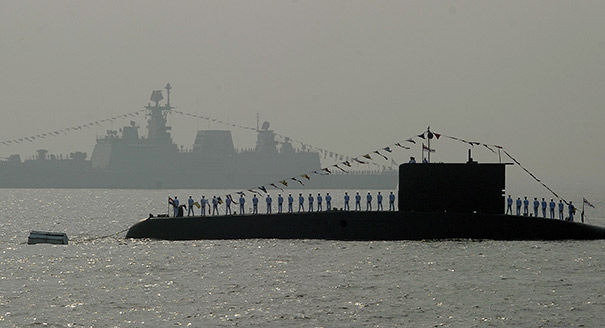
Manohar Parrikar and Ashton B. Carter are under pressure to cope with the challenges of the current fluid power dynamic in Asia.
Source: Indian Express
US Defence Secretary Ashton B. Carter, on his first visit to New Delhi after taking charge, will hold talks with Defence Minister Manohar Parrikar this week. On the face of it, Parrikar and Carter have little in common. The former Goa chief minister is a newcomer to the national stage; Carter’s formidable reputation as a leading defence intellectual precedes him. Carter has served as assistant secretary, undersecretary and deputy secretary in the Pentagon since the early 1990s, before becoming the top gun of the US defence department last year. He has taught at Oxford University and the Harvard Kennedy School.
But Carter and Parrikar do share an interest in science and technology. Carter has a PhD in theoretical physics from Oxford. Parrikar has graduated from IIT-Mumbai in metallurgical engineering, run a private business producing hydraulic equipment and is interested in fluid
power engineering.
Within a year, the Narendra Modi government has brought significant changes to India’s defence policy. It has ended the paralysis on arms acquisition and put greater emphasis on creating a defence industrial base. It has encouraged the participation of private and foreign capital in Indian defence production. These initiatives have created a much better policy environment for the DTTI.
Equally important, Parrikar has demonstrated the political will to shake things up in the MoD, which had become acutely sclerotic under Antony’s extended reign. Parrikar decisively cut through the bureaucratic logjam on the purchase of Rafale fighters. He has also taken the surgeon’s knife to the DRDO. After sacking the DRDO chief earlier, Parrikar has separated the posts of DRDO chief and scientific advisor to the defence minister. For the first time since Indira Gandhi brought a young scientist, V.S. Arunachalam, to head the DRDO in the early 1980s, Parrikar has injected younger blood into leadership positions.
That Carter is stopping at the Visakhapatnam naval station on his way from Vietnam to Delhi tells us how radically the Asian context for an India-US partnership has changed. Vietnam, which inflicted a humiliating military defeat on the US exactly four decades ago, is now actively seeking stronger defence ties with Washington.
Well until the mid-1980s, Delhi had to constantly deal with Washington’s misperception that India had given base facilities to the Soviet Union in Vizag. Today, Carter sees Vizag as the lynchpin of India’s “Act East” strategy. Vietnam and India have not given up their security cooperation with Russia after the collapse of the Soviet Union. Even as they buy weapons from Moscow, Delhi and Hanoi see Washington as critical to the new balance of power, a part of their “Russia Plus” strategy amid the rapid rise of Chinese military power. Last January, PM Narendra Modi and US President Barack Obama unveiled a new vision for security cooperation in Asia and the Pacific.
It is now up to Parrikar and Carter to translate that vision into a practical roadmap on a range of areas — from collaboration on aircraft carrier design to coordination of humanitarian assistance and disaster relief, and from joint production of weapons systems to coordination with friends and partners in the Indo-Pacific.
Carter’s well-known commitment to deepening defence cooperation with India and Parrikar’s determination to recast India’s defence structures do set the stage for a rebooting of the India-US strategic partnership. Both are under pressure to cope with the challenges of the current fluid power dynamic in Asia.
This article was originally published by the Indian Express.
Former Nonresident Senior Fellow, Carnegie India
A leading analyst of India’s foreign policy, Mohan is also an expert on South Asian security, great-power relations in Asia, and arms control.
Recent Work

C. Raja Mohan, Darshana M. Baruah


Alexander Gabuev, Paul Haenle, C. Raja Mohan, …
Carnegie India does not take institutional positions on public policy issues; the views represented herein are those of the author(s) and do not necessarily reflect the views of Carnegie, its staff, or its trustees.

In any defense establishment, change is an ongoing process. However, despite the best of intentions, existing bureaucracies, bound by habit and years of socialization, have their limits in implementing transformative change.

Anit Mukherjee
As AI grows more sophisticated, as the supply chains that power it become more contested, and as access to frontier models becomes geopolitically charged, India must begin to ask a different set of questions. Not what applications it can build on someone else’s infrastructure but what the world needs.

Konark Bhandari

The Indian Ocean Region hosts one of the densest concentrations of subsea cables in the world. Yet, despite accounting for a significant share of global internet traffic, India’s participation remains limited.

Charukeshi Bhatt

How is AI reshaping space security, creating governance challenges, and where does international diplomacy stand today?


Tejas Bharadwaj, Almudena Azcárate Ortega

After the chill in ties between 2020 and 2024 that brought India–China relations to their lowest point in several decades, the two countries have engaged each other afresh. This paper argues that there are predominantly four imperatives guiding India’s approach to China, and they exist in an order of priority.

Saheb Singh Chadha