

Research
- +6
Yasmine Farouk, Nathan J. Brown, Maysaa Shuja Al-Deen, …
{
  "authors": [
    "Anouar Boukhars"
  ],
  "type": "other",
  "centerAffiliationAll": "dc",
  "centers": [
    "Carnegie Endowment for International Peace",
    "Malcolm H. Kerr Carnegie Middle East Center"
  ],
  "collections": [],
  "englishNewsletterAll": "menaTransitions",
  "nonEnglishNewsletterAll": "",
  "primaryCenter": "Carnegie Endowment for International Peace",
  "programAffiliation": "MEP",
  "programs": [
    "Middle East"
  ],
  "projects": [],
  "regions": [
    "North Africa",
    "Maghreb"
  ],
  "topics": [
    "Security"
  ]
}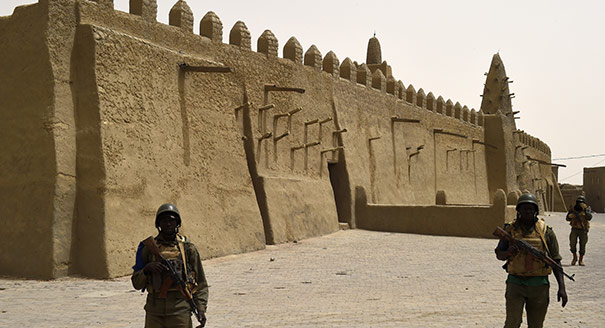
Source: Getty
The Sahel-Sahara region faces a multitude of security challenges, including structural factors that have contributed to radicalization and the successful exploitation of ethnicity and religion by violent extremist groups.
Source: FRIDE
The Sahel-Sahara faces a cluster of security challenges. The upsurge in ethnic radicalisation and its growing overlap with violent militancy are only the most visible signs of the troubles hanging over this vast region. This locus of insecurities mushrooms at the periphery of national boundaries where government writs rarely run. The permeability of borders, and proliferation of zones of political vacuums and economic marginalization in the hinterlands, fuel irredentism and enable the geographical expansion of violent extremists and their networking in excluded border communities. Violence spilling over from neighbouring conflicts often expedites the gradual transformation of such border communities into malignant epicentres of radicalized ethnic claims, cross-border militancy, and organized crime.
Understanding this deadly interplay of political grievances, social exclusion, and hinterland neglect is necessary for tackling the underlying causes of militancy in the Sahel/Saharan border regions. Mapping the dynamics that prompt radicalisation and drive individuals into the orbit of violent extremist networks also requires a keen understanding of the pull of social networks, ideology, and human agency. Conflicts in the Sahel Sahara show that while an abundance of structural factors such as weak governance, social exclusion and state repression creates enabling environments for radicalisation, they remain insufficient to pulling individuals into violent extremism in the absence of the pull exercised by extremist networks, inspirational ideologues, or political entrepreneurs. The spread of external fundamentalist ideas, the appeal of charismatic recruiters, and the material and emotional benefits generated from affiliation with radical social networks play a critical role in producing violent extremism....
Former Nonresident Fellow, Middle East Program
Boukhars was a nonresident fellow in Carnegie’s Middle East Program. He is a professor of countering violent extremism and counter-terrorism at the Africa Center for Strategic Studies, National Defense University.
Recent Work



Yasmine Farouk, Nathan J. Brown, Maysaa Shuja Al-Deen, …

Frederic Wehrey, Nathan J. Brown, Bader Al-Saif, …
Carnegie India does not take institutional positions on public policy issues; the views represented herein are those of the author(s) and do not necessarily reflect the views of Carnegie, its staff, or its trustees.

In any defense establishment, change is an ongoing process. However, despite the best of intentions, existing bureaucracies, bound by habit and years of socialization, have their limits in implementing transformative change.

Anit Mukherjee

After the chill in ties between 2020 and 2024 that brought India–China relations to their lowest point in several decades, the two countries have engaged each other afresh. This paper argues that there are predominantly four imperatives guiding India’s approach to China, and they exist in an order of priority.

Saheb Singh Chadha

A partnership between India, a country of subcontinental size, and Africa, a continent of fifty-four countries, may seem asymmetric until one notes that both are home to nearly the same number of people—1.4 billion. This essay spells out the existing challenges to the partnership, its optimal potential, and the possible pathways to realize it over the next quarter-century.

Rajiv Bhatia

This piece argues that the present Indian strategy, based on opportunistic diversification and utilization of limited strategic reserves, remains inadequate when confronting supply disruptions. It evaluates India’s options in the short, medium, and long terms.

Vrinda Sahai

This piece examines India’s response to U.S. sanctions and tariffs, specifically assessing the immediate market consequences, such as alterations in import costs, and the broader strategic implications for India’s energy security and foreign policy orientation.
Vrinda Sahai