

Commentary
How is AI reshaping space security, creating governance challenges, and where does international diplomacy stand today?
Tejas Bharadwaj, Almudena Azcárate Ortega
{
  "authors": [
    "Dmitri Trenin",
    "Ryan Faith",
    "Michal Baranowski",
    "Christopher S. Chivvis"
  ],
  "type": "legacyinthemedia",
  "centerAffiliationAll": "dc",
  "centers": [
    "Carnegie Endowment for International Peace",
    "Carnegie Russia Eurasia Center"
  ],
  "collections": [],
  "englishNewsletterAll": "ctw",
  "nonEnglishNewsletterAll": "",
  "primaryCenter": "Carnegie Russia Eurasia Center",
  "programAffiliation": "russia",
  "programs": [
    "Russia and Eurasia"
  ],
  "projects": [
    "Eurasia in Transition"
  ],
  "regions": [
    "North America",
    "United States",
    "Russia",
    "Eastern Europe",
    "Ukraine",
    "Western Europe"
  ],
  "topics": [
    "Security",
    "Military",
    "Foreign Policy"
  ]
}
Source: Getty
A Russian attack on NATO’s eastern member states was never likely. At the same time, the threat of escalation in eastern Ukraine and the potential for more direct Russian and NATO involvement in the fighting there is a clear and present danger.
Source: KCRW’s To the Point
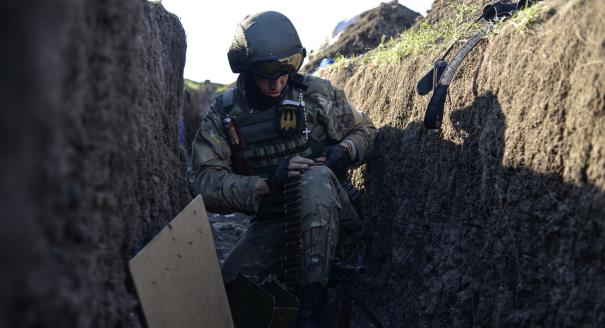
After years of counterinsurgency in the Middle East, the Pentagon says the biggest threat to U.S. security is Russia. That’s not just because of Russia’s nuclear weapons, it’s “hybrid warfare” of the sort Vladimir Putin is using in eastern Ukraine. U.S. troops are already training to combine counterinsurgency with conventional weapons, street-level fighting, cyber warfare, and propaganda. One very concrete example of that changing strategy took place in the Mojave Desert earlier this month in an exercise called Operation Dragon Spear. The goal is deterring Russia from moving on NATO members Latvia, Estonia, and Lithuania—or other members of the former Soviet Union.
Carnegie’s Dmitri Trenin talked to KCRW on this issue. Ryan Faith of the Vice News, Christopher Chivvis of the RAND Corporation, and Michal Baranowski of the German Marshall Fund were also featured, along with host Warren Olney.
Trenin’s key point was that Russia’s attitude toward Ukraine differs fundamentally from its view of the Baltic states and Poland: Ukraine is part of what Putin calls “the Russian world,” while the latter are seen as parts of the Soviet empire that are “lost forever.” There is no reason, therefore, to believe Putin will do to other countries what he has done in Ukraine.
Asked whether NATO’s attempt to shore up its eastern flank would be an effective deterrent toward Russia, Trenin suggested the question missed the mark, because a Russian attack on NATO’s eastern member states was never likely. While acknowledging that history had given eastern Europe reason to fear Russia, Trenin argued that it would be wiser to focus on the threat of escalation in eastern Ukraine—the potential for more direct Russian and NATO involvement in the fighting in Donbas is “a clear and present danger.”
Former Director, Carnegie Moscow Center
Trenin was director of the Carnegie Moscow Center from 2008 to early 2022.
Ryan Faith
Michal Baranowski

Senior Fellow and Director, American Statecraft Program
Christopher S. Chivvis is the director of the American Statecraft Program at the Carnegie Endowment for International Peace.
Carnegie India does not take institutional positions on public policy issues; the views represented herein are those of the author(s) and do not necessarily reflect the views of Carnegie, its staff, or its trustees.

How is AI reshaping space security, creating governance challenges, and where does international diplomacy stand today?


Tejas Bharadwaj, Almudena Azcárate Ortega

After the chill in ties between 2020 and 2024 that brought India–China relations to their lowest point in several decades, the two countries have engaged each other afresh. This paper argues that there are predominantly four imperatives guiding India’s approach to China, and they exist in an order of priority.

Saheb Singh Chadha

This piece argues that India’s central challenge is not managing a single flashpoint but resolving the underlying tension between expansion and institutional coherency of the BRICS grouping.

Vrinda Sahai

A partnership between India, a country of subcontinental size, and Africa, a continent of fifty-four countries, may seem asymmetric until one notes that both are home to nearly the same number of people—1.4 billion. This essay spells out the existing challenges to the partnership, its optimal potential, and the possible pathways to realize it over the next quarter-century.

Rajiv Bhatia

The U.S.–India semiconductor cooperation story is well-stocked with top-level strategic intent. What remains unresolved, however, are some underlying challenges that will determine whether the cooperation actually functions. Three such friction points stand out.

Shruti Mittal