

Commentary
Marc Lynch
{
  "authors": [
    "Marc Lynch"
  ],
  "type": "other",
  "centerAffiliationAll": "dc",
  "centers": [
    "Carnegie Endowment for International Peace"
  ],
  "collections": [
    "Arab Awakening"
  ],
  "englishNewsletterAll": "menaTransitions",
  "nonEnglishNewsletterAll": "",
  "primaryCenter": "Carnegie Endowment for International Peace",
  "programAffiliation": "MEP",
  "programs": [
    "Middle East"
  ],
  "projects": [],
  "regions": [
    "Middle East",
    "North Africa"
  ],
  "topics": [
    "Political Reform",
    "Democracy"
  ]
}
Source: Getty
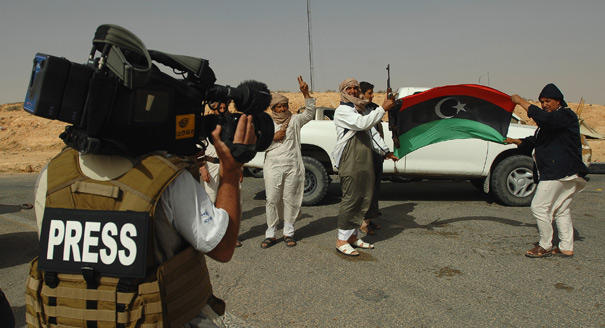
New media played a vital role in the 2011 political uprisings in the Middle East but also contributed to the failure of those uprisings.
Source: Journal of Democracy
The Arab uprisings of 2011 erupted in a region shaped by a decade and a half of revolutionary transformations in the world of Arab media. This revolution was driven by satellite television, local radio, semi-independent press outlets, and the Internet. These new media played a vital role in the 2011 political uprisings. The new media brought critical news and opinion to a broad public, gave voice to the voiceless, built ties between activists and ordinary citizens, and linked local protests into a powerful master narrative of regional uprising.The political uprisings affected the media landscape directly, enabling the rapid launching of dozens of new independent television stations, newspapers, and websites. Within a few years, however, most of the attempted democratic transitions had failed—and the media had surely had something to do with it. Media organs that had proved crucial to the uprisings degenerated with dismaying rapidity into highly partisan platforms serving state authorities or political factions. Why did the media both drive the wave of uprisings that rocked the Arab world in 2011 and contribute to the failure of those uprisings to consolidate democratic institutions?...

Former Nonresident Senior Fellow, Middle East Program
Marc Lynch was a nonresident senior fellow in Carnegie’s Middle East Program where his work focuses on the politics of the Arab world.
Recent Work
Marc Lynch
Marc Lynch
Carnegie India does not take institutional positions on public policy issues; the views represented herein are those of the author(s) and do not necessarily reflect the views of Carnegie, its staff, or its trustees.

A partnership between India, a country of subcontinental size, and Africa, a continent of fifty-four countries, may seem asymmetric until one notes that both are home to nearly the same number of people—1.4 billion. This essay spells out the existing challenges to the partnership, its optimal potential, and the possible pathways to realize it over the next quarter-century.

Rajiv Bhatia

An Israeli response to Iran’s October 1 attack is imminent. The key question is of its intensity and potential fallout, both within Iran, in terms of nuclear security policy changes, and across the broader region. The coming days are likely to reshape West Asia irreversibly.
Gaddam Dharmendra

Experts weigh in on whether the United States is too hostile toward China.



Stephen Wertheim, Evan S. Medeiros, Vijay Gokhale
As India’s economy recovers from the coronavirus pandemic, Indian businesses need efficient financial structures to regain their ground. Key reforms to India’s Insolvency and Bankruptcy Code could fill these gaps.

Anirudh Burman

Access to cross-border data is an integral piece of the law enforcement puzzle. India is well placed to lead the discussions on international data agreements subject to undertaking necessary surveillance reforms.

Smriti Parsheera, Prateek Jha