

Paper
Renad Mansour, Faleh A. Jabar
{
  "authors": [
    "Renad Mansour"
  ],
  "type": "legacyinthemedia",
  "centerAffiliationAll": "dc",
  "centers": [
    "Carnegie Endowment for International Peace",
    "Malcolm H. Kerr Carnegie Middle East Center"
  ],
  "collections": [],
  "englishNewsletterAll": "menaTransitions",
  "nonEnglishNewsletterAll": "",
  "primaryCenter": "Malcolm H. Kerr Carnegie Middle East Center",
  "programAffiliation": "MEP",
  "programs": [
    "Middle East"
  ],
  "projects": [],
  "regions": [
    "Levant",
    "Iraq",
    "Middle East"
  ],
  "topics": [
    "Political Reform"
  ]
}
Source: Getty
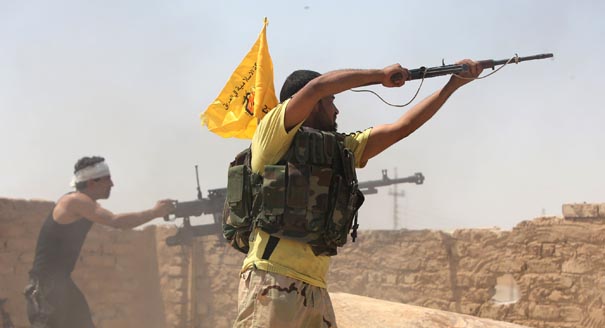
With the Iraqi state relying on Shiite paramilitary groups to combat ISIS, there are growing fears that such groups will only exacerbate sectarian tensions in the country.
Source: Al-Jazeera
Carnegie's Renad Mansour joined Al'Jazeera's Sami Zeidan, Ali Al-Dabbagh former spokesman for the Iraqi government, and Juan Cole of the University of Michigan to discuss the Iraqi government's problematic use of Shiite militias to fight ISIS and the growing tide of sectarian violence on the Sunni civilians in Iraq as a result. The discussion centered on the consequences, specifically the expanding sectarian tension, and growing concerns over the Iraqi government's reliance on, and lack of control over, Shiite militias.
Mansour argued that the Shiite militias, many under the umbrella group of 'Popular Mobilisation Forces', lack a common command structure, which prevents their effective oversight or accountability, and increases their risk of committing sectarian attacks. Mansour pointed to Prime Minister's assertion that Popular Mobilisation Forces are part of the state, which implies a state sanctioning of sectarian attacks and the risk this poses to Iraqi politicians and figures who want to reconcile with the Sunni community and others wishing to stop Abadi's reforms.

Former El-Erian Fellow, Middle East Center
Mansour was an El-Erian fellow at the Carnegie Middle East Center, where his research focuses on Iraq, Iran, and Kurdish affairs.
Recent Work
Renad Mansour, Faleh A. Jabar
Renad Mansour
Carnegie India does not take institutional positions on public policy issues; the views represented herein are those of the author(s) and do not necessarily reflect the views of Carnegie, its staff, or its trustees.

An Israeli response to Iran’s October 1 attack is imminent. The key question is of its intensity and potential fallout, both within Iran, in terms of nuclear security policy changes, and across the broader region. The coming days are likely to reshape West Asia irreversibly.
Gaddam Dharmendra

As India’s economy recovers from the coronavirus pandemic, Indian businesses need efficient financial structures to regain their ground. Key reforms to India’s Insolvency and Bankruptcy Code could fill these gaps.

Anirudh Burman

Access to cross-border data is an integral piece of the law enforcement puzzle. India is well placed to lead the discussions on international data agreements subject to undertaking necessary surveillance reforms.

Smriti Parsheera, Prateek Jha

After the coronavirus pandemic wanes, how will China’s reorientation of the Belt and Road Initiative to address global health concerns influence its relationships with South Asian countries?


Deep Pal, Rahul Bhatia
Early in the outbreak, government researchers forecast several high-risk scenarios that were downplayed or ignored in public messaging.
Gautam I. Menon