

Commentary
Dmitri Trenin
{
  "authors": [
    "Dmitri Trenin"
  ],
  "type": "legacyinthemedia",
  "centerAffiliationAll": "",
  "centers": [
    "Carnegie Endowment for International Peace",
    "Carnegie Russia Eurasia Center"
  ],
  "collections": [],
  "englishNewsletterAll": "",
  "nonEnglishNewsletterAll": "",
  "primaryCenter": "Carnegie Russia Eurasia Center",
  "programAffiliation": "",
  "programs": [],
  "projects": [],
  "regions": [
    "North America",
    "United States",
    "Russia",
    "Western Europe"
  ],
  "topics": [
    "Foreign Policy"
  ]
}
Source: Getty
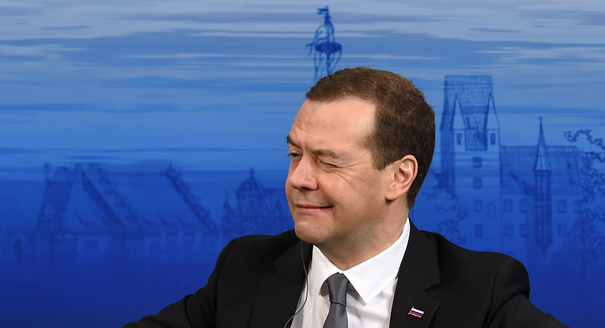
Speaking in Munich, Medvedev diagnosed an ongoing slide into a new Cold War and, accordingly, an increase of dangers—both from a potential direct clash between Russia and the United States/NATO and from their inability to cooperate to fight extremism.
Source: Valdaiclub.com
It is more correct to speak about a new confrontation with the United States and alienation from the European Union. It is not the Cold War: now there are completely different conditions than in the second half of the 20th century. Also too bad and dangerous, but in a different way. Prime Minister Medvedev's trip to Munich meant Vladimir Putin's attempt to bring to the West directly from the Kremlin the view over the situation and at the same time to indicate his willingness to cooperate. Medvedev did not declare a new Cold War in Munich. He diagnosed a slide into it and, accordingly, an increase of dangers - both from the direct clash between Russia and the US/NATO and their inability to cooperate in fight against extremism.
There are two "Munichs" - public part, with a big hall, televised speeches and discussions, and a closed one - in small salons, where business meetings take place. In the big hall the Russian issue was clearly dominated during three days of the conference. Albeit with various degrees of intensity, Russia was blamed by the Americans and Western Europeans, Arabs, and especially by Eastern Europeans. Russia was considered as a threat, which once again was cementing the West. At the same time the main event of MSC-2016 was the agreement reached by 17 states under the leadership of the United States and Russia on the cessation of hostilities in Syria and humanitarian assistance to this country. After that Putin and Obama held a telephone conversation, dedicated to the implementation of this agreement.
One of the main objectives of Medvedev's visit to Munich was communication with the German business community. According to the participants of that meeting, a completely different atmosphere prevailed there than in the big hall of MSC-2016. The sides expressed mutual interest in the resumption of full-scale economic cooperation, discussed the prospects of lifting EU sanctions against Russia.
A compromise is not possible now over strategic, fundamental issues of the world order, rules and norms of states’ behavior, because a result of the confrontation is not yet clear. On specific issues - Syria, Ukraine - compromises are possible in principle, but they are not easy to achieve. But to keep the situation from further deterioration is even more difficult.
The US refusal of the demand to remove Assad would mean a recognition by Washington of complete defeat of its policy in Syria and at the same time a recognition of Moscow's victory. It is simply impossible for political reasons. In the United States, Assad is evil, comparable to ISIS, so such recognition is not possible from a moral point of view. It should be kept in mind that in the hierarchy of threats and challenges, which US Secretary of Defense Ashton Carter mentioned in recent speech in Washington, Russia occupies the first place, and ISIS - the fifth, after China, Iran and North Korea.
Russia's strategy is to force the US to equal partnership based on common threat from ISIS. The State Department went on cooperation with Russia, but the Pentagon does not go beyond measures to prevent incidents during the parallel actions of the American and Russian armed forces in Syria. In my view, the cooperation between the Russian Federation and the United States on Syria may be developing, but their anti-terror alliance is impossible.
The Munich Security Conference brings together representatives of all the major international players in the military-political sphere. This year there were 30 heads of states and governments and 70 ministers – mainly of foreign affairs and defense, plus hundreds of other experts. This is a unique platform for meetings, exchanges of views, formal meetings and informal consultations. Russia has the opportunity to work in Munich not only from the podium, but also on other levels, not only explaining or defending its position, but also finding the possibilities of cooperation.
Former Director, Carnegie Moscow Center
Trenin was director of the Carnegie Moscow Center from 2008 to early 2022.
Recent Work
Dmitri Trenin
Dmitri Trenin
Carnegie India does not take institutional positions on public policy issues; the views represented herein are those of the author(s) and do not necessarily reflect the views of Carnegie, its staff, or its trustees.

How is AI reshaping space security, creating governance challenges, and where does international diplomacy stand today?


Tejas Bharadwaj, Almudena Azcárate Ortega

After the chill in ties between 2020 and 2024 that brought India–China relations to their lowest point in several decades, the two countries have engaged each other afresh. This paper argues that there are predominantly four imperatives guiding India’s approach to China, and they exist in an order of priority.

Saheb Singh Chadha

This piece argues that India’s central challenge is not managing a single flashpoint but resolving the underlying tension between expansion and institutional coherency of the BRICS grouping.

Vrinda Sahai

A partnership between India, a country of subcontinental size, and Africa, a continent of fifty-four countries, may seem asymmetric until one notes that both are home to nearly the same number of people—1.4 billion. This essay spells out the existing challenges to the partnership, its optimal potential, and the possible pathways to realize it over the next quarter-century.

Rajiv Bhatia

The U.S.–India semiconductor cooperation story is well-stocked with top-level strategic intent. What remains unresolved, however, are some underlying challenges that will determine whether the cooperation actually functions. Three such friction points stand out.

Shruti Mittal