

Commentary
Alexey Malashenko
{
  "authors": [
    "Alexey Malashenko"
  ],
  "type": "legacyinthemedia",
  "centerAffiliationAll": "",
  "centers": [
    "Carnegie Endowment for International Peace",
    "Carnegie Russia Eurasia Center"
  ],
  "collections": [],
  "englishNewsletterAll": "",
  "nonEnglishNewsletterAll": "",
  "primaryCenter": "Carnegie Russia Eurasia Center",
  "programAffiliation": "",
  "programs": [],
  "projects": [],
  "regions": [
    "Middle East",
    "Caucasus",
    "Russia"
  ],
  "topics": [
    "Security"
  ]
}
Source: Getty
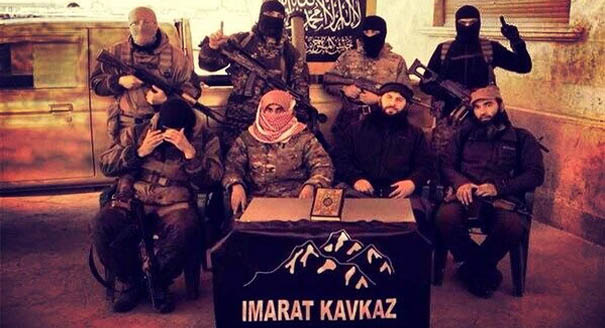
The North Caucasus Islamists’ wish to join ISIS makes some sense. By joining, they would cast themselves not just as regional players but worldwide jihadists. The relations between ISIS and the Caucasus Emirate, however, have been fraught with difficulties.
Source: Cipher Brief
The situation in the Russian North Caucasus has been complex for over 25 years now. A host of economic and social reasons, as well as the relations between this region and the federal authorities, and the mistakes made by both federal and regional politicians, have all contributed to the problem.
Although most experts consider the current situation in Russia relatively stable, it’s to a large extent contingent upon the Islamic factor—particularly upon the actions carried out by Islamic radicals, many of whom pledged their allegiance to the Islamic State.ISIS has tried to gain control of Russian Islamists. While the insurgency organization didn’t have sufficient resources to intervene in Russia’s domestic affairs, its leaders hoped to bridge that gap with the help of local religious opposition. ISIS is especially active in Kabardino-Balkaria, and, to a lesser extent, in Chechnya. The Caucasus Emirate (CE) has been operating there since 2007 and remains the most prominent local Islamist organization till this day...
This article was originally published on The Cipher Brief website.

Former Scholar in Residence, Religion, Society, and Security Program
Malashenko is a former chair of the Carnegie Moscow Center’s Religion, Society, and Security Program.
Recent Work
Alexey Malashenko
Alexey Malashenko
Carnegie India does not take institutional positions on public policy issues; the views represented herein are those of the author(s) and do not necessarily reflect the views of Carnegie, its staff, or its trustees.

In any defense establishment, change is an ongoing process. However, despite the best of intentions, existing bureaucracies, bound by habit and years of socialization, have their limits in implementing transformative change.

Anit Mukherjee

After the chill in ties between 2020 and 2024 that brought India–China relations to their lowest point in several decades, the two countries have engaged each other afresh. This paper argues that there are predominantly four imperatives guiding India’s approach to China, and they exist in an order of priority.

Saheb Singh Chadha

This piece argues that India’s central challenge is not managing a single flashpoint but resolving the underlying tension between expansion and institutional coherency of the BRICS grouping.

Vrinda Sahai

This piece argues that the present Indian strategy, based on opportunistic diversification and utilization of limited strategic reserves, remains inadequate when confronting supply disruptions. It evaluates India’s options in the short, medium, and long terms.
Vrinda Sahai

This piece examines India’s response to U.S. sanctions and tariffs, specifically assessing the immediate market consequences, such as alterations in import costs, and the broader strategic implications for India’s energy security and foreign policy orientation.
Vrinda Sahai