

In The Media
Jessica Tuchman Mathews
{
  "authors": [
    "Jessica Tuchman Mathews"
  ],
  "type": "legacyinthemedia",
  "centerAffiliationAll": "",
  "centers": [
    "Carnegie Endowment for International Peace"
  ],
  "collections": [],
  "englishNewsletterAll": "",
  "nonEnglishNewsletterAll": "",
  "primaryCenter": "Carnegie Endowment for International Peace",
  "programAffiliation": "",
  "programs": [],
  "projects": [],
  "regions": [
    "North America",
    "United States",
    "East Asia",
    "China",
    "Russia",
    "Eastern Europe",
    "Ukraine"
  ],
  "topics": [
    "Political Reform",
    "Foreign Policy"
  ]
}
Source: Getty
Foreign policy practitioners believe the next president will confront perhaps the most dangerous international environment and the broadest and most intimidating set of challenges to U.S. foreign policy since at least the end of the cold war, and arguably longer.
Source: New York Review of Books
Judging from the lack of attention to foreign policy in this campaign, one might conclude that few security challenges loom. Other than immigration policy (more a domestic than an international issue), trade, and, occasionally, the Iran nuclear deal, the rest of the world has been largely invisible.
Yet overwhelmingly, the Republican leaders most distraught by Donald Trump’s candidacy are foreign policy and international security experts. In March, 121 of them stated their “united…opposition” to someone “so utterly unfitted” to the job. A second group signed another such letter in August. Others, including former National Security Adviser Brent Scowcroft, former Treasury Secretary Henry Paulson, former Defense Secretary Robert Gates, and former chairwoman of the House Foreign Affairs Committee Ileana Ros-Lehtinen, have independently announced their opposition. On a list compiled by The New York Times of the 110 most senior Republican leaders who have said they won’t vote for Trump, no fewer than seventy are foreign policy experts. . . .
This article was originally published by the New York Review of Books.
Distinguished Fellow
Mathews is a distinguished fellow at the Carnegie Endowment for International Peace. She served as Carnegie’s president for 18 years.
Recent Work
Jessica Tuchman Mathews
Jessica Tuchman Mathews
Carnegie India does not take institutional positions on public policy issues; the views represented herein are those of the author(s) and do not necessarily reflect the views of Carnegie, its staff, or its trustees.

This piece argues that India’s central challenge is not managing a single flashpoint but resolving the underlying tension between expansion and institutional coherency of the BRICS grouping.

Vrinda Sahai

A partnership between India, a country of subcontinental size, and Africa, a continent of fifty-four countries, may seem asymmetric until one notes that both are home to nearly the same number of people—1.4 billion. This essay spells out the existing challenges to the partnership, its optimal potential, and the possible pathways to realize it over the next quarter-century.

Rajiv Bhatia

The U.S.–India semiconductor cooperation story is well-stocked with top-level strategic intent. What remains unresolved, however, are some underlying challenges that will determine whether the cooperation actually functions. Three such friction points stand out.

Shruti Mittal

The India–EU Free Trade Agreement (FTA) is shaping up to be one of the most consequential trade negotiations, both economically and strategically. But, what’s in the agreement, what’s missing, and what will determine its success in the years ahead
Vrinda Sahai, Nicolas Köhler-Suzuki
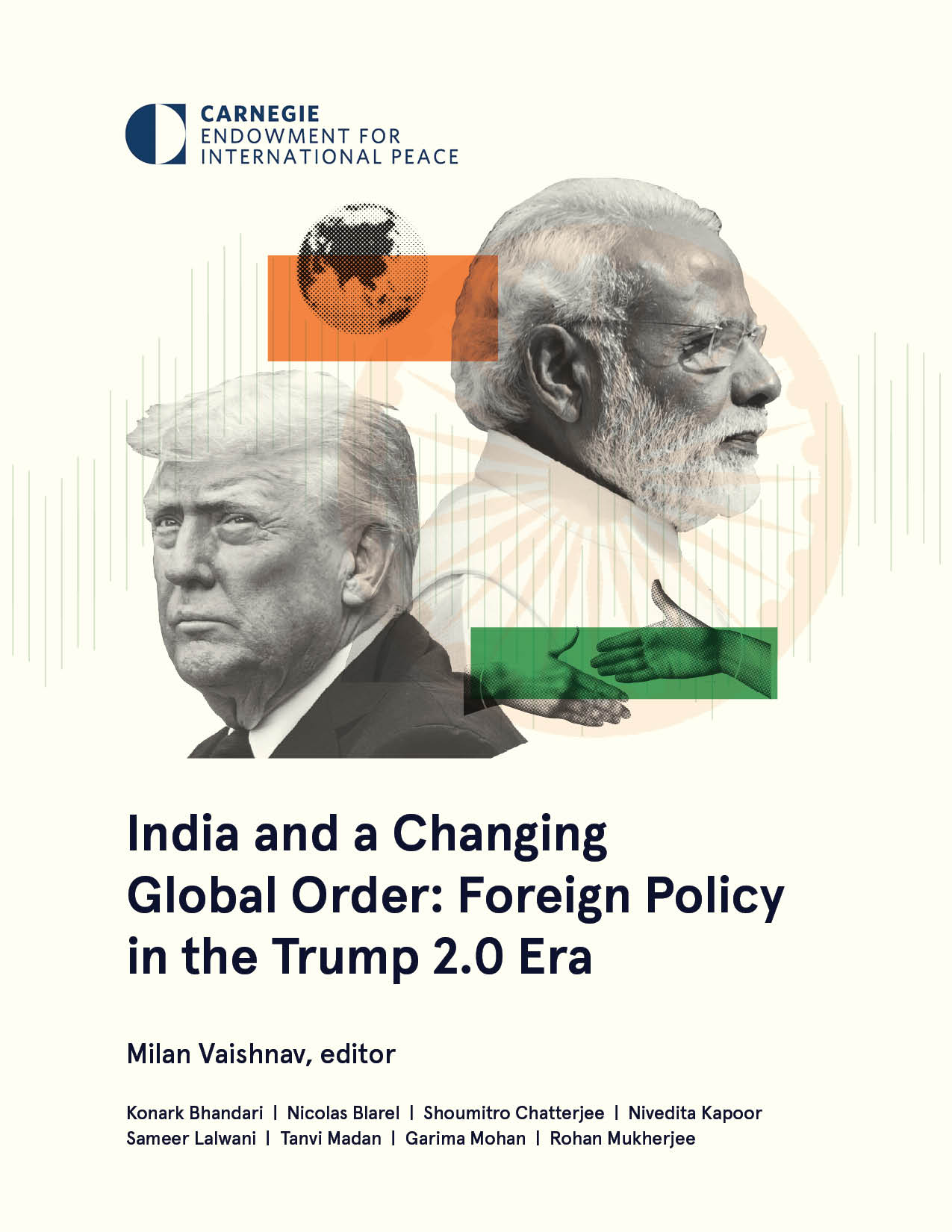
Trump 2.0 has unsettled India’s external environment—but has not overturned its foreign policy strategy, which continues to rely on diversification, hedging, and calibrated partnerships across a fractured order.

Milan Vaishnav, ed., Sameer Lalwani, Tanvi Madan, …