

Commentary
Aron Lund
{
  "authors": [
    "Aron Lund"
  ],
  "type": "legacyinthemedia",
  "centerAffiliationAll": "dc",
  "centers": [
    "Carnegie Endowment for International Peace",
    "Malcolm H. Kerr Carnegie Middle East Center"
  ],
  "collections": [
    "Arab Awakening"
  ],
  "englishNewsletterAll": "menaTransitions",
  "nonEnglishNewsletterAll": "",
  "primaryCenter": "Carnegie Endowment for International Peace",
  "programAffiliation": "MEP",
  "programs": [
    "Middle East"
  ],
  "projects": [],
  "regions": [
    "Middle East",
    "Syria",
    "Russia",
    "Levant"
  ],
  "topics": [
    "Political Reform",
    "Security",
    "Military",
    "Foreign Policy"
  ]
}
Source: Getty
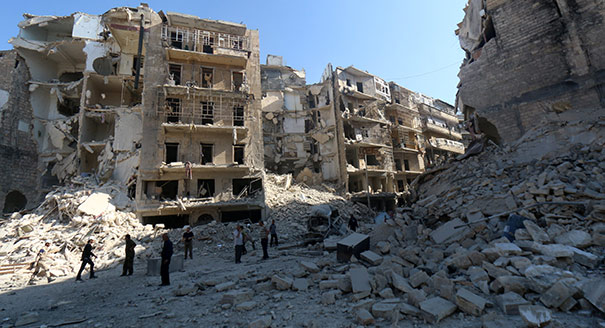
As violence grips Eastern Aleppo, few opportunities for peace and humanitarian assistance appear viable.
Source: Century Foundation
“In a maximum of two months, two and a half months, the city of eastern Aleppo at this rate may be totally destroyed,” United Nations Special Envoy Staffan de Mistura told a news conference in Geneva on October 6. “Thousands of Syrian civilians, not terrorists, will be killed and many of them wounded.”
For months, the Syrian and Russian air forces have pummeled the rebel-held enclave in Eastern Aleppo with high explosives and even incendiary weapons. Peace talks and truce plans have failed to make any headway, and the insurgents have failed in their repeated attempts to break the siege. De Mistura now turned to the Al Qaeda-offshoot, formerly known as the Nusra Front and now as Fateh al-Sham—which according to the UN has some 900 hundreds fighters holed up in Eastern Aleppo among a total of 8,000 insurgents—with a dramatic proposal:
“If you did decide to leave in dignity, and with your weapons, to Idlib or anywhere you wanted to go, I personally am ready physically to accompany you,” said de Mistura. The soft-spoken, 69-year-old Swedish-Italian diplomat would seem an unlikely sight on the cratered and rubble-strewn roads of Eastern Aleppo, but here he was, proposing himself as a solitary human shield to evacuate the jihadis in return for an end to the bombing.
Syria’s factions are not likely to take up the diplomat’s offer, if recent history is any guide. Yet, the government, and its backers, including Russia and Iran, seem confident that their strategy to encircle Aleppo will work, and that restoring control over Syria’s economic capital is now only a matter of time. Absent a major reversal of fortune, the Syrian government sees a path to a form of victory. Where does that leave the United Nations, or the United States and other rebel backers? More pressingly, where does it leave Syria’s civilians...
Former Nonresident Fellow, Middle East Program
Aron Lund was a nonresident fellow in the Middle East Program and the author of several reports and books on the Syrian opposition movement.
Recent Work
Aron Lund
Aron Lund
Carnegie India does not take institutional positions on public policy issues; the views represented herein are those of the author(s) and do not necessarily reflect the views of Carnegie, its staff, or its trustees.

In any defense establishment, change is an ongoing process. However, despite the best of intentions, existing bureaucracies, bound by habit and years of socialization, have their limits in implementing transformative change.

Anit Mukherjee

After the chill in ties between 2020 and 2024 that brought India–China relations to their lowest point in several decades, the two countries have engaged each other afresh. This paper argues that there are predominantly four imperatives guiding India’s approach to China, and they exist in an order of priority.

Saheb Singh Chadha

This piece argues that India’s central challenge is not managing a single flashpoint but resolving the underlying tension between expansion and institutional coherency of the BRICS grouping.

Vrinda Sahai

A partnership between India, a country of subcontinental size, and Africa, a continent of fifty-four countries, may seem asymmetric until one notes that both are home to nearly the same number of people—1.4 billion. This essay spells out the existing challenges to the partnership, its optimal potential, and the possible pathways to realize it over the next quarter-century.

Rajiv Bhatia

The India–EU Free Trade Agreement (FTA) is shaping up to be one of the most consequential trade negotiations, both economically and strategically. But, what’s in the agreement, what’s missing, and what will determine its success in the years ahead
Vrinda Sahai, Nicolas Köhler-Suzuki