
• Research
  • About
  • Experts
Carnegie India logoCarnegie lettermark logo
Technology
{
  "authors": [
    "Cornelius Adebahr",
    "Benedetta Berti",
    "Mohamed Eljarh",
    "Kristina Kausch"
  ],
  "type": "legacyinthemedia",
  "centerAffiliationAll": "dc",
  "centers": [
    "Carnegie Endowment for International Peace",
    "Carnegie Europe"
  ],
  "collections": [
    "Europe’s Southern Neighborhood"
  ],
  "englishNewsletterAll": "",
  "nonEnglishNewsletterAll": "",
  "primaryCenter": "Carnegie Europe",
  "programAffiliation": "EP",
  "programs": [
    "Europe"
  ],
  "projects": [],
  "regions": [
    "Middle East",
    "North Africa",
    "Iran"
  ],
  "topics": [
    "Security"
  ]
}

Source: Getty

In The Media
Carnegie Europe

Nonstate Actors in the Broader Southern Mediterranean

From peaceful political and social grassroots movements to violent extremists, nonstate actors can put pressure on flawed states by demanding accountability, justice, revolutionary change, or power.

Link Copied
By Cornelius Adebahr, Benedetta Berti, Mohamed Eljarh, Kristina Kausch
Published on Nov 1, 2016

Source: Konrad Adenauer Stiftung

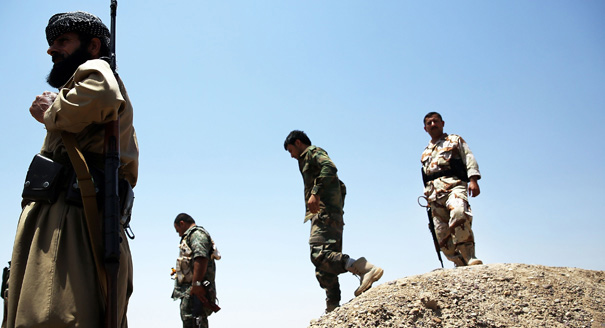
The state system in the Arab world is being challenged from within. Weak institutions, hollowed out for decades under successive authoritarian strongmen, are besieged by a myriad of newly empowered non-state actors. Spanning across widely diverse groupings, from peaceful political and social grassroots movements to violent extremists, non-state actors can put pressure on flawed states by demanding accountability, justice, revolutionary change, or power.

Deficient state institutions and enhanced socio-economic and security challenges have created governance vacuums in which prospective alternative providers have been able to thrive. However, the deterioration of state-citizen relations not only rests on the states’ failure to deliver services, but also on its fading value as a provider of a cohesive national identity. As sources of higher authority – such as Arab nationalism or royal families – lose ground, sectarian and communitarian sources of identity gain traction. States’ lacking capacity to provide social services and security has pushed many people to seek shelter and assistance within their traditional communities. At the same time, the strengthening of local identities makes consensus on how the shared state should be designed in order to accommodate the various communities’ needs and preferences increasingly difficult.

Governments have reacted to the global rise of non-state challengers in many different ways. The rise of the Islamic State (IS) as an expansionist territorial project and the spread of violent jihadi movements have led to military responses of different kinds and magnitude. At the same time, incumbent regimes have utilized the tangible security threat posed by violent extremism to justify pre-emptive repression of political and social grassroots movements which they perceive as a threat to their rule and privileges. Non-state actors have also increasingly become proxy agents in national conflict scenarios by state players who seek to further a larger regional agenda.

Who are the emerging influential non-state actors in the Southern Mediterranean; and how does their interplay with state institutions of a given territory affect local and regional security?

Read Full Text

This publication was originally published by the Konrad Adenauer Stiftung.

Authors

Cornelius Adebahr
Former Nonresident Fellow, Carnegie Europe
Cornelius Adebahr
Benedetta Berti

Berti is the head of policy planning in the office of the Secretary General at NATO.

Mohamed Eljarh
Kristina Kausch
Deputy Managing Director and Senior Fellow at the German Marshall Fund.
Kristina Kausch
SecurityMiddle EastNorth AfricaIran

Carnegie India does not take institutional positions on public policy issues; the views represented herein are those of the author(s) and do not necessarily reflect the views of Carnegie, its staff, or its trustees.

More Work from Carnegie India

  • Commentary
    The Impact of U.S. Sanctions and Tariffs on India’s Russian Oil Imports

    This piece examines India’s response to U.S. sanctions and tariffs, specifically assessing the immediate market consequences, such as alterations in import costs, and the broader strategic implications for India’s energy security and foreign policy orientation.

      Vrinda Sahai

  • Article
    Military Lessons from Operation Sindoor

    The India-Pakistan conflict that played out between May 6 and May 10, 2025, offers several military lessons. This article presents key takeaways from Operation Sindoor and breaks down how India’s preparations shaped the outcome and what more is needed to strengthen future readiness.

      Dinakar Peri

  • Book
    India and the Sovereignty Principle: The Disaggregation Imperative

    This book offers a comprehensive analysis of India's evolving relationship with sovereignty in a complex global order. Moving beyond conventional narratives, it examines how the sovereignty principle shapes India's behavior across four critical domains—from traditional military power to contemporary data governance.

      Rudra Chaudhuri, Nabarun Roy

  • Article
    Hidden Tides: IUU Fishing and Regional Security Dynamics for India

    This article examines the scale and impact of Chinese IUU fishing operations globally and identifies the nature of the challenge posed by IUU fishing in the Indian Ocean Region (IOR). It also investigates why existing maritime law and international frameworks have struggled to address this growing threat.

      Ajay Kumar, Charukeshi Bhatt

  • Book
    Violence and Development Along the India-Pakistan Border in Jammu and Kashmir

    This book examines the impact of cross-border violence on communities living along the Line of Control and the International Border in Jammu and Kashmir, India.

      Deep Pal, Surya Valliappan Krishna, Saheb Singh Chadha

Get more news and analysis from
Carnegie India
Carnegie India logo, white
Unit C-4, 5, 6, EdenparkShaheed Jeet Singh MargNew Delhi – 110016, IndiaPhone: 011-40078687
  • Research
  • About
  • Experts
  • Projects
  • Events
  • Contact
  • Careers
  • Privacy
  • For Media
Get more news and analysis from
Carnegie India
© 2026 Carnegie Endowment for International Peace. All rights reserved.





