

Research
- +8
William J. Burns, Michael Chertoff, Catherine Ashton, …
{
  "authors": [
    "William J. Burns"
  ],
  "type": "legacyinthemedia",
  "centerAffiliationAll": "",
  "centers": [
    "Carnegie Endowment for International Peace",
    "Carnegie Russia Eurasia Center"
  ],
  "collections": [],
  "englishNewsletterAll": "",
  "nonEnglishNewsletterAll": "",
  "primaryCenter": "Carnegie Endowment for International Peace",
  "programAffiliation": "",
  "programs": [],
  "projects": [],
  "regions": [
    "North America",
    "United States",
    "Russia"
  ],
  "topics": [
    "Foreign Policy"
  ]
}
Source: Getty
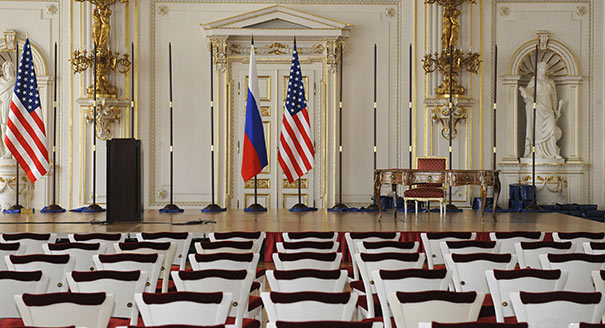
There should be no more illusions. The U.S. relationship with Russia will remain competitive, and often adversarial, for the foreseeable future.
Source: New York Times
In the quarter-century since the end of the Cold War, profound grievances, misperceptions and disappointments have often defined the relationship between the United States and Russia. I lived through this turbulence during my years as a diplomat in Moscow, navigating the curious mix of hope and humiliation that I remember so vividly in the Russia of Boris N. Yeltsin, and the pugnacity and raw ambition of Vladimir V. Putin’s Kremlin. And I lived through it in Washington, serving both Republican and Democratic administrations.
There have been more than enough illusions on both sides. The United States has oscillated between visions of an enduring partnership with Moscow and dismissing it as a sulking regional power in terminal decline. Russia has moved between notions of a strategic partnership with the United States and a later, deeper desire to upend the current international order, where a dominant United States consigns Russia to a subordinate role.
The reality is that our relationship with Russia will remain competitive, and often adversarial, for the foreseeable future. At its core is a fundamental disconnect in outlook and about each other’s role in the world.
It is tempting to think that personal rapport can bridge this disconnect and that the art of the deal can unlock a grand bargain. That is a foolish starting point for sensible policy. It would be especially foolish to think that Russia’s deeply troubling interference in our election can or should be played down, however inconvenient.
President Putin’s aggressive election meddling, like his broader foreign policy, has at least two motivating factors. The first is his conviction that the surest path to restoring Russia as a great power comes at the expense of an American-led order. He wants Russia unconstrained by Western values and institutions, free to pursue a sphere of influence.
The second motivating factor is closely connected to the first. The legitimacy of Mr. Putin’s system of repressive domestic control depends on the existence of external threats. Surfing on high oil prices, he used to be able to bolster his social contract with the Russian people through rising standards of living. That was clear in the boomtown Moscow I knew as the American ambassador a decade ago, full of the promise of a rising middle class and the consumption of an elite convinced that anything worth doing was worth overdoing. But Mr. Putin has lost that card in a world of lower energy prices and Western sanctions, and with a one-dimensional economy in which real reform is trumped by the imperative of political control and the corruption that lubricates it.
The ultimate realist, Mr. Putin understands Russia’s relative weakness, but regularly demonstrates that declining powers can be at least as disruptive as rising powers. He sees a target-rich environment all around him.
If he can’t easily build Russia up, he can take the United States down a few pegs, with his characteristic tactical agility and willingness to play rough and take risks. If he can’t have a deferential government in Kiev, he can grab Crimea and try to engineer the next best thing, a dysfunctional Ukraine. If he can’t abide the risk of regime upheaval in Syria, he can flex Russia’s military muscle, emasculate the West, and preserve Bashar al-Assad atop the rubble of Aleppo. If he can’t directly intimidate the European Union, he can accelerate its unraveling by supporting anti-Union nationalists and exploiting the wave of migration spawned in part by his own brutality. Wherever he can, he exposes the seeming hypocrisy and fecklessness of Western democracies, blurring the line between fact and fiction.
So what to do? Russia is still too big, proud and influential to ignore and still the only nuclear power comparable to the United States. It remains a major player on problems from the Arctic to Iran and North Korea. We need to focus on the critical before we test the desirable. The first step is to sustain, and if necessary amplify, the actions taken by the Obama administration in response to Russian hacking. Russia challenged the integrity of our democratic system, and Europe’s 2017 electoral landscape is the next battlefield.
A second step is to reassure our European allies of our absolute commitment to NATO. American politicians tell one another to “remember your base,” and that’s what should guide policy toward Russia. Our network of allies is not a millstone around America’s neck, but a powerful asset that sets us apart.
A third step is to stay sharply focused on Ukraine, a country whose fate will be critical to the future of Europe, and Russia, over the next generation. This is not about NATO or European Union membership, both distant aspirations. It is about helping Ukrainian leaders build the successful political system that Russia seeks to subvert.
Finally, we should be wary of superficially appealing notions like a common war on Islamic extremism or a common effort to “contain” China. Russia’s bloody role in Syria makes the terrorist threat far worse and despite long-term concerns about a rising China, Mr. Putin has little inclination to sacrifice a relationship with Beijing.
I’ve learned a few lessons during my diplomatic career, often the hard way. I learned to respect Russians and their history and vitality. I learned that it rarely pays to neglect or underestimate Russia, or display gratuitous disrespect. But I also learned that firmness and vigilance, and a healthy grasp of the limits of the possible, are the best way to deal with the combustible combination of grievance and insecurity that Vladimir Putin embodies. I’ve learned that we have a much better hand to play with Mr. Putin than he does with us. If we play it methodically, confident in our enduring strengths, and unapologetic about our values, we can eventually build a more stable relationship, without illusions.
Former Carnegie President (2015-2021)
A former career diplomat, William J. Burns served as director of the CIA, deputy secretary of State, and ambassador to Russia and Jordan. Burns was also president of the Carnegie Endowment for International Peace from 2015 to 2021.
Recent Work
William J. Burns, Michael Chertoff, Catherine Ashton, …
William J. Burns
Carnegie India does not take institutional positions on public policy issues; the views represented herein are those of the author(s) and do not necessarily reflect the views of Carnegie, its staff, or its trustees.

How is AI reshaping space security, creating governance challenges, and where does international diplomacy stand today?


Tejas Bharadwaj, Almudena Azcárate Ortega

After the chill in ties between 2020 and 2024 that brought India–China relations to their lowest point in several decades, the two countries have engaged each other afresh. This paper argues that there are predominantly four imperatives guiding India’s approach to China, and they exist in an order of priority.

Saheb Singh Chadha

This piece argues that India’s central challenge is not managing a single flashpoint but resolving the underlying tension between expansion and institutional coherency of the BRICS grouping.

Vrinda Sahai

A partnership between India, a country of subcontinental size, and Africa, a continent of fifty-four countries, may seem asymmetric until one notes that both are home to nearly the same number of people—1.4 billion. This essay spells out the existing challenges to the partnership, its optimal potential, and the possible pathways to realize it over the next quarter-century.

Rajiv Bhatia

The U.S.–India semiconductor cooperation story is well-stocked with top-level strategic intent. What remains unresolved, however, are some underlying challenges that will determine whether the cooperation actually functions. Three such friction points stand out.

Shruti Mittal