Source: Washington Post
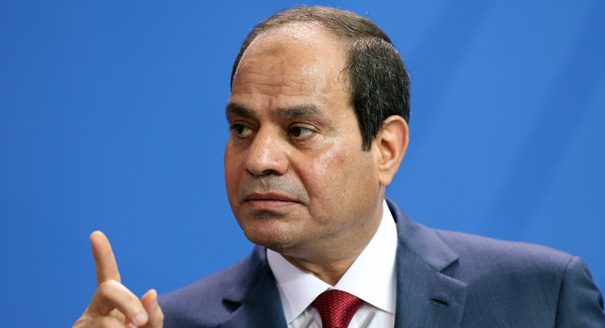
Egyptian President Abdel Fatah al-Sissi will be celebrated in Washington on Monday as a major ally in the fight against terrorism and radical Islamic extremism, as well as a supporter of U.S. efforts to bring peace and stability in the region. Unfortunately, he is neither.
Sissi’s brutal repression has made Egypt a mass-production facility for violent extremism. Terrorist incidents have increased dramatically, not decreased, since he took power in 2013. As for the region, Sissi supports the regime of Bashar al-Assad in Syria, and has offered unqualified endorsement of Russia’s increasing military presence throughout the Middle East.
And a friend of the United States? When it comes to taking American money, yes, Sissi is happy to receive the more than $1 billion that Congress reflexively votes Egypt each year. But meanwhile his state-manipulated media is filled with anti-Western diatribes, and Americans working in Egypt, and Egyptians who work with Western organizations, have faced trumped-up charges under increasingly harsh laws criminalizing not only funding but even contacts between Egyptians and foreigners.
Nonetheless, many in the administration and Congress persist in seeing Sissi as a stalwart ally. They should take a harder look. Egypt’s prisons, filled with thousands of young men and women arrested arbitrarily, then physically abused and tortured, have become incubators of radicalism. The suicide bomber who killed 29 in a Cairo church in December, for example, was a product of a brutal prison system where youths who may not have been radical before they go in become radical by the time they get out.
It’s not only Islamists who suffer repression. Sissi has cracked down on secular groups, from Egyptian human rights organizations to youth groups. One victim, typical of thousands of others except for the fact that she happens to be a U.S. citizen, is Aya Hijazi, inexplicably imprisoned for more than 1,000 days on artificial charges related to her work with street children.
Perhaps the greatest danger to Egypt’s stability is its disastrous economy. Here Sissi gets high marks in the United States for taking long-postponed moves such as floating the currency and reducing energy subsidies. But he has failed to take badly needed steps to train the burgeoning labor force and to encourage job creation in the private sector. According to official statistics, Egypt’s misery index in February was 45 percent: 33 percent core inflationplus 12 percent unemployment. Unemployment among Egyptians under 30 is much higher. Instead, Sissi has funneled billions into the vast business empire of the Egyptian military. Mega-construction projects such as the $8 billion Suez Canal expansion and the $45 billion new desert capital city keep the generals happy — and Sissi coup-proof.
The United States has a long record of blindly supporting whoever happens to hold the reins of power in Cairo. In the past seven years alone, it has supported the regime of Hosni Mubarak, the military government that took over from him, the government of the Muslim Brotherhood’s Mohamed Morsi and now Sissi. It has ignored their failings and looked the other way while they drove Egypt further into an economic and political ditch. And all the while, the United States has provided the same massive levels of aid in the same form without demanding anything in return. It has provided heavy weaponry that has no use whatsoever to fight terrorists or to secure borders, simply to keep the Egyptian military happy. It has treated Egypt like a partner in peace even as Egypt’s leadership has become irrelevant to peace efforts in the region.
A new administration offers a chance for a new look at this old and increasingly dysfunctional relationship. It’s time to get off autopilot. Sissi is coming to Washington to ask for more: more money, more weapons, more respect. President Trump should ask some hard questions about what the United States has been getting for the $77 billion it has already spent. He might press Sissi to change his counterterrorism tactics to make them more effective and less repressive. He might insist that Sissi release arrested Americans and stop trashing the United States in the no-longer-free media. He might suggest that Egypt’s economic policies put more unemployed youth to work rather than feed military projects and companies. He might demand that Sissi back the United States on Syria and other regional issues.
Trump isn’t shy about asking even our closest allies what they have done for us lately. He might during this visit ask that question of Sissi.
This article was originally published by the Washington Post.