

Commentary
Cornelius Adebahr
{
  "authors": [
    "Cornelius Adebahr"
  ],
  "type": "legacyinthemedia",
  "centerAffiliationAll": "dc",
  "centers": [
    "Carnegie Endowment for International Peace",
    "Carnegie Europe"
  ],
  "collections": [
    "Iranian Proliferation"
  ],
  "englishNewsletterAll": "ctw",
  "nonEnglishNewsletterAll": "",
  "primaryCenter": "Carnegie Europe",
  "programAffiliation": "EP",
  "programs": [
    "Europe"
  ],
  "projects": [],
  "regions": [
    "Middle East",
    "Europe",
    "North America",
    "United States",
    "Iran",
    "Western Europe"
  ],
  "topics": [
    "Foreign Policy",
    "Nuclear Policy",
    "Global Governance"
  ]
}
Source: Getty
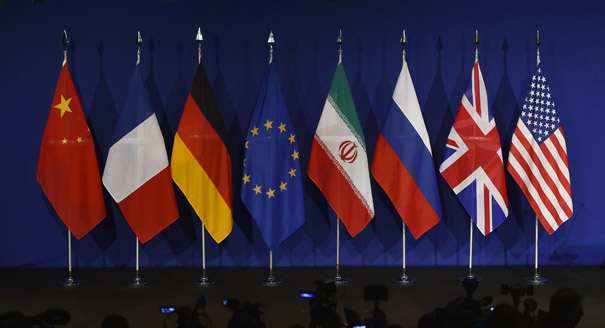
The European Union, the most vocal supporter of the JCPOA, does not have the means to uphold the deal in the face of the United States and Iran, the two most crucial signatories, trying to kill it.
Source: Global Policy
The geopolitical triangle between Europe, the United States, and Iran that brought about the nuclear deal is about to fall apart. Most obviously, the U.S. government led by President Donald Trump is in no mood to maintain the agreement strictly limiting Tehran’s civilian nuclear program so as not to allow for the manufacturing of an atomic bomb. In Iran itself, recently re-elected President Hassan Rouhani is struggling to fend of domestic challenges from his conservative rivals, who not only dislike the deal but also fear a more profound shift of the Islamic regime itself, now in its 38th year, towards a somewhat milder appearance. Finally, the EU – the most vocal supporter of the deal – does not have the means to uphold it in the face of the two most crucial signatories trying to kill it by a thousand small cuts.
Just how close Washington is to disavowing the deal became public in mid-July, when President Trump “only reluctantly” confirmed Iran’s compliance with the deal to the U.S. Congress. The latter mandates such confirmation every 90 days lest it re-impose the sanctions suspended under the 2015 deal, formally known as Joint Comprehensive Plan of Action (JCPOA). Already in mid-April, Trump had signalled his unwillingness to take this step, despite a lack of demonstrable evidence that Iran was not in compliance. Now again, with all his advisors pressing him to acknowledge Tehran’s compliance, President Trump made it clear that he simply did not want to do so – until he eventually budged.
Thus, just when the deal itself completed its second anniversary, on July 14, Trump barely avoided the United States openly violating it. Consequently, the sixth regular meeting of the Joint Commission overseeing the implementation of the JCPOA a couple of days later was a tense affair: The fact that there was a public statement could already be considered a success, though it only thinly veiled the open dispute with calls for “continued compliance” with the JCPOA “in good faith and in all its provisions”. Yet this hair-trigger situation will put the JCPOA in serious jeopardy every three months, any possible Iranian actions notwithstanding.
Meanwhile, over in Tehran, President Rouhani did not have the luxury of enjoying his decisive electoral win of May for long. His conservative rivals immediately pushed back against the possibility of implementing any of his farther-reaching campaign promises and turning them into real reforms: Supreme Leader Ali Khamenei warned against further negotiations with and more economic opening towards the West, while high-ranking clerics are thought to be behind Rouhani’s choice of an all-male, all-Shia cabinet with no minority – such as Kurds, Turkmens and Baluchis, who are usually Sunnis – or youth representatives.
Rouhani announced his cabinet picks in early August, just a few weeks after his brother – and presidential adviser – Hossein Fereydoun was arrested on financial charges and later set free on bail. The timing of the detention appeared to be intended to provide pressure to come up with a cabinet that reflected the interests of the conservative establishment. Two weeks later, Iran’s parliament, the Majles, approved all ministers but one.
Finally, the EU maintains an “unwavering commitment to the deal” it helped bring about, yet it is unclear which means it could bring to bear to defend it – and defending it needs. EU High Representative Federica Mogherini used her presence in Tehran at Rouhani’s presidential inauguration on August 5 – which some Iranian lawmakers cherished for the opportunity to take selfies with Brussels’ top diplomat – to display the EU’s role as the JCPOA’s guardian while also discussing an expansion of European-Iranian bilateral relations. Rouhani returned the favour by praising Europe for its support and warning the United States of breaking the deal.
Yet such display of harmony cannot gloss over two facts: First, also the Europeans, notable the three member states participating in the nuclear negotiations (France, Germany, and the United Kingdom, also called the E3) are greatly worried about Iran’s regional expansion in the Middle East as well as over its ballistic missile program. In a joint statement, the E3 and the United States condemned Iran’s most recent test of a space launch missile on July 27 as “inconsistent with UN Security Council Resolution (UNSCR) 2231”, the resolution endorsing the JCPOA. However, they know that it is not President Rouhani and his government who control these parts of Iran’s foreign policy but the Supreme Leader and the Revolutionary Guards, with whom they have little contact.
Second, there is little the EU can put in the way of stopping the United States to break the deal if the latter was to decide so. It neither has the means to cajole Washington to continue its implementation, nor could it ‘pick up the tap’ and replace a failing U.S. commitment with its own measures. Even with U.S. encouragement under President Obama European banks and firms were hesitant to engage in legitimate business with Iran; no company would do so in the face of active U.S. pressure to disinvest.
Finally, despite the deal’s virtues and its importance as a European diplomatic success, EU-Iran relations are simply not important enough to risk (further) transatlantic estrangement at a time of global turmoil. More important disputes between the Europeans and the Trump administration include maintaining the North Atlantic alliance itself and confronting Russia (or not), dealing with the Middle East more broadly and the Syrian and Israeli-Palestinian conflicts in particular, avoiding a global trade war, and maintaining the global compact on climate change.
This challenge mostly leaves the Europeans with only diplomatic pressure to put on both Iran and the United States, calling on them to refrain from abandoning the deal either directly through its violation or indirectly through negligence – and with the hope that either international events or domestic developments will distract the hotheads on both sides from pursuing their goal of dismantling this singular multilateral agreement.

Former Nonresident Fellow, Carnegie Europe
Cornelius Adebahr was a nonresident fellow at Carnegie Europe. His research focuses on foreign and security policy, in particular regarding Iran and the Persian Gulf, on European and transatlantic affairs, and on citizens’ engagement.
Recent Work
Cornelius Adebahr

Cornelius Adebahr, Barbara Mittelhammer
Carnegie India does not take institutional positions on public policy issues; the views represented herein are those of the author(s) and do not necessarily reflect the views of Carnegie, its staff, or its trustees.

How is AI reshaping space security, creating governance challenges, and where does international diplomacy stand today?


Tejas Bharadwaj, Almudena Azcárate Ortega

After the chill in ties between 2020 and 2024 that brought India–China relations to their lowest point in several decades, the two countries have engaged each other afresh. This paper argues that there are predominantly four imperatives guiding India’s approach to China, and they exist in an order of priority.

Saheb Singh Chadha

This piece argues that India’s central challenge is not managing a single flashpoint but resolving the underlying tension between expansion and institutional coherency of the BRICS grouping.

Vrinda Sahai
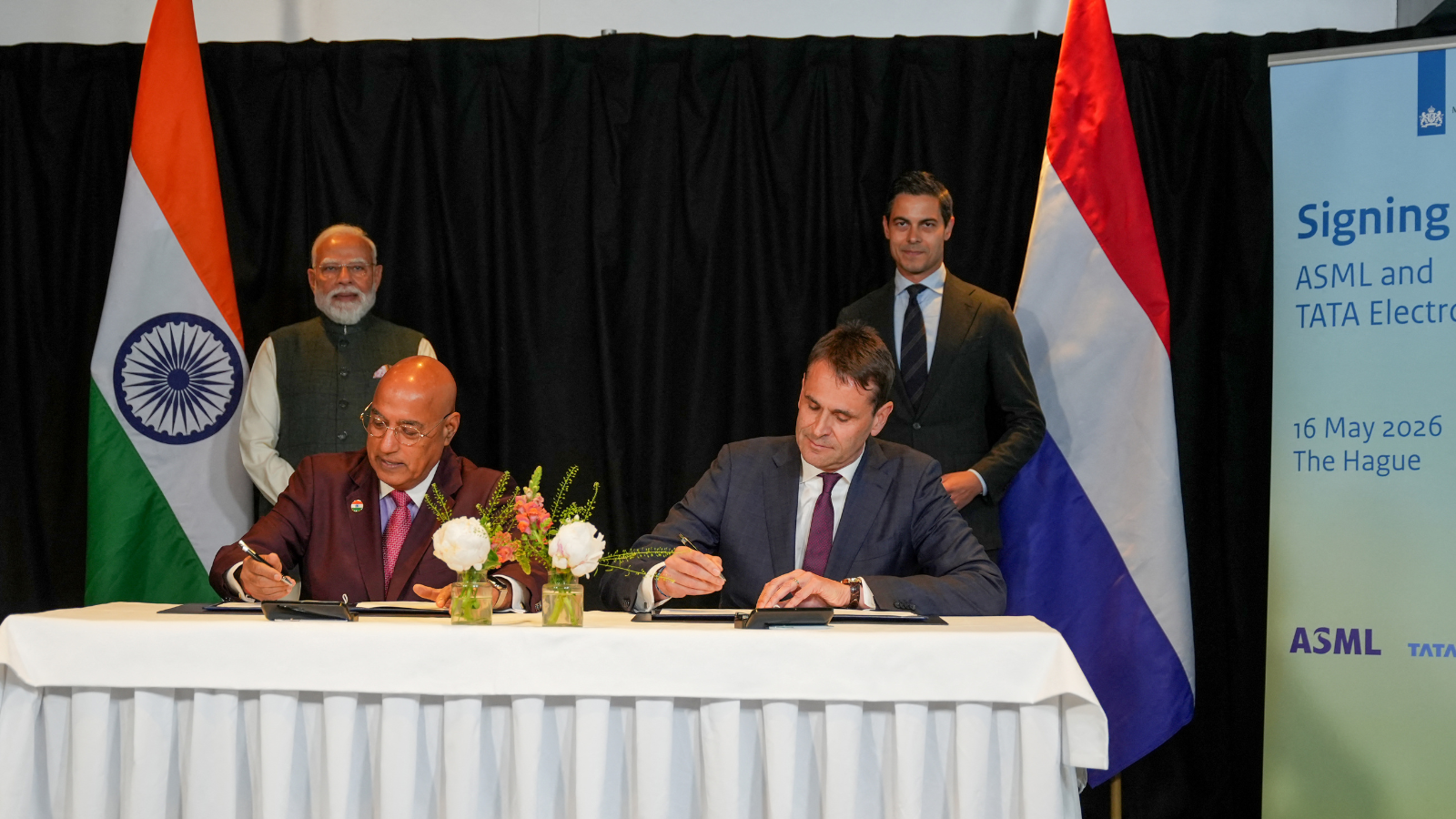
The ASML MoU with Tata Electronics is an indicator of how far the Indian semiconductor ecosystem has come. This ecosystem has been years in the making and represents real commercial logic.

Konark Bhandari

A partnership between India, a country of subcontinental size, and Africa, a continent of fifty-four countries, may seem asymmetric until one notes that both are home to nearly the same number of people—1.4 billion. This essay spells out the existing challenges to the partnership, its optimal potential, and the possible pathways to realize it over the next quarter-century.

Rajiv Bhatia