

Research
Cornelius Adebahr, Barbara Mittelhammer
{
  "authors": [
    "Cornelius Adebahr"
  ],
  "type": "commentary",
  "blog": "Strategic Europe",
  "centerAffiliationAll": "",
  "centers": [
    "Carnegie Endowment for International Peace",
    "Carnegie Europe"
  ],
  "englishNewsletterAll": "",
  "nonEnglishNewsletterAll": "",
  "primaryCenter": "Carnegie Europe",
  "programAffiliation": "",
  "programs": [],
  "projects": [],
  "regions": [
    "Iran",
    "Europe",
    "Gulf"
  ],
  "topics": [
    "Nuclear Policy",
    "Foreign Policy",
    "EU"
  ]
}
Source: Getty
For too long, the EU focused on Iran’s nuclear program while mostly ignoring its malign regional activities and missile program. As the consequences of both hit closer to home, the union must pursue a new strategy focused on containing Iran’s regime, supporting Iranian civil society, and engaging with Gulf states.
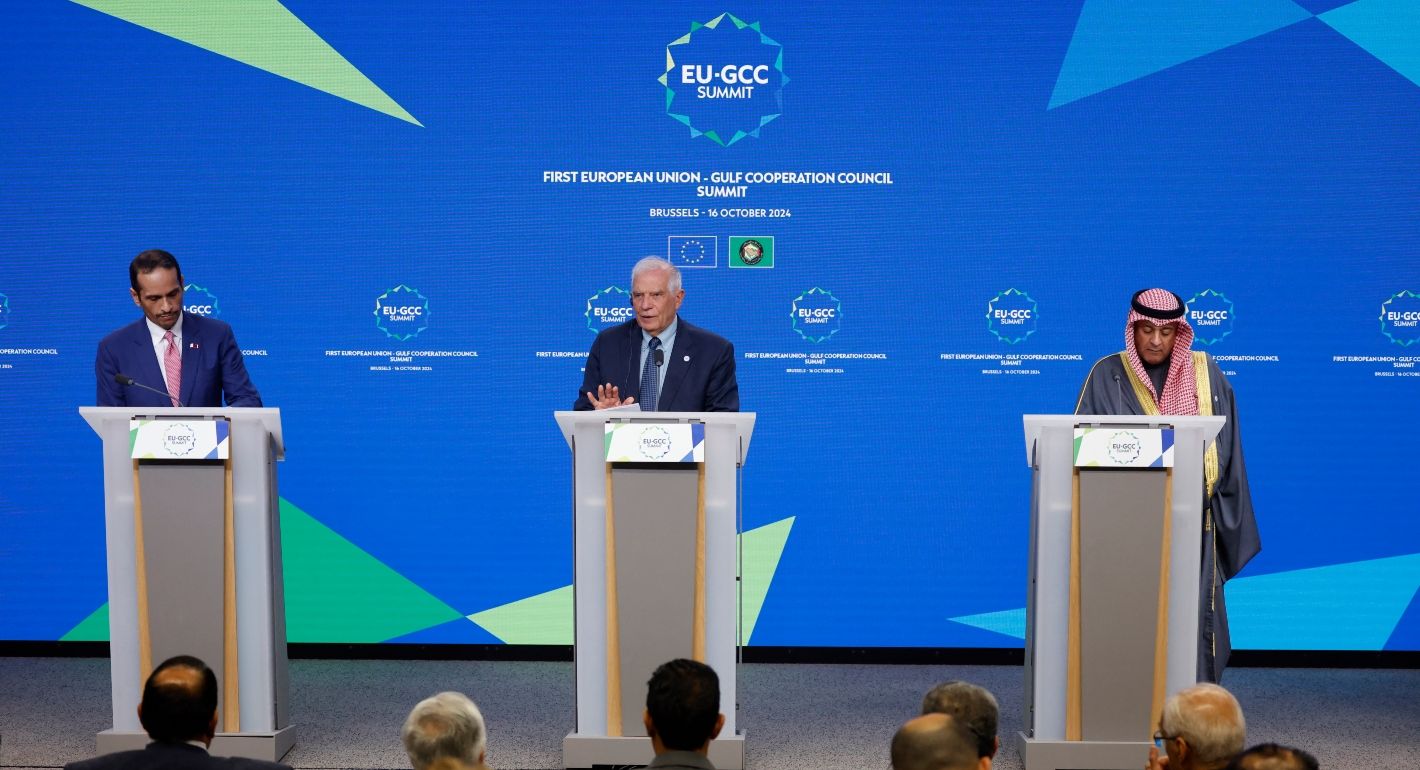
At the Foreign Affairs Council meeting on October 14, EU member states’ ministers again ramped up the pressure on Iran by sanctioning its companies and airlines. Two days later, the EU held its first summit with countries from the Gulf Cooperation Council (GCC).
What European leaders have not yet done, however, is think about the challenges Iran and the region present in a holistic way. That includes assessing why the EU’s past and present Iran strategies have not borne fruit.
A sober reckoning had been long overdue, even before Hamas’s terrorist attack in October 2023 and Israel’s subsequent multi-front war caused the region to unravel. Today, the Middle East is careening toward a Sarajevo moment that could spark a global war. Yet, the EU continues to fiddle, clinging to long-held policy paradigms—“More sanctions! But the nuclear deal! And the two-state solution!”—while being drowned out by the noise from the parties involved.
EU member states need to urgently recalibrate their approach toward Iran based on established European interests. This should include three main tracks: containing the Iranian regime more forcefully in its conventional activities, supporting Iranian civil society in its own right and as an investment into the future, and engaging Iran’s Arab neighbors with a view to sparking discussions on regional security.
For far too long, the EU closed its eyes to a changing reality in the region. After Washington abandoned the Iran nuclear deal in 2018, European capitals focused primarily on its resurrection, with little regard for—but some handwringing over—the dire human rights situation in Iran and a merely half-hearted pushback on Tehran’s malign power projection through a network of armed groups it has sponsored, and only after Iranian drones entered the Ukrainian battlefield. Approaching Iran in such a selective way has clearly proved insufficient. The deterioration of established guardrails after Washington’s withdrawal from the nuclear deal demonstrated that any EU strategy needs to stand on its own feet.
The Europeans need to find a strategic answer to both a no-holds-barred Israeli government that has no long-term strategy for its multi-front war and an Iranian regime that wreaks havoc in the region and mistreats its own people. While the EU has begun to react to Tehran’s material support for Russia’s war against Ukraine, it is still lagging behind when it comes to Iran’s nefarious activities on European soil, including cyber-attacks and threats to political figures, institutions, and dissident groups.
The EU’s narrowly defined security interests have long been affected by the Islamic Republic’s actions, whether the latter’s defiance of key nuclear non-proliferation mechanisms, its open support for regional militias, or its clandestine operations in Europe. While the scale of the Iranian threat is not comparable to that posed by Russia or China, the latter two powers’ increasingly close relationship with Tehran underscores a geopolitical realignment that diminishes overall Europe’s security.
EU member states have also had to deal with the humanitarian consequences of the wars in the Middle East and beyond. Given how the refugee flows from nearly a decade ago contributed to a change in Europe’s domestic political scene that threatens its democratic foundations, a ceasefire in Gaza and Lebanon is of essential import for the continent.
The EU should therefore work to bolster its strategic approach in three ways.
First, the EU needs to get more serious about containing the Islamic Republic’s malign activities. This includes sanctions enforcement on missile and drone exports, including through a better understanding of their production and financing, but also bolstering the Aspides naval mission in the Persian Gulf. And it extends to working on the contours of a revised nuclear deal today so that it can be put in place soon after the U.S. election in November. The sooner the better, as Tehran is now seriously considering the nuclear option to establish its own deterrence.
Second, the EU should agree on an institutional policy of material support for Iranian civil society inside Iran as well protecting those fleeing the country and diaspora members in EU states. This would be a necessary complement to the containment of the Iranian government, among other things to signal that it distinguishes between the ruling system and the population.
Finally, collaborating with GCC countries on a common approach to collective security in the region would be mutually beneficial for the EU and the Middle East. This would include expanding the European maritime mission in the Strait of Hormuz while building on the diplomatic and political tracks that the GCC have been establishing with Iran. The first EU-GCC summit held in Brussels on October 16 opened up a pathway for Europeans to consider the neighbors’ views on Iran, both the long-standing animosity and the recent rapprochement around the cautious Saudi-Iranian détente. In their joint statement the EU and the GCC emphasized the importance of “diplomatic engagement with Iran to pursue regional de-escalation” and of “ceasing [the] proliferation of ballistic missiles and unmanned aerial vehicles and any technologies that threaten the security of both our regions.” They also regretted Iran’s “unabated nuclear advances.” The statement avoided a harsher condemnation of Iran to accommodate the delicate balance Gulf countries are trying to strike between preserving the truce they have struck with Iran and the need to end the war that its proxies are engaged in with Israel.
Though none of the above would, on its own, end the explosive escalation in the region, it would improve the ability of Europeans to weigh, as sovereign actors, on an arena that has a direct destabilizing impact on the continent.
Former Nonresident Fellow, Carnegie Europe
Cornelius Adebahr was a nonresident fellow at Carnegie Europe. His research focuses on foreign and security policy, in particular regarding Iran and the Persian Gulf, on European and transatlantic affairs, and on citizens’ engagement.
Recent Work

Cornelius Adebahr, Barbara Mittelhammer

Cornelius Adebahr, Barbara Mittelhammer
Carnegie does not take institutional positions on public policy issues; the views represented herein are those of the author(s) and do not necessarily reflect the views of Carnegie, its staff, or its trustees.

The EU can impose sanctions but struggles to enforce them without the United States. With Washington increasingly disinterested in backing European interests, the bloc must now fend for itself.


Nicu Popescu, Tiago Antunes

Russia is testing the waters of NATO’s mutual defense clause. What do strikes in Romanian territorial waters mean for the alliance’s posture toward Moscow?

Dimitar Bechev

With its public finances in shambles, the far right polling at 35 percent ahead of the 2027 presidential election, and a growing protest movement, is France’s crisis a threat to the EU’s geopolitical awakening?

Rym Momtaz, ed.

Ahead of a tough winter for Ukraine, Donald Trump’s swing back toward Russia bodes ill. But instead of panicking, Kyiv’s European allies are focusing on action.
Rym Momtaz

While the EU and European governments are embracing the much-lauded middle-power moment, this entails three difficult conundrums.

Richard Youngs