

Commentary
Andrey Pertsev
{
  "authors": [
    "Andrey Pertsev"
  ],
  "type": "commentary",
  "centerAffiliationAll": "",
  "centers": [
    "Carnegie Endowment for International Peace",
    "Carnegie Russia Eurasia Center"
  ],
  "collections": [
    "Inside Russia"
  ],
  "englishNewsletterAll": "",
  "nonEnglishNewsletterAll": "",
  "primaryCenter": "Carnegie Russia Eurasia Center",
  "programAffiliation": "",
  "programs": [],
  "projects": [],
  "regions": [],
  "topics": [
    "Economy"
  ]
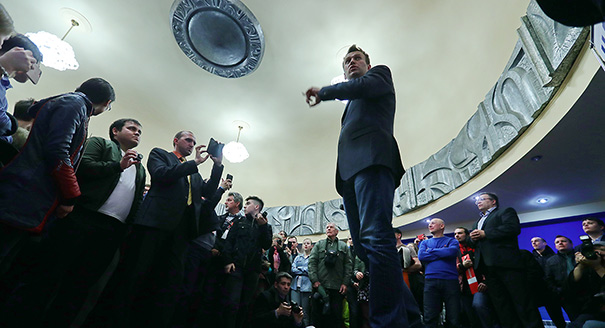
}
Source: Getty
Is opposition leader Alexei Navalny a “Kremlin project,” a “future tyrant,” or “Russia’s only hope?” Conversations about Navalny often proceed along these moral lines, though it is Navalny’s practicality—especially in the technological realm—that has been the driving force of his popularity.
Left Front leader Sergei Udaltsov’s release from prison and his subsequent criticism of opposition leader Alexei Navalny have sparked renewed discussions about what Russia would look like under a Navalny presidency. These conversations often take place along moral lines: “Would he be a tyrant?” and “Is he better or worse than Putin?” are common refrains in Russia today.
The source of Navalny’s popularity is no secret; one need only to compare him to Udaltsov to understand why he has become the uncontested leader of Russia’s opposition movement. Udaltsov is ideological and charismatic but has only a limited following, both because he is uninterested in addressing the very real issues facing Russians and because he has been unable to harness the Internet to cultivate support.
Navalny is the exact opposite. In the early days of his career as a politician, his fandom was largely an online phenomenon. This initially hurt him: the fact that this energy was focused on the Internet impeded the 2011–2012 anti-Putin demonstrations, as Navalny’s atomized online base was unable to organize formal protest structures. But his campaign headquarters for his bid in the 2013 Moscow mayoral election became this kind of offline structure, helping bring his Internet fan base into the real world. Now, Navalny is putting this experience to use in his campaign for the presidency (though his criminal record technically makes him ineligible to run).
Whatever government propaganda may say about his support base, the fact is that Navalny now has a sizeable following, including in the regions. These followers are sincere in their convictions, and are politically active and well organized. When people start asking, “If not Putin, then who?” somebody nearby can reasonably be expected to respond: “We have Navalny.” No Russian politician has a comparable network, including Vladimir Putin.
Navalny is the only Russian politician to employ modern technology to connect with the public. For example, Navalny seems to have opened campaign headquarters in cities where the offices’ opening ceremonies might attract large crowds. His team has used a calculated social media strategy to spread images of these celebrations, which depicted a variety of people signing up to volunteer—young people, successful members of the middle class, and pensioners. “Don’t be shy, you’re not alone,” these photos seem to say.
And people haven’t been shy. Navalny’s headquarters have given members of the opposition a chance to meet, communicate with each other, and feel like they aren’t alone. Importantly, they have given volunteers the ability to act, even if that only means handing out fliers on the street. Outraged members of the opposition no longer have to stay at home in discontent; they can do something to change the leadership in their country.
The increase in access to the Internet in Russia has also massively aided Navalny’s ascent. According to polling by the Russian Public Opinion Research Center, television remains the main source of news for 52 percent of the population (though two years ago this number stood at 62 percent). But only 46 percent of Russians trust television if they are interpreting conflicting information (down from 60 percent two years ago). Crucially, the Internet has become the main source of information for 32 percent of the country (up from 22 percent in 2015).
The state also helps Navalny’s cause: the security services regularly search and tear up his campaign offices, arresting volunteers and, ultimately, bringing the opposition closer together.
Unlike in 2013, fighting corruption isn’t Navalny’s only talking point now. He is pushing to increase the monthly minimum wage to 25,000 rubles and to double education and public health spending. This is music to the ears of the paternalistically-minded Russian electorate.
As a result, many accuse Navalny of being a populist. And he is, like many other Russian politicians. In Russia, the role of populist-in-chief was played by Vladimir Putin in the early 2000s. Later, the state limited the types of promises other political forces could make so they wouldn’t step on his toes.
Navalny’s campaign platform is based on the idea that if bureaucrats stop stealing and the security strongmen receive less of the budget, there will be enough money in Russia for everything people actually want—roads, wages, pensions, medicine, and education. This position is understandably popular.
In short, Navalny is merely stepping into territory that the state and the in-system opposition have abandoned. The Kremlin no longer plays to the demands of paternalism and populism, though those demands remain strong.
The propaganda that began to take over airspace after the annexation of Crimea has helped Navalny. Many Russians are now thinking in binary terms—good and bad, black and white. In this system, Navalny, who has for many years called himself the only opposition to Vladimir Putin, is able to cultivate support by using the same propagandistic language as the regime.
But this inclination toward absolutes may ultimately be a serious disadvantage for Navalny; he doesn’t know how to meet anyone halfway, including his own supporters.
This has been a successful tactic so far. People who sympathize with Navalny condemn any criticism directed at him without thinking twice. The idea is that any criticism harms the opposition’s cause because it helps Putin. Most social media posts and even op-eds by notable scholars end thusly: Navalny may have his problems, but he is the only one fighting against “abominable corruption” and so is a priori always right. This position is very pleasing to Navalny and his staff, giving them little reason to change.
It is naive to talk about Navalny as a tyrant-to-be. But his political style is clearly authoritarian and monological. In 2013, he began shutting out journalists, even those who knew his press secretary personally. Now, he seems to believe that media coverage is altogether unnecessary, since he can deliver the only point of view that matters in a short blog post.

Andrey Pertsev is a journalist with Meduza website.
Recent Work
Andrey Pertsev
Andrey Pertsev
Carnegie India does not take institutional positions on public policy issues; the views represented herein are those of the author(s) and do not necessarily reflect the views of Carnegie, its staff, or its trustees.

On March 10, 2026, India’s Union Cabinet approved amendments to Press Note 3, a regulation that mandated government approval on all foreign direct investment (FDI) from countries sharing a land border with India. This amendment raises questions primarily about whether its stated benefits will materialize and if the risks have been adequately weighed. This piece will address the same.

Konark Bhandari

This piece examines India’s response to U.S. sanctions and tariffs, specifically assessing the immediate market consequences, such as alterations in import costs, and the broader strategic implications for India’s energy security and foreign policy orientation.

Vrinda Sahai

This paper examines the evolution of India-China economic ties from 2005 to 2025. It explores the impact of global events, bilateral political ties, and domestic policies on distinct spheres of the economic relationship.

Santosh Pai
The India-U.S. relationship currently appears buffeted between three “Ts”—TRUST, Tariffs, and Trump.
Arun K. Singh
This article argues that the geopolitical circumstances have never been more conducive, not merely for the early conclusion of the free trade agreement (FTA) between India and the EU, but also for crafting a substantive and comprehensive strategic partnership.

Mohan Kumar