

Commentary
Andrey Pertsev
{
  "authors": [
    "Andrey Pertsev"
  ],
  "type": "commentary",
  "blog": "Carnegie Politika",
  "centerAffiliationAll": "",
  "centers": [
    "Carnegie Endowment for International Peace",
    "Carnegie Russia Eurasia Center"
  ],
  "englishNewsletterAll": "",
  "nonEnglishNewsletterAll": "",
  "primaryCenter": "Carnegie Russia Eurasia Center",
  "programAffiliation": "",
  "regions": [
    "Russia"
  ],
  "topics": [
    "Domestic Politics",
    "Civil Society",
    "Technology"
  ]
}
Source: Getty
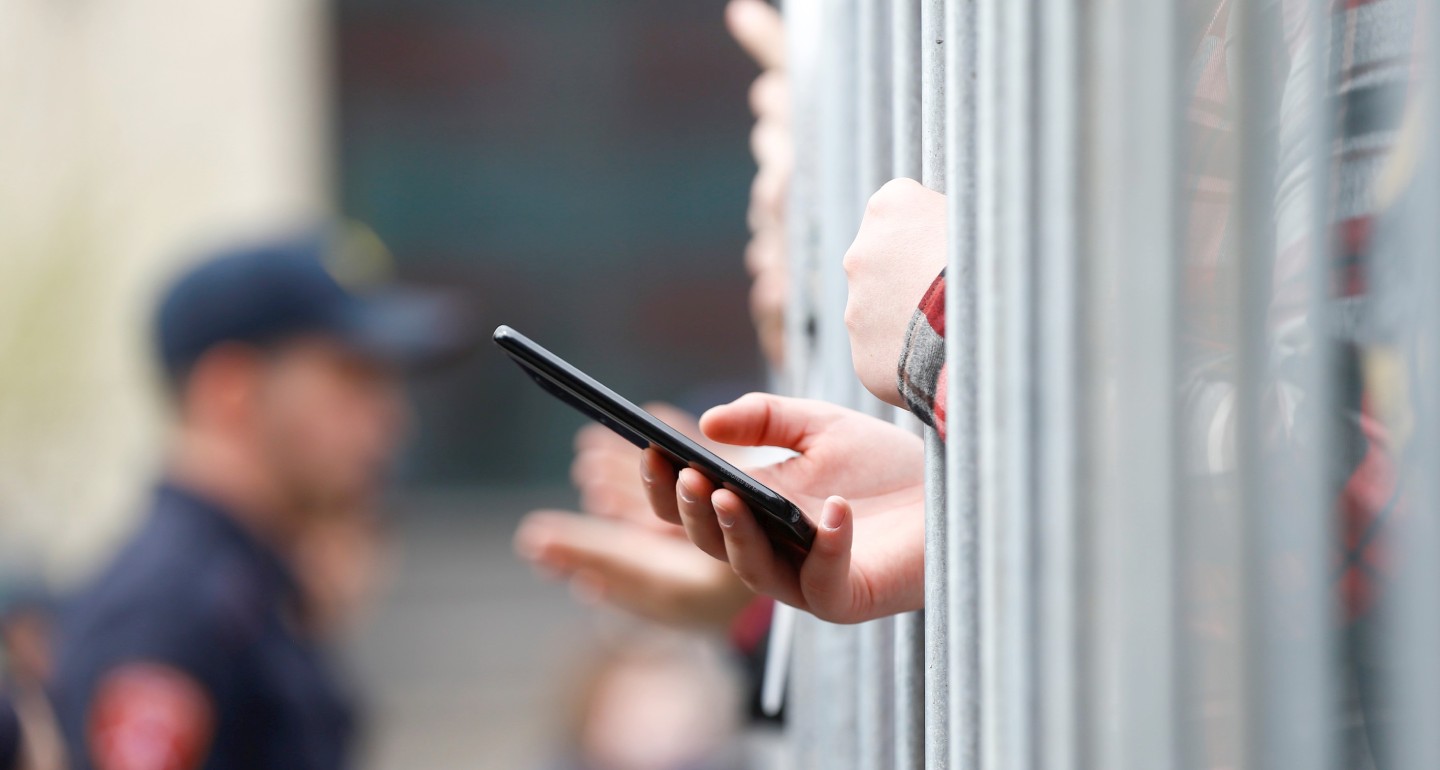
The prospect of a total block on Russia’s most popular messaging app has sparked disagreement between the regime’s political managers and its security agencies.
Russia’s political system has never allowed the country’s elites to publicly display dissent when it comes to sensitive topics. But this unwritten rule has been broken amid recent arguments about the blocking of the popular messaging service Telegram and strong-arming people to replace it with the homegrown Max.
Several political parties, some governors, and a series of pro-regime commentators have all come out in support of Telegram. Significantly, the Kremlin’s political managers—for whom Telegram is an important tool for mobilizing voters ahead of September parliamentary elections—have done nothing to muzzle them. As the elite’s internal rifts over Telegram come out into the open, it reinforces a sense that Russia’s whole political system is becoming unbalanced.
This is not the first time the Russian authorities have tried to block Telegram, which was founded by the Russian tech entrepreneur Pavel Durov, who now lives abroad. Their first attempt was back in 2018, when the app began to emerge as an alternative source of information amid growing censorship. That attempt failed because the government simply did not have the technological capability required. Two years later, Telegram was officially pardoned.
Since then, Telegram’s popularity has grown significantly. The presidential administration came to see it as a convenient way to influence public opinion: officials and politicians created their own Telegram networks, and would push their agendas by passing information and ideas to anonymous channels.
As it was so widely used, Telegram also became an important part of efforts to boost voter turnout. The Kremlin’s political managers set up chats to liaise with Russian business, which, in turn, exhorted employees to vote. Telegram became a handy tool for officials, helping them do everything from shaping public opinion to manipulating electoral outcomes.
However, Russia’s security agencies see any platform that allows the free exchange of information as a source of danger. Under their logic, Telegram must be shut down because it cannot be controlled: it does not have a legal entity in Russia, and its leadership is only prepared to make concessions on a few select issues.
The invasion of Ukraine in 2022 became an additional pretext for banning undesirable messaging apps and services. The first to be restricted were Instagram and Facebook: as they weren’t used by officials for work, they were the most vulnerable. Then it was the turn of Viber, which was popular with the general public, but less so among the elites.
Renewed discussions about blocking Telegram began after the 2024 terrorist attack on Moscow’s Crocus City concert hall. Back then, officials appeared to defend Telegram, and instead let the security agencies block another major online resource: the video-sharing site YouTube. Although phone calls via WhatsApp and Telegram were blocked in 2025, the presidential administration was counting on continuing to use Telegram channels and chats to disseminate information and mobilize voters up to the State Duma elections in September 2026.
However, the security agencies appear to have been given the green light to move faster. The prospect of the worsening economic situation in Russia triggering street demonstrations strengthened the case being made by security officials, who likely argued that threats should be nipped in the bud. As a former intelligence officer, President Vladimir Putin understands their reasoning only too well.
Nevertheless, the prospect of losing Telegram has led to a highly unusual conflict within the elites. Some of the most high-profile opponents have been from Russia’s so-called “in-system opposition”: parties that are represented in the Duma and are generally loyal to Putin.
One of the most notable is the State Duma’s deputy speaker, Vladislav Davankov, a former presidential candidate for the New People party who is seen as being close to Kremlin deputy chief of staff Sergei Kiriyenko. New People set up a petition opposing the blocking of Telegram. The Just Russia party has also criticized the measures, while the Liberal Democrat Party of Russia (LDPR) suspended one of its deputies for speaking out in favor of the ban.
Political experts and spin doctors affiliated with the Kremlin have also leapt to Telegram’s defense. Putin’s spokesperson Dmitry Peskov was ambiguous in his comments on the issue, urging Telegram’s management to be “flexible” in its dealings with the Russian authorities. The governor of the Belgorod region, which borders Ukraine, has also said publicly that he is worried about losing Telegram. In particular, he highlighted the risks of a forced transition to Max, the Kremlin’s home-grown equivalent, which does not make it possible to send push notifications about the threat of incoming missiles and drones.
The prospect of Telegram being blocked entirely presents Kiriyenko with something of a dilemma. On the one hand, he would benefit in that his son Vladimir is in charge of VK, the company that developed Max. On the other hand, Kiriyenko is responsible for the results of the September parliamentary elections. Telegram is a key part of campaigning and mobilizing voters in support of the regime.
Even more concerningly, the blocking of Russia’s most popular messaging app could trigger discontent, with unpredictable consequences. That’s the last thing Kiriyenko needs in the run-up to what are already expected to be challenging elections.
Of course, Kiriyenko is hardly a champion of free speech. He simply sees Telegram as an effective tool that is needed in a specific situation until a particular time. It’s very likely that there would be far less elite opposition to blocking Telegram after the elections.
However, the public objections apparently sanctioned by Kiriyenko have amplified the voices of other pro-regime critics, including pro-war bloggers and soldiers who use Telegram to coordinate and to earn money.
Despite the speed with which Kiriyenko’s influence has expanded in recent years, he is not ready for an open conflict with Russia’s security agencies. Kiriyenko’s political managers are just letting off steam—and they have refrained from using the more powerful tools at their disposal. But censorship and the establishment’s usual silence on such topics mean even these modest public criticisms have resonated loudly with a society weary of war.
The split within the Russian elite over Telegram should not be exaggerated, not least because it is a split over methods rather than ideas. It is enough for now, however, to prevent the messaging app’s fate from being sealed. Different outcomes are still possible, from a total block to partial restrictions or even a formal block with a tacit acknowledgement that those for whom Telegram is important can continue to use it.

Andrey Pertsev is a journalist with Meduza website.
Recent Work
Andrey Pertsev
Andrey Pertsev
Carnegie does not take institutional positions on public policy issues; the views represented herein are those of the author(s) and do not necessarily reflect the views of Carnegie, its staff, or its trustees.
Russia spent years building a “sovereign internet,” concentrating web infrastructure exclusively within Russian territory. Ukrainian drone attacks have shown how vulnerable that approach has left the Russian internet.

Maria Kolomychenko

Putin’s conservative staffing policies and search for ever greater control have cemented parliament’s transformation into a bureaucratic appendage of the executive branch.
Andrey Pertsev

Ex-president Gurbanguly Berdimuhamedov remains interested in politics, but his son Serdar, Turkmenistan’s current president, is becoming increasingly independent and willing to break with his father’s legacy. If their covert rivalry goes too far, both risk losing power.

Galiya Ibragimova

For every ruble allocated to social policy, health, and education in 2027, double that amount is earmarked for the army, the police, and the security services.

Alexandra Prokopenko
An analysis of traffic accident data suggests that Ukrainian drone attacks caused a material but not disastrous fall in Russian gasoline consumption over the summer.

Sergey Vakulenko