

Paper
Christopher S. Chivvis, Rohan Mukherjee, Milan Vaishnav
{
  "authors": [
    "Milan Vaishnav"
  ],
  "type": "legacyinthemedia",
  "centerAffiliationAll": "dc",
  "centers": [
    "Carnegie Endowment for International Peace"
  ],
  "collections": [],
  "englishNewsletterAll": "ctw",
  "nonEnglishNewsletterAll": "",
  "primaryCenter": "Carnegie Endowment for International Peace",
  "programAffiliation": "SAP",
  "programs": [
    "South Asia"
  ],
  "projects": [],
  "regions": [
    "South Asia",
    "India"
  ],
  "topics": [
    "Political Reform",
    "Economy"
  ]
}
Source: Getty
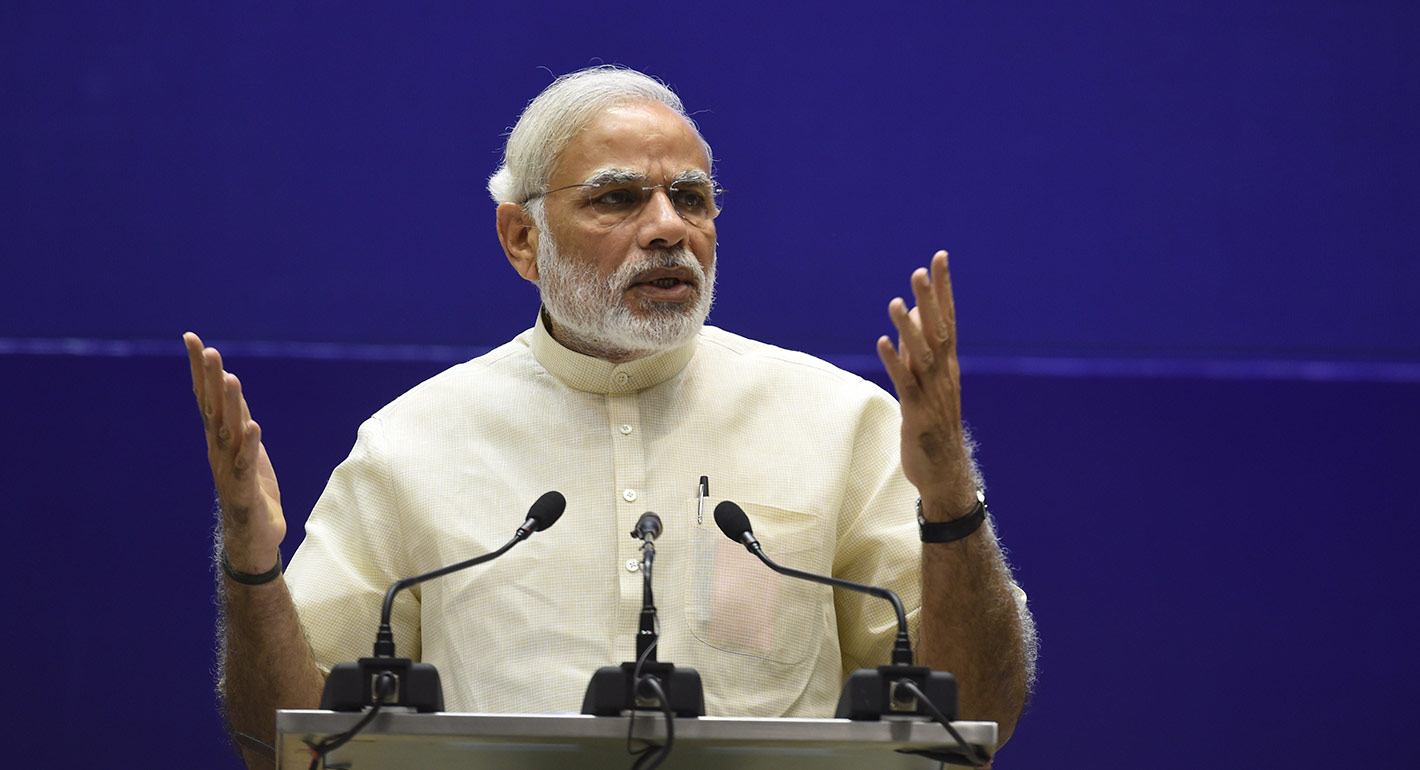
Modi has generally been good for business but not always good for a level playing field. His government is pro-business, but it also has a strongly nationalist outlook, and those two things are mutually reinforcing.
Source: Cipher Brief
Last November, Indian Prime Minister Narendra Modi implemented a demonetization of the country’s two most popular bank notes, sparking chaos across the country as people tried to deposit their cash before it became worthless. However, one year later, the Indian economy is growing at a healthy seven percent annually, and Modi remains an extremely popular leader. The Cipher Brief’s Fritz Lodge spoke with Director of the South Asia Program at the Carnegie Endowment, Milan Vaishnav, about Prime Minister Modi’s economic plan to transform India into an economic superpower, and the critical role that defense spending and military modernization plays in “Modinomics.”
Milan Vaishnav: There are three major goals. The first – and probably most successful – is to bring about a degree of macroeconomic stability. One of the realities that Modi inherited from his predecessor was a deteriorating macroeconomic picture, which saw slowing growth, persistently high inflation, large fiscal deficits, and a pretty large current account deficit.
With dogged determination, Modi’s economic team has managed to turn around the macro picture on each of these fronts. Growth has rebounded to a steady level, inflation has come down considerably, we’ve seen a concerted effort to narrow the fiscal deficit, and we’ve seen the current account deficit decrease. These factors are due partially to policy changes but also partially to good luck – low oil prices have been a major contributor to deficit reduction, for instance.
Objective number two has been to try to revive the India investment story. This has a domestic piece and an international piece. The domestic piece is to try to rejuvenate the animal spirits of the economy, and the external piece is to attract new foreign capital. The first goal has not been a success. Domestic investment is still pretty subdued and a lot of investment projects are stalled. But we have seen pretty healthy foreign inflows, in terms of both foreign direct investment and portfolio investment. Associated with this has been some modest progress towards cleaning up the investment climate. Modi has made it a goal of his administration to get India into the top 50 of the World Bank’s ease of doing business indicator, and they’ve got a long way to go – they’re only at 130 – but they have moved up from 142 when he started his term in office. So there has been some modest progress there.
The last objective has been a war on corruption and the black economy. The most obvious evidence of this is the November 8th gambit to demonetize the economy, but Modi has also followed this up with a number of ancillary moves, trying to clean up the real estate sector, attempts to reform political finance, various amnesty schemes to get people to deposit black money into legitimate bank accounts, et cetera.
This interview was originally published in the Cipher Brief.

Director and Senior Fellow, South Asia Program
Milan Vaishnav is a senior fellow and director of the South Asia Program and the host of the Grand Tamasha podcast at the Carnegie Endowment for International Peace. His primary research focus is the political economy of India, and he examines issues such as corruption and governance, state capacity, federalism, and electoral behavior. He also conducts research on the Indian diaspora.
Recent Work
Christopher S. Chivvis, Rohan Mukherjee, Milan Vaishnav


Sophia Besch, Eric Ciaramella, Steve Feldstein, …
Carnegie India does not take institutional positions on public policy issues; the views represented herein are those of the author(s) and do not necessarily reflect the views of Carnegie, its staff, or its trustees.

In any defense establishment, change is an ongoing process. However, despite the best of intentions, existing bureaucracies, bound by habit and years of socialization, have their limits in implementing transformative change.

Anit Mukherjee

As AI grows more sophisticated, as the supply chains that power it become more contested, and as access to frontier models becomes geopolitically charged, India must begin to ask a different set of questions. Not what applications it can build on someone else’s infrastructure but what the world needs.

Konark Bhandari

The Indian Ocean Region hosts one of the densest concentrations of subsea cables in the world. Yet, despite accounting for a significant share of global internet traffic, India’s participation remains limited.

Charukeshi Bhatt

How is AI reshaping space security, creating governance challenges, and where does international diplomacy stand today?


Tejas Bharadwaj, Almudena Azcárate Ortega

After the chill in ties between 2020 and 2024 that brought India–China relations to their lowest point in several decades, the two countries have engaged each other afresh. This paper argues that there are predominantly four imperatives guiding India’s approach to China, and they exist in an order of priority.

Saheb Singh Chadha